903-second window · 3 observations · Measured Sep 25, 2026, 11:41 AM UTC · Provider: go_recent_snapshot_v2
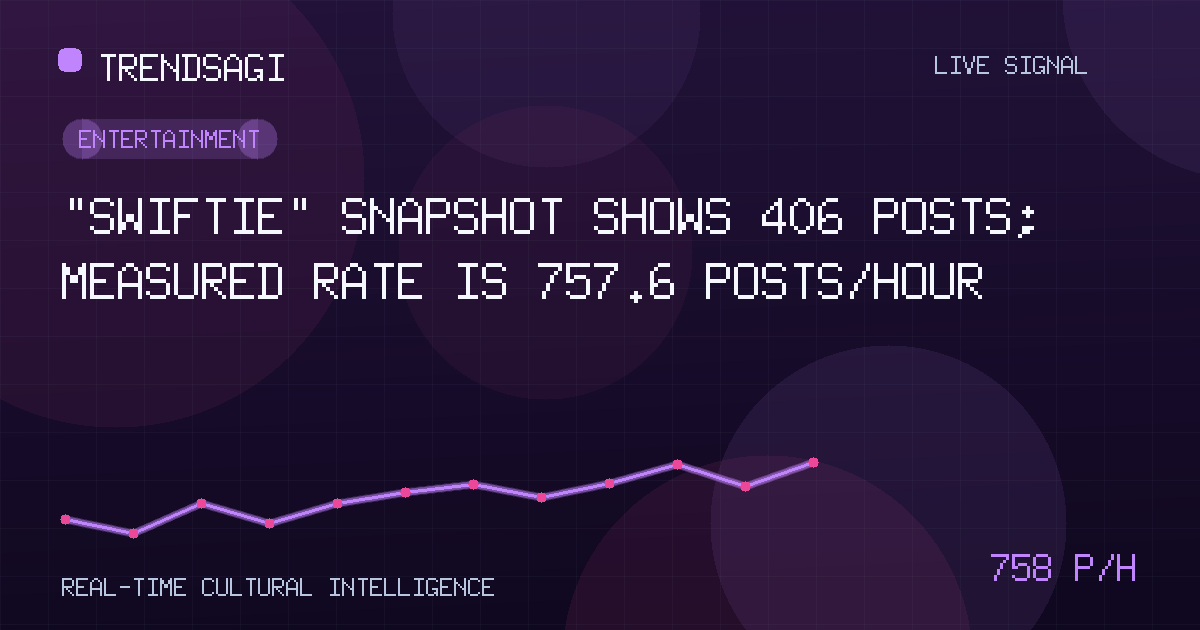
“Swiftie” snapshot shows 406 posts; measured rate is 757.6 posts/hour
The “swiftie” snapshot records 406 posts and a measured 757.6 posts/hour, but the cause is unclear; learn what to verify next.
Automated briefing. Generated from stored signal measurements and source-backed research; it is not manually reviewed. Read the methodology and limitations.
Metrics in this briefing are a snapshot associated with its publication date and may not reflect current conditions.
What changed
Activity around the stored “swiftie” label warrants investigation, but its cause is not verified. The latest snapshot contains 406 posts, and the measured snapshot rate is 757.6 posts/hour. That is evidence of concentrated activity in the observed records, not confirmation of a specific entertainment event.
The rate was measured at 2026-09-25T11:41:47Z from 3 stored observations across an exact 903-second window. It is a window-specific measure, not a live or current rate, a forecast, or a measure of reach. The record does not show whether the increase persists, how large it is relative to a longer baseline, or what prompted it.
| Observation time | Measured posts/hour | Snapshot volume |
|---|---|---|
| 2026-09-25T11:41:47Z | 757.6 | 406 posts |
The 406-post figure is snapshot volume, not a rate. The 757.6 posts/hour figure describes the stated window; it is not engagement or a count of unique people. These figures describe the supplied signal, not all social platforms, and they do not establish the size or importance of an underlying event.
What the signal can establish
The defensible finding is an increase in recorded posting activity during the specified window, in a signal categorized as entertainment. That is enough to prioritize checking the label. It is not enough to explain the event, characterize the audience, or claim broad public interest.
- It establishes a measured change in recorded posting activity for this topic signal.
- It does not establish the platforms, geography, language, or population covered by the collection.
- It does not show whether posts are original reactions, copies, replies, or coordinated distribution.
The supplied signal has no event description, so the label should not be expanded into a particular fandom, work, or event without checking the underlying posts. A label can gain attention because something new happened, but it can also gain posts because accounts are repeating the same material. The current record does not distinguish those cases.
A concentrated publishing burst is a verification trigger, not an explanation. It shows where to look next, but not what happened, who participated, or whether attention will continue.
Why this topic may be moving
No independently verified public catalyst is established in the available evidence, so naming a particular announcement, appearance, controversy, or release as the cause would be unsupported. The cause remains unclear. The entertainment category supplies context, not an explanation.
The useful distinction is between a genuine change in conversation and a change in distribution. A verified event occurring near the observation time would be one explanation. A wave of repeated links would be another. Neither is demonstrated by the volume and rate alone, and the absence of a source means the causal story remains open.
Why it matters
For editors and researchers, this is a verification lead rather than a ready-made story. The immediate decision is whether the underlying posts reveal a specific, substantiated development. A brief burst can justify a fast check without justifying a claim of lasting momentum.
Media, communications, and audience teams should also resist using the signal as an audience estimate. Post volume can prioritize a review queue, but it cannot show sentiment, intent, unique participation, or the likely duration of attention. If the label is ambiguous, a response based on it risks addressing the wrong subject.
For readers following the topic, the practical takeaway is simple: treat the change as real within the measurement, and treat any explanation as provisional until it is sourced and time-aligned.
What to watch next
- Define the label. Review sample posts for the entity or event actually referenced, and exclude matches that use the same word differently.
- Establish timing. Look for a public announcement or attributable report that precedes or overlaps the observed window. Keep publication and post times separate; later commentary cannot establish what triggered earlier activity.
- Check primary material. Start with official accounts or direct publications referenced by sample posts. A verifiable announcement can establish an event, but it does not establish how many people reacted.
- Measure repetition and breadth. Separate original reactions from reposts and repeated wording, and note whether conversation involves different sources or the same circulating item.
- Compare like with like. When available, review the next complete stored snapshot and supplied observations using the same topic definition and collection method. Report any new rate with its own observation time and window; do not carry 757.6 forward as current.
Concrete watch signals
- A verified public update that clearly matches the posts in the observed window.
- New independent posts that continue the same subject, rather than only recirculating one item.
- Activity broadening beyond the sources initially observed, rather than staying inside one cluster.
- A follow-up snapshot with a newly measured rate, explicit observation time, and comparable collection scope.
- Evidence that the label is conflating separate subjects, which would call for splitting the signal.
Methodology and limitations
The measured snapshot rate of 757.6 posts/hour is based on 3 stored observations across an exact 903-second window, measured at 2026-09-25T11:41:47Z. The table reports the supplied values as separate fields; the rate has not been recalculated or carried forward. The 406-post snapshot is not presented as a rate.
Collection scope is not supplied. The record does not show the individual posts, platforms sampled, geography, language, account types, or collection method. It therefore cannot establish how representative the signal is, whether activity is organic or coordinated, or whether sentiment is positive, negative, or mixed.
The underlying observation values and longer-run history are not included, so no baseline, percentage change, or acceleration is stated here. Nor is the topic defined beyond its label and entertainment classification. These constraints limit the conclusion to increased recorded posting activity at the stated observation time, with the cause unverified.
Track This Topic for New Signals
Set alerts for future velocity or sentiment changes around this topic.
Explore Tracking PlansAbout TrendsAGI research
TrendsAGI's automated research pipeline publishes dated signal snapshots, methodology notes, and practical workflows for teams evaluating cultural momentum. Read how signals are scoped, scored, and limited in our research methodology.


