910-second window · 3 observations · Measured Sep 23, 2026, 11:56 PM UTC · Provider: go_recent_snapshot_v2
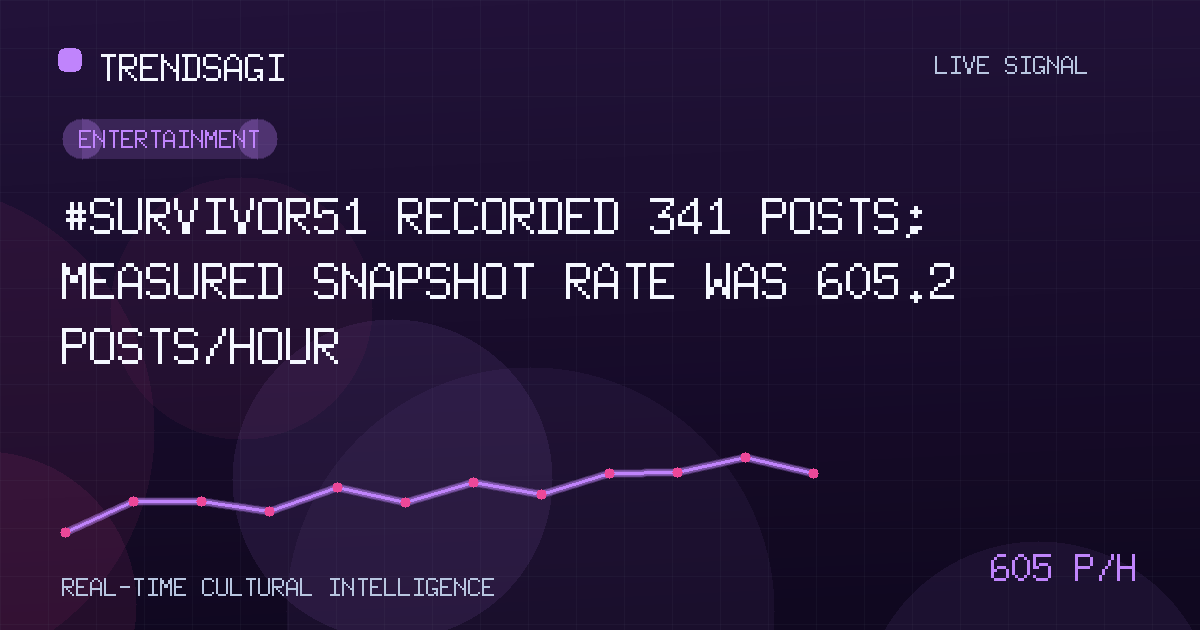
#Survivor51 recorded 341 posts; measured snapshot rate was 605.2 posts/hour
#Survivor51 had 341 posts in the latest snapshot and a measured rate of 605.2 posts/hour; what triggered the activity remains unverified.
Automated briefing. Generated from stored signal measurements and source-backed research; it is not manually reviewed. Read the methodology and limitations.
Metrics in this briefing are a snapshot associated with its publication date and may not reflect current conditions.
What changed
The stored signal shows a short-window rise in posting activity around #Survivor51, but not its cause. At 2026-09-23T23:56:16Z, the latest snapshot contained 341 posts; the measured snapshot rate was 605.2 posts/hour. This is evidence of concentrated activity in the stored window, not a live/current rate, forecast, reach estimate, engagement total or unique-person count.
The 605.2 posts/hour figure describes an exact 910-second window built from 3 stored observations, with the latest observation at 2026-09-23T23:56:16Z. The 341 posts are a snapshot volume, not a rate. Keeping those measures separate is essential: the rate characterizes observed posting across that window, while the snapshot records the volume at the latest observation.
| Observation time (UTC) | Measured posts/hour | Snapshot volume (posts) |
|---|---|---|
| 2026-09-23T23:56:16Z | 605.2 | 341 |
Why this topic may be moving
The cause is unclear from the information established here. The stored category is “Entertainment,” but that is a classification, not evidence of a particular trigger. No verified public context in this assessment ties the activity to a specific episode release, contestant development, result, announcement, controversy or promotional campaign. Those are possibilities to check, not explanations supported by the stored measurements.
The signal establishes an observable burst of posting around #Survivor51. It does not identify the trigger, the number of distinct participants or whether the activity reflects broad interest.
The stored signal cannot separate original posts from repeats, active participants from occasional posters, or public reaction from promotion. It also cannot establish sentiment or geography. Those distinctions matter because the measured posts/hour figure can coexist with limited account diversity or a narrow discussion focus. Posting volume alone does not resolve them.
Why it matters
For editors and trend researchers, this is a useful lead that warrants context work, not a causal headline. The measurements can support a precise statement about short-window activity; claims about an episode, audience response or wider cultural impact require separate evidence.
For media teams, talent teams, brands and platform analysts, the immediate question is whether the cluster aligns with a verifiable content moment and whether it persists. A tag-level burst alone cannot establish global demand, advertising value, sponsor interest or organic reach.
- Editorial value: A verified, time-matched trigger could turn a raw activity signal into explainable coverage. Until that evidence is found, report the observed change and leave the cause explicitly unresolved.
- Audience value: Distinct authors, original posts and expressed reactions would help show whether discussion is broad or concentrated. None of those qualities is established by the supplied measurements.
- Analytical value: Repeated measurements under consistent collection conditions would help test persistence. They would still not, on their own, establish causation.
What to watch next
The next check is not another volume number by itself; it is corroboration that can explain the timing and composition of the activity.
- Match the clock: Review posts close to 2026-09-23T23:56:16Z for repeated references to a specific episode, clip, contestant, outcome, announcement or controversy. Repetition would identify a candidate focus, not prove causation.
- Verify the trigger: Seek an official release or reputable reporting whose publication time can be established relative to the window. Separate when an event occurred from when it was reported; either can affect the timing of conversation.
- Audit participation: Where access permits, assess distinct authoring accounts, original versus copied text and duplicate content. Those checks help distinguish broad discussion from repeated publication without treating any check as conclusive by itself.
- Refresh consistently: Keep the same tag, time boundaries, collection method and deduplication approach. Check whether the measured 605.2 posts/hour pattern persists, recedes or appears isolated; do not compare unlike measurements.
- Watch concrete signals: A time-matched public announcement, converging references to the same subject, sustained observed activity or verified reporting explicitly linking the burst to an event would strengthen the explanation. None is confirmed here.
Methodology and limitations
All conclusions are limited to the stored #Survivor51 signal. The latest observation is timestamped 2026-09-23T23:56:16Z. Its snapshot volume is 341 posts, while the measured snapshot rate is 605.2 posts/hour over an exact 910-second window using 3 stored observations. The rate is not live/current, and the snapshot volume is not a rate.
No historical baseline, complete time series, collection coverage, account-level data or verified causal context is supplied. The 3 observations do not show whether activity rose continuously, briefly peaked or remained steady within the window. The signal also cannot establish sentiment, geography, authenticity, reach, engagement, unique participation or future demand. No future total should be inferred by extending the measured snapshot rate.
No verified public context has been established here, so the explanation remains open rather than being filled with a plausible but unsupported story.
Track This Topic for New Signals
Set alerts for future velocity or sentiment changes around this topic.
Explore Tracking PlansAbout TrendsAGI research
TrendsAGI's automated research pipeline publishes dated signal snapshots, methodology notes, and practical workflows for teams evaluating cultural momentum. Read how signals are scoped, scored, and limited in our research methodology.