899-second window · 3 observations · Measured Sep 26, 2026, 12:55 AM UTC · Provider: go_recent_snapshot_v2
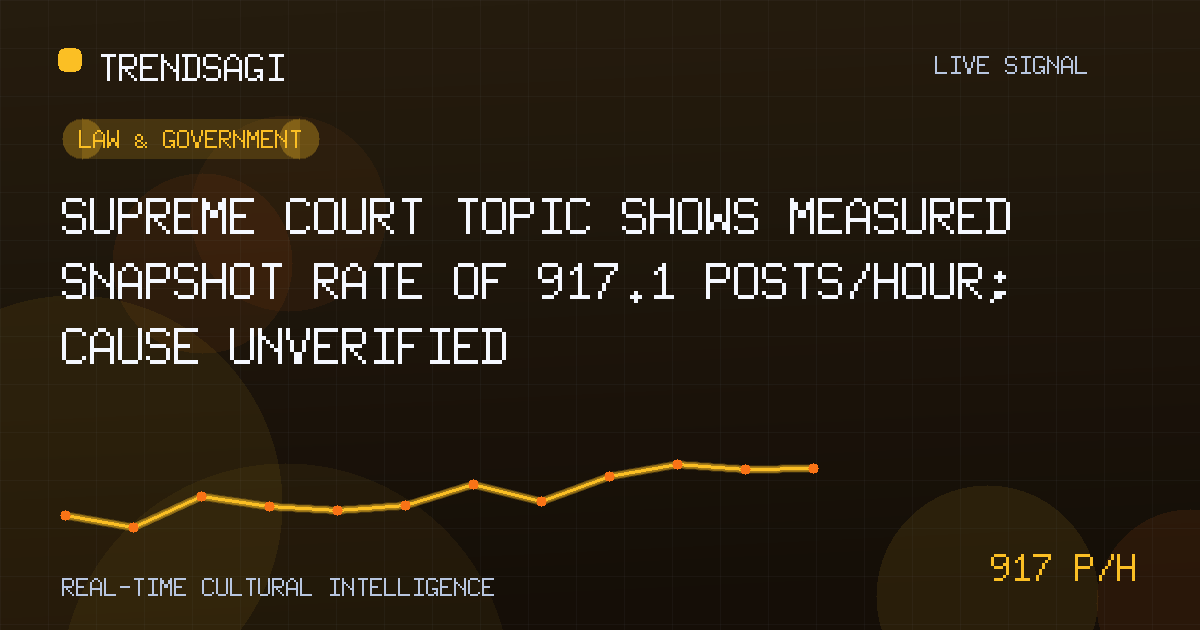
Supreme Court topic shows measured snapshot rate of 917.1 posts/hour; cause unverified
The Supreme Court label shows a 917.1 posts/hour measured snapshot rate; its trigger, reach and significance remain unverified.
Automated briefing. Generated from stored signal measurements and source-backed research; it is not manually reviewed. Read the methodology and limitations.
Metrics in this briefing are a snapshot associated with its publication date and may not reflect current conditions.
What changed
The direct answer is that the stored “Supreme Court” topic registered activity in the latest snapshot, but the available record does not establish why. No case, ruling, appointment, jurisdiction or news event should be treated as the trigger without verified public context.
At 2026-09-26T00:55:50Z, the latest snapshot contained 600 posts. Across an exact 899-second window using 3 stored observations, the measured change was 917.1 posts/hour. The figure is a measured snapshot rate, not a live or current rate, forecast, reach, engagement count or unique-person count. The 600 posts are snapshot volume, not a rate.
| Observation time | Measured snapshot rate | Snapshot volume |
|---|---|---|
| 2026-09-26T00:55:50Z | 917.1 posts/hour | 600 posts |
The distinction matters: the snapshot describes how many labeled items were present at the observation, while the measured rate describes change within the stored window. Neither figure identifies the underlying event.
Why this topic may be moving
The cause remains unclear. The stored category is “Law & Government,” the topic label is broad, and the signal description is empty. The measurement identifies a cluster of posts associated with the label; it does not identify the event that produced the cluster.
A label can move for very different reasons, including:
- An official court document, docket development or speech could generate new reporting and reaction.
- Commentary about a pending case could amplify discussion without a new judicial action.
- Appointment politics, jurisdiction-specific news or a viral clip could introduce the term to a wider conversation.
- Platform collection changes, duplicate posting or coordinated activity could affect the observed count.
None is verified as the explanation here. These are monitoring hypotheses, not claims about what happened. Assigning the movement to one of them without contemporaneous public context would confuse correlation with causation.
The signal shows that labeled activity was measured in the window; it does not show which court, case or event was responsible.
Why it matters
Attention and importance are not interchangeable. The rate is useful as an editorial prompt to investigate, but it is weak evidence for legal significance.
- News editors should identify the court and jurisdiction before assigning coverage; the label itself identifies neither.
- Legal and policy teams should compare the social signal with primary documents and formal outcomes before drawing conclusions about precedential or policy effect.
- Communications teams should look for a verified trigger and audience misunderstanding before responding; volume alone does not establish a crisis.
- Researchers should preserve the query, language settings, geography and collection method, none of which is supplied here.
For ordinary readers, the practical takeaway is narrow: the label merits checking, but it does not justify assuming that a major decision occurred or that the posts are accurate, independent or representative.
What the signal can and cannot establish
The stored evidence supports a limited factual statement about the observed collection.
- At the stated observation time, the collection included 600 posts carrying the topic label.
- Using 3 stored observations over the exact 899-second window, the dataset measured 917.1 posts/hour.
- The signal was assigned to the “Law & Government” category.
It does not provide enough evidence for broader conclusions:
- There is no prior baseline, so the rate cannot be ranked as unusually high or compared with normal court-news activity.
- There are no unique-author, original-post, engagement, sentiment, accuracy or public-reach measurements.
- The label does not identify a country, court, case, legal issue or source of the movement.
- The record does not establish whether the measured activity persists beyond the observation window.
- It does not separate organic discussion from duplication, automation or collection artifacts.
Those limits prevent a reliable judgment about who participated or what the discussion means.
What to watch next
Use the alert as a checklist, then seek evidence that can narrow or reject each hypothesis.
- Identify the entity. Check whether the posts concern a specific court, a particular case, a commentator’s post or a reused clip.
- Verify the event. Look for a timestamped official document, court announcement, docket change or attributable report, and record the publication time.
- Align the timeline. Compare any verified event with the 899-second measurement window and with a longer, consistently collected series.
- Check persistence. Look for continued activity after the snapshot rather than extrapolating 917.1 posts/hour forward.
- Audit the sample. Review a representative set of posts for duplicates, copied text, bots, missing context and misleading labels.
- Track substantive follow-through. Note whether official documents generate distinct reporting, whether discussion changes when facts are corrected, and whether the rate recedes.
- Improve the signal. Add court, jurisdiction, case identifiers, language and geography, then rerun the same collection method.
A credible trigger should connect the public event, the labeled sample and the timing; anything less remains a hypothesis.
Methodology and limitations
The figures are reproduced from the stored record; no rate has been recalculated or extrapolated. “Measured change rate” refers to 917.1 posts/hour over the exact 899-second window using 3 stored observations. “Snapshot volume” refers to the 600 posts present at 2026-09-26T00:55:50Z.
No verified contemporaneous public explanation was available for inclusion, so the cause is explicitly left unclear. The empty signal description and broad label prevent a responsible link to a particular event. The dataset also provides no baseline, sampling frame, deduplication method or account-level data. Accordingly, this briefing can establish a measured change in the stored topic collection, but not its cause, persistence, audience, accuracy or importance.
Track This Topic for New Signals
Set alerts for future velocity or sentiment changes around this topic.
Explore Tracking PlansAbout TrendsAGI research
TrendsAGI's automated research pipeline publishes dated signal snapshots, methodology notes, and practical workflows for teams evaluating cultural momentum. Read how signals are scoped, scored, and limited in our research methodology.