1209-second window · 3 observations · Measured Oct 5, 2026, 11:56 AM UTC · Provider: go_recent_snapshot_v2
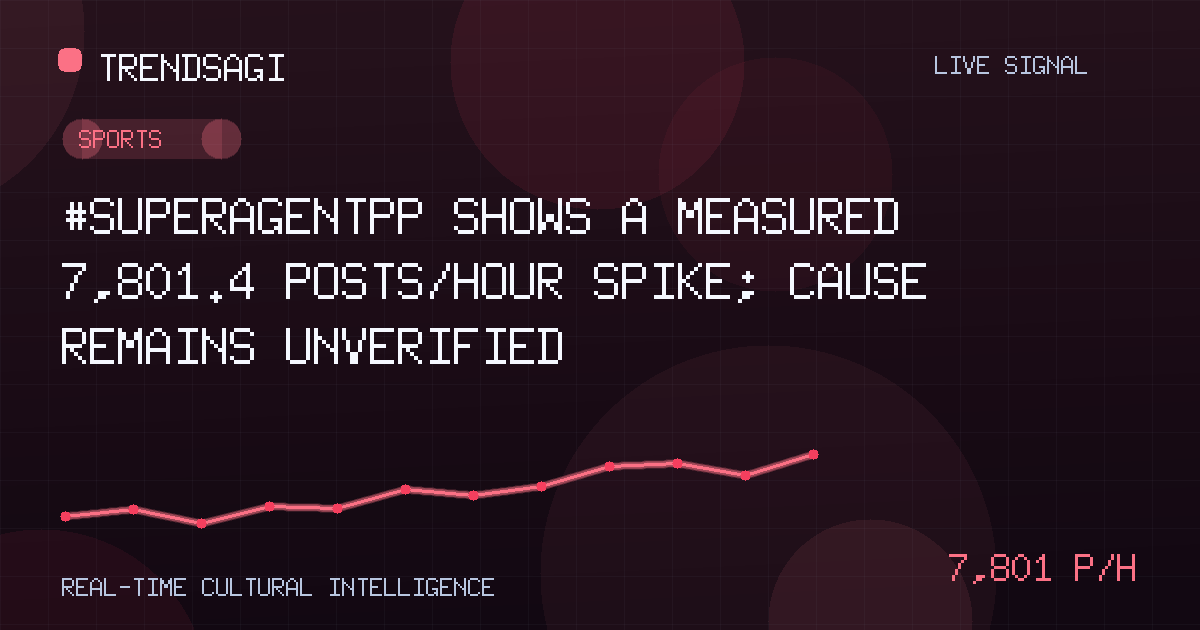
#SUPERAGENTPP shows a measured 7,801.4 posts/hour spike; cause remains unverified
SUPERAGENTPP logged 4,800 posts and a measured 7,801.4 posts/hour; here is what is known, unknown, and worth checking.
Automated briefing. Generated from stored signal measurements and source-backed research; it is not manually reviewed. Read the methodology and limitations.
Metrics in this briefing are a snapshot associated with its publication date and may not reflect current conditions.
What changed
The stored record shows concentrated posting activity associated with #SUPERAGENTPP, but it does not establish what the hashtag refers to or why the activity increased. No verified public context in the available record connects the change to a sports event, announcement, controversy, or other identifiable trigger, so the cause remains unverified.
The measured snapshot rate was 7,801.4 posts/hour over an exact 1209-second window using 3 stored observations. The figure describes only that measured window: it is not a live or current rate, forecast, reach, engagement, or count of unique people.
The latest snapshot contained 4,800 posts at 2026-10-05T11:56:55Z. Snapshot volume and posting rate are separate measurements: volume describes that stored observation, while the rate describes change across the specified window.
| Observation time | Measured posts/hour | Snapshot volume |
|---|---|---|
| 2026-10-05T11:56:55Z | 7,801.4 | 4,800 posts |
Why this topic may be moving
The available evidence supports a short-window burst in observed posting, not an explanation for it. The record classifies the topic as Sports, but that label does not prove the posts concern a match, team, athlete, league, or sporting announcement, and it does not identify who posted.
Several non-exclusive mechanisms could produce this pattern:
- An actual public event, result, release, or controversy may have prompted discussion, but no verified trigger has been established.
- A community may use the label for a recurring stream, show, game, or promotion that falls outside the stored category.
- Reposting, repeated content, coordinated scheduling, automated posting, duplicate ingestion, or a collection artifact could raise the observed pace. The rate alone does not prove any of these possibilities.
- News coverage or an official account may have directed attention to the hashtag, but the available record contains no verified publisher or announcement supporting that explanation.
No timestamped item from an identifiable publisher or official account appears in the available record. Until such evidence is found, naming a specific trigger would be speculation. That evidence gap does not prove that no real-world cause exists.
What the signal can—and cannot—establish
The signal establishes the stored measurements: the latest snapshot contained 4,800 posts, and the measured change rate was 7,801.4 posts/hour over the exact 1209-second window using 3 stored observations. Those values make the activity important enough to investigate.
A measured post rate documents the pace recorded in a specific window; it does not identify the people behind the posts, explain the cause, or establish distinct reach.
The signal does not establish the number of unique authors, whether posts were original or duplicated, their geography, sentiment, engagement, credibility, or distribution across the wider public. It also cannot validate the Sports classification. Without account-level and content-level records, the signal cannot separate broad human interest from a repetitive or synchronized campaign.
The 4,800 snapshot volume should not be described as simultaneous activity, and the 7,801.4 posts/hour figure should not be converted into an audience size. The rate measures posting change; it does not measure how many people saw, discussed, or acted on the topic.
Why it matters
For trend editors, the immediate value is triage: #SUPERAGENTPP warrants review because of the measured pace, but not a causal headline. A responsible account should state that the stored volume is elevated within the observed window while its meaning and trigger remain unresolved.
Sports organizations and community teams should care only if content inspection connects the label to their event, audience, or reputation. Platform-integrity and audience-research teams may also care if duplicated text, shared links, or synchronized account activity helps explain the pattern. Neither group should infer impact from the aggregate rate alone.
For general readers, this case shows that a spike can be measurable while its cause remains unknown. That distinction is especially important when the topic label is obscure, the stored description is absent, or the category may not match the underlying posts.
What to watch next
The next step is to collect evidence that can confirm or reject the competing explanations rather than guess at a trigger.
- Collect comparable observations. Check subsequent windows measured on the same basis. A rate at or above 7,801.4 posts/hour would show that the recorded pace persisted or strengthened; a lower rate would indicate that the burst was shorter. Neither result would identify the cause by itself.
- Inspect the posts and accounts. Review a representative sample from the 1209-second window and the periods immediately around it. Record whether items are original, replies, reposts, duplicates, links, images, or recycled text, and note any event that can be independently verified.
- Resolve the label. Determine what #SUPERAGENTPP means from the content and linked identities rather than from the topic string alone. Test whether the posts consistently concern sports before relying on the stored category.
- Look for coordination or automation. Repeated wording, identical links, tight timing clusters, or overlap among the same accounts would raise questions about amplification. Those patterns would warrant investigation but would not by themselves prove bot activity.
- Seek timestamped public evidence. Check verified publishers, official accounts, event schedules, platform notices, and relevant reporting. A potential cause should appear before or at the start of the measured window; an item published afterward may instead be a response.
- Track audience effects separately. Distinguish post production from replies, reposts, reactions, or clicks. A large posting rate does not establish broad engagement or meaningful reach.
Methodology and limitations
The rate was supplied as 7,801.4 posts/hour, measured over an exact 1209-second window using 3 stored observations and recorded at 2026-10-05T11:56:55Z. The latest snapshot volume was 4,800 posts. No baseline history, post text, account data, engagement data, geographic breakdown, or verified public trigger is included in the available record.
No external event or publisher is named because no verified causal item is included. The analysis can describe the measured signal and prescribe checks, but it cannot establish provenance, authenticity, organic interest, or causation. Any later explanation should preserve those distinctions and state its evidence clearly.
Track This Topic for New Signals
Set alerts for future velocity or sentiment changes around this topic.
Explore Tracking PlansAbout TrendsAGI research
TrendsAGI's automated research pipeline publishes dated signal snapshots, methodology notes, and practical workflows for teams evaluating cultural momentum. Read how signals are scoped, scored, and limited in our research methodology.