902-second window · 3 observations · Measured Sep 29, 2026, 10:55 PM UTC · Provider: go_recent_snapshot_v2
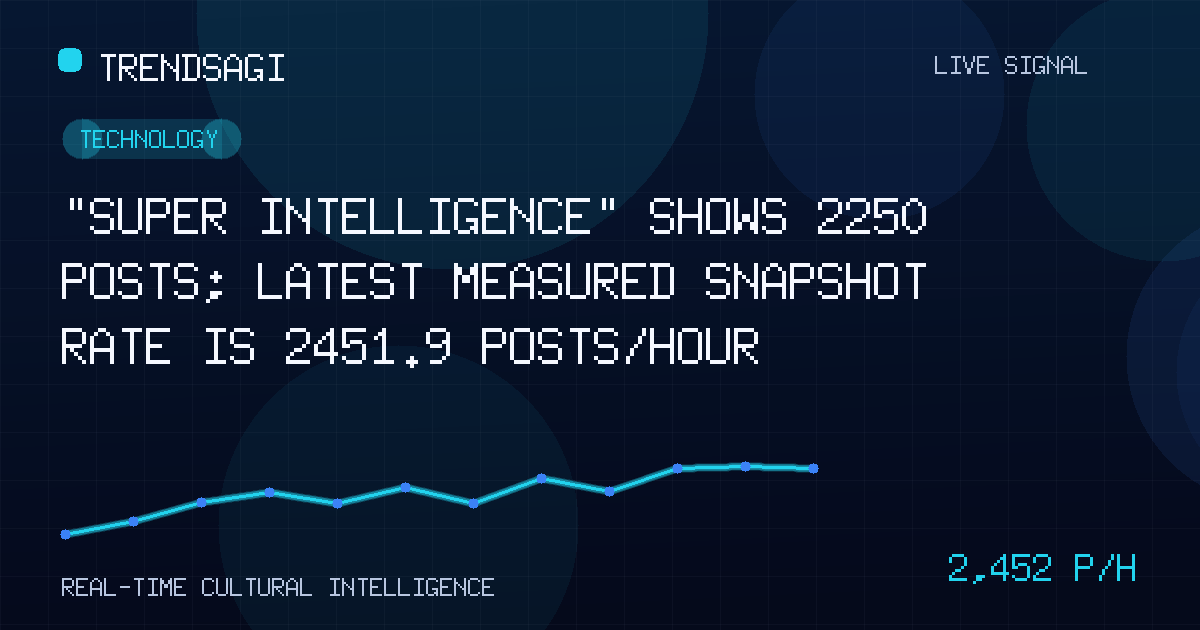
“Super Intelligence” shows 2250 posts; latest measured snapshot rate is 2451.9 posts/hour
Super Intelligence shows 2250 posts and a measured 2451.9 posts/hour snapshot rate; the signal indicates attention, not a verified catalyst.
Automated briefing. Generated from stored signal measurements and source-backed research; it is not manually reviewed. Read the methodology and limitations.
Metrics in this briefing are a snapshot associated with its publication date and may not reflect current conditions.
What changed
The direct answer is that the stored “Super Intelligence” conversation contains 2250 posts in the latest snapshot, observed at 2026-09-29T22:55:45Z. That is meaningful activity within the captured stream, but it does not identify a scientific breakthrough, product announcement, policy action, or other catalyst. The available context contains no verified public event that explains the movement, so the cause should be reported as unclear rather than guessed.
The measured change is a snapshot rate of 2451.9 posts/hour, derived over an exact 902-second window using 3 stored observations. It is not a live or current rate, forecast, reach figure, engagement total, or count of unique people. The 2250 figure is the latest snapshot volume, not a rate; the two figures answer different questions and should not be substituted for one another.
| Observation time | Measured snapshot rate | Latest snapshot volume |
|---|---|---|
| 2026-09-29T22:55:45Z | 2451.9 posts/hour | 2250 posts |
This signal establishes intensity in the captured stream, not a verified event in the wider world. The next editorial task is verification, not amplification.
Why this topic may be moving
There is no verified catalyst in the available record. The explanations below are possibilities for investigation, not findings about why activity is concentrated.
- Event-led attention: A named research result, product release, demonstration, interview, or policy development could concentrate attention. No such event is verified as the cause here.
- Label ambiguity: The phrase can point to advanced AI, artificial general intelligence, machine cognition, or human-level reasoning. Without reading the posts, the signal cannot show which meaning dominates or whether different claims are being mixed together.
- Secondary amplification: A striking post, video, or thread can generate replies and reposts that make a broad label appear larger than the underlying original discussion.
- Collection effects: Duplicate copying, quoting, automated posting, or uneven collection across sources can raise volume without representing an equivalent increase in independent conversation.
These possibilities should shape verification work rather than become narrative certainty. Until a specific catalyst is corroborated, the responsible conclusion is concentrated attention of unknown cause, not a confirmed technology milestone.
What the signal can establish
The record is useful for editorial triage. It establishes that the collection captured 2250 posts at the stated time and that the supplied short-window measurement is 2451.9 posts/hour. It supports deciding where deeper sourcing and monitoring may be worthwhile.
- Captured activity: The volume and rate show how much appeared within the defined snapshot and measurement window.
- Research priority: The label indicates attention around a high-level capability question that may be worth examining.
- A verification target: The captured stream provides a concrete place to identify referenced events, claims, and sources.
The signal does not establish a historical baseline, public sentiment, factual accuracy, organic participation, unique-person counts, or influence. It also cannot distinguish a genuinely new development from recycled claims. With 3 stored observations, the record cannot show whether this level is unusual over a longer period, whether momentum will persist, or how activity compares across sources. The capitalized phrase is a category label, not validation that a single technical concept or event exists.
Why it matters
For AI researchers, engineering leaders, and product teams, concentrated discussion can be an early warning that capability claims, terminology, or safety concerns need clearer communication. It may expose confusion worth investigating, but volume alone is not evidence that a capability has improved.
For journalists and policy teams, the signal matters because an unverified burst may shape coverage before the underlying facts are checked. Trust and safety teams should examine whether the conversation is organic, repetitive, or coordinated. Strategic decision-makers should wait for corroboration rather than infer demand, investment, or consensus from post count.
What to watch next
Several concrete signals would clarify whether this is a durable development or a short-lived burst:
- Persistence: Whether later snapshots remain elevated against a longer baseline collected with the same method.
- Event concentration: Whether posts repeatedly reference the same public event, document, account, or claim.
- Primary-source confirmation: Whether an official organization, research paper, filing, or publisher page corroborates the supposed catalyst.
- Originality: Whether the stream adds original reporting and analysis or mainly repeats the same assertion.
- Meaning: Whether the broad label narrows into a defined technical, commercial, or policy issue.
- Cross-source durability: Whether independent sources continue discussing the subject without relying on the same originating post.
The practical next checks are to review a representative slice of the captured posts, classify each item by event reference, stance, source type, and originality, remove near-duplicates, inspect the originating material, and compare the result with a longer same-method baseline. A cause should be named only when the posts point to it and an authoritative public source supports it.
Methodology and limitations
This briefing uses the supplied timestamp, volume, rate, window, and observation count without converting snapshot volume into a rate or adding a trend estimate. The measured snapshot rate is treated as a historical measurement, not a live or current condition.
No external event is attributed because the available context contains no verified public catalyst. The short window, 3 observations, broad category label, and unknown collection rules limit causal and comparative conclusions. Readers should use this signal to decide what to verify next, not to claim that “Super Intelligence” has advanced or become mainstream.
Track This Topic for New Signals
Set alerts for future velocity or sentiment changes around this topic.
Explore Tracking PlansAbout TrendsAGI research
TrendsAGI's automated research pipeline publishes dated signal snapshots, methodology notes, and practical workflows for teams evaluating cultural momentum. Read how signals are scoped, scored, and limited in our research methodology.