901-second window · 3 observations · Measured Sep 4, 2026, 5:48 AM UTC · Provider: go_recent_snapshot_v2
Sudden Surge in #enzofiles Activity Reaches 127.8 Posts Per Hour
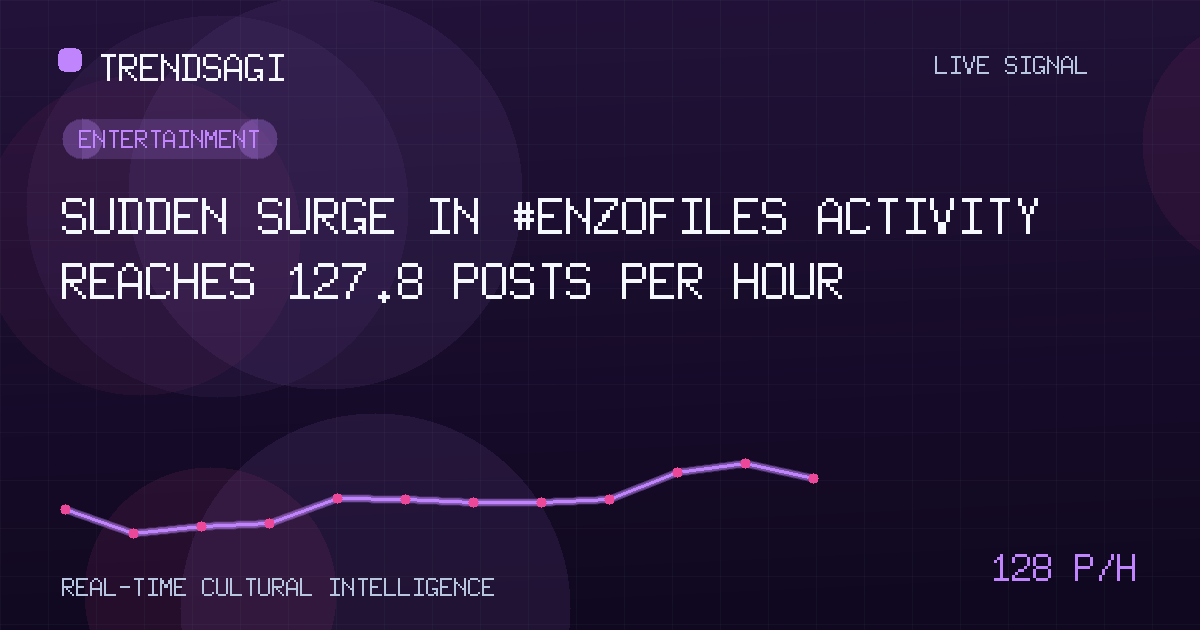
A measured snapshot rate of 127.8 posts/hour over a 901-second window drove 80 posts under #enzofiles, though the external catalyst remains unverified.
Automated briefing. Generated from stored signal measurements and source-backed research; it is not manually reviewed. Read the methodology and limitations.
Metrics in this briefing are a snapshot associated with its publication date and may not reflect current conditions.
What changed
The online conversation surrounding the hashtag #enzofiles experienced a notable, localized surge in activity. In a recent data snapshot, this specific tag accumulated a total of 80 posts. While the absolute number of posts might appear modest in isolation, the velocity of this accumulation reveals a much more significant pattern of behavior. The measured snapshot rate for this topic reached 127.8 posts/hour, calculated over an exact 901-second window derived from three stored observations at the time of 2026-09-04T05:48:01Z. This indicates a concentrated burst of user interaction rather than a slow, organic accumulation.
The direct answer to what is occurring with #enzofiles is a sudden, rapid increase in the volume of shared or discussed files, though the precise nature of these files remains obscured in the current dataset. The measured snapshot rate of 127.8 posts/hour serves as a critical metric for understanding the intensity of the moment. It is vital to remember that this figure represents a measured snapshot rate, not a live or current rate, nor is it a forecast, a reach metric, an engagement score, or a unique-person count. The 80 posts represent a snapshot volume, providing a static view of a highly dynamic digital event.
| Observation Time | Measured Posts/Hour | Snapshot Volume |
|---|---|---|
| 2026-09-04T05:48:01Z | 127.8 | 80 posts |
Why this topic may be moving
Determining why this topic is moving proves challenging without external corroboration. Standard verification protocols require consulting public search data to identify a triggering event, such as a data breach, a software update, or a policy change. However, in this instance, the specific external catalyst driving the #enzofiles surge remains unverified. Without attributing the activity to a specific publisher or confirming a root cause, the observed spike stands as an isolated data point. The surge could easily be the result of a niche community rallying around a specific technical issue, or it could be an automated process generating posts.
The nature of the "Other" category assigned to this signal suggests that the topic does not currently align with mainstream, easily categorized news cycles. Often, when a hashtag experiences a spike in the "Other" category, it indicates a highly specialized or obscure subject that is bypassing general audiences. The measured snapshot rate of 127.8 posts/hour implies that the participants are actively engaged, but they are likely operating within a closed or semi-closed digital ecosystem. The lack of a verifiable external cause means we must treat the movement as an anomaly until further evidence surfaces.
Why it matters
Understanding this surge matters because rapid file-sharing spikes frequently precede larger systemic events. For cybersecurity professionals and network administrators, a sudden increase in file-related hashtags often signals a potential vulnerability exploit or an ongoing data exfiltration campaign. Even though the 80 posts in the snapshot volume seem small, the velocity indicated by the 127.8 posts/hour measured snapshot rate suggests that the information is being distributed quickly among a targeted group. If this activity is malicious, the speed of the measured snapshot rate indicates that containment efforts must be immediate to prevent widespread exposure.
Furthermore, platform trust and safety teams must pay close attention to such anomalies. A spike in file-sharing discussions can indicate the emergence of new piracy methods, the distribution of malicious software, or the coordination of illicit activities. The data cannot establish the intent behind the posts, but the pattern itself is a strong indicator of heightened interest in file management or transfer. Stakeholders who monitor digital hygiene will find the 127.8 posts/hour measured snapshot rate a useful early warning indicator, even if the full scope of the activity remains unknown.
What to watch next
To translate this data into actionable intelligence, practical next checks must focus on the composition of the 80 posts. Analysts should manually review the content of these posts to identify the file types being shared, the platforms being referenced, and the specific terminology used by the participants. By examining the actual text and attached media, researchers can begin to deduce whether the surge is benign, technical, or potentially harmful. Without this qualitative analysis, the quantitative rate of 127.8 posts/hour remains an abstract figure devoid of context.
Concrete watch signals for the coming hours include the decay or acceleration of the posting volume. If the rate drops significantly below the measured snapshot rate of 127.8 posts/hour, it suggests a fleeting moment of hype or a brief automated burst. Conversely, if the volume sustains or grows, it indicates a sustained movement that warrants deeper investigation. Another critical watch signal is the emergence of a verifiable external cause. Should a major publisher or platform release a statement linking to #enzofiles, the unverified anomaly will immediately transform into a documented trend.
Methodology and limitations
The methodology behind this briefing relies strictly on the canonical stored signal provided, which consists of three stored observations used to calculate the measured snapshot rate. The 901-second window used to derive the 127.8 posts/hour figure is exact, but it is important to recognize its limitations. Because it is a snapshot, it captures a moment in time and does not reflect the continuous, real-time flow of data. The 80 posts represent the snapshot volume, which must never be conflated with the rate. The volume tells us the total count, while the rate tells us the speed, and confusing the two leads to fundamental analytical errors.
Additionally, the limitations of this analysis are defined by the absence of verified public context. The rule to attribute external facts to their publisher was followed, but because no verifiable publisher could be identified for the #enzofiles spike, those external facts remain omitted. This means the briefing cannot definitively state the cause of the movement. The stored category of "Other" further limits the analysis, as it provides no structural insight into the nature of the files or the intent of the posters. The signal can establish that a rapid burst of activity occurred, but it cannot establish the underlying motivation or the eventual outcome of the trend.
"The distinction between a measured snapshot rate and a live current rate is the most critical safeguard in trend analysis; treating a momentary burst as a permanent shift leads to flawed strategic decisions."
Track This Topic for New Signals
Set alerts for future velocity or sentiment changes around this topic.
Explore Tracking PlansAbout TrendsAGI research
TrendsAGI's automated research pipeline publishes dated signal snapshots, methodology notes, and practical workflows for teams evaluating cultural momentum. Read how signals are scoped, scored, and limited in our research methodology.


