1803-second window · 3 observations · Measured Sep 25, 2026, 8:51 PM UTC · Provider: go_recent_snapshot_v2
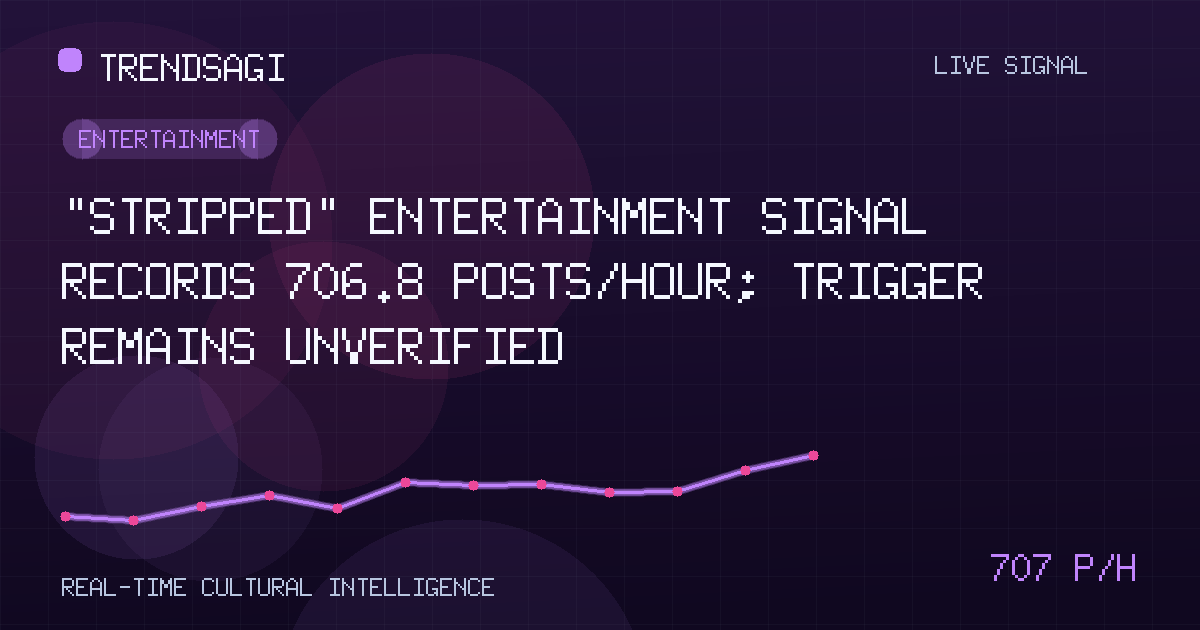
“Stripped” entertainment signal records 706.8 posts/hour; trigger remains unverified
The stored “Stripped” signal recorded 706.8 posts/hour over 1803 seconds, flagging a topic for verification rather than confirming its identity or cause.
Automated briefing. Generated from stored signal measurements and source-backed research; it is not manually reviewed. Read the methodology and limitations.
Metrics in this briefing are a snapshot associated with its publication date and may not reflect current conditions.
What changed
At the stored observation time of 2026-09-25T20:51:49Z, the Entertainment topic labeled “Stripped” contained 782 posts in its latest stored snapshot. The direct answer is that the stored signal captured concentrated activity under that label, but the record does not identify what “Stripped” refers to or establish why the activity occurred.
The measured change rate was 706.8 posts/hour over an exact 1803-second window using 3 stored observations. This is a measured snapshot rate for the recorded interval—not a live or current rate, forecast, reach, engagement count, or unique-person count. The 782-post figure is snapshot volume, not another rate; the two figures should not be combined without knowing their collection scope.
| Observation time | 2026-09-25T20:51:49Z |
|---|---|
| Measured snapshot rate | 706.8 posts/hour |
| Rate window | 1803 seconds; 3 stored observations |
| Latest snapshot volume | 782 posts |
Why this topic may be moving
The cause remains unclear. No verified public context has been established for this signal, and no entity or event definition accompanies the one-word label. “Entertainment” is a category assignment, not proof that the posts concern a particular film, song, show, performance, or celebrity.
- Entity collision. The same word could name a work or person while also functioning as a common adjective, causing unrelated meanings to be pooled.
- Timely event. A release, episode, performance, announcement, or controversy could prompt a response, but no such trigger is verified here.
- Social amplification. A clip, meme, fan reaction, or repost pattern could increase volume without demonstrating broad public interest.
- Measurement effects. Duplicate content, coordinated behavior, query drift, or collection changes could contribute; the record does not identify or quantify them.
A defensible attribution would require a public source that names the same “Stripped” entity or event, provides timing consistent with the observed activity, and matches the language in sampled posts. A reputable publisher or official announcement could support that test, but no such causal item has been verified for this briefing. The explanations above remain hypotheses.
Why it matters
The measured rate is useful as an editorial alert even before its cause is known. It tells teams where to investigate, not what the story is.
- Entertainment editors can determine whether a specific work, episode, performance, or public figure is driving discussion and whether reporting adds information.
- Social and community teams can check conversation coherence, repeated claims, likely coordination, and participation by distinct accounts.
- Researchers can begin a cleaner time series while preserving query, sampling, language, geography, and deduplication rules.
- Brand-safety and rights teams can assess reputational or content-rights risk before publishing a causal conclusion.
Editorial takeaway: The signal is actionable as a monitoring alert, not yet as a causal finding: activity is measured, but the subject and trigger remain unresolved.
What the signal can and cannot establish
The narrow conclusion is straightforward: labeled activity existed at the stated time, the exact window produced a measured rate of 706.8 posts/hour, and the topic warrants verification. The signal does not establish a broader story about who is involved or what happened.
- It does not resolve whether “Stripped” is a title, name, phrase, episode, or unrelated word use.
- It does not show whether 706.8 posts/hour is high relative to a normal period, because no comparison baseline is provided.
- It does not reveal sentiment, originality, organic reach, or whether apparent momentum came mainly from distinct authors.
- It does not supply platform, geography, or language breakdowns.
- It does not prove that a release, controversy, meme, or celebrity event caused the movement.
What to watch next
The next step is to turn an ambiguous alert into a testable account of what changed and why.
- Resolve the label. Review a representative sample of posts, quoted and unquoted query results, likely aliases, and surrounding phrases. Separate distinct meanings before aggregating them.
- Establish chronology. Find the earliest substantive original posts, then compare their timing with official announcements and reputable reporting. The external event should occur before the cluster or clearly explain it.
- Audit composition. Separate original posts from duplicates and reposts; inspect account history, claims, languages, platforms, and locations. Do not treat repeated copying as evidence of more people.
- Create a valid baseline. Compare identical collection windows and query definitions across prior periods. Look for persistence, decay, or another burst rather than judging the snapshot in isolation.
- Verify the trigger. Require independent public evidence that identifies the same entity and event. A match in wording alone is insufficient if the surrounding posts use “Stripped” differently.
Concrete watch signals are:
- whether subsequent comparable windows remain near the observed rate or fall;
- whether context-rich original posts become more prevalent than duplicates;
- whether independent sources converge on one entity and explanation;
- whether the query resolves into a dominant meaning or remains semantically mixed.
Methodology and limitations
The reported measurements retain their distinct definitions. The 706.8 posts/hour figure is a measured snapshot rate based on 3 stored observations across 1803 seconds; 782 is the latest stored snapshot volume. Neither is extrapolated, and no forecast is implied. Because their scopes are not defined together, they are not used to infer a total or audience size.
No external fact is attributed because no public cause met the verification check. The record also lacks an identifying topic description, a comparison baseline, account-level deduplication, sentiment, platform and geographic breakdowns, and a confidence interval. It therefore cannot establish statistical exceptionality, organic reach, or causation. The appropriate editorial status is a monitoring lead: report the measured change accurately, leave the reason explicitly unresolved, and update only when the entity, chronology, and trigger agree.
Track This Topic for New Signals
Set alerts for future velocity or sentiment changes around this topic.
Explore Tracking PlansAbout TrendsAGI research
TrendsAGI's automated research pipeline publishes dated signal snapshots, methodology notes, and practical workflows for teams evaluating cultural momentum. Read how signals are scoped, scored, and limited in our research methodology.


