1810-second window · 3 observations · Measured Oct 3, 2026, 3:56 AM UTC · Provider: go_recent_snapshot_v2
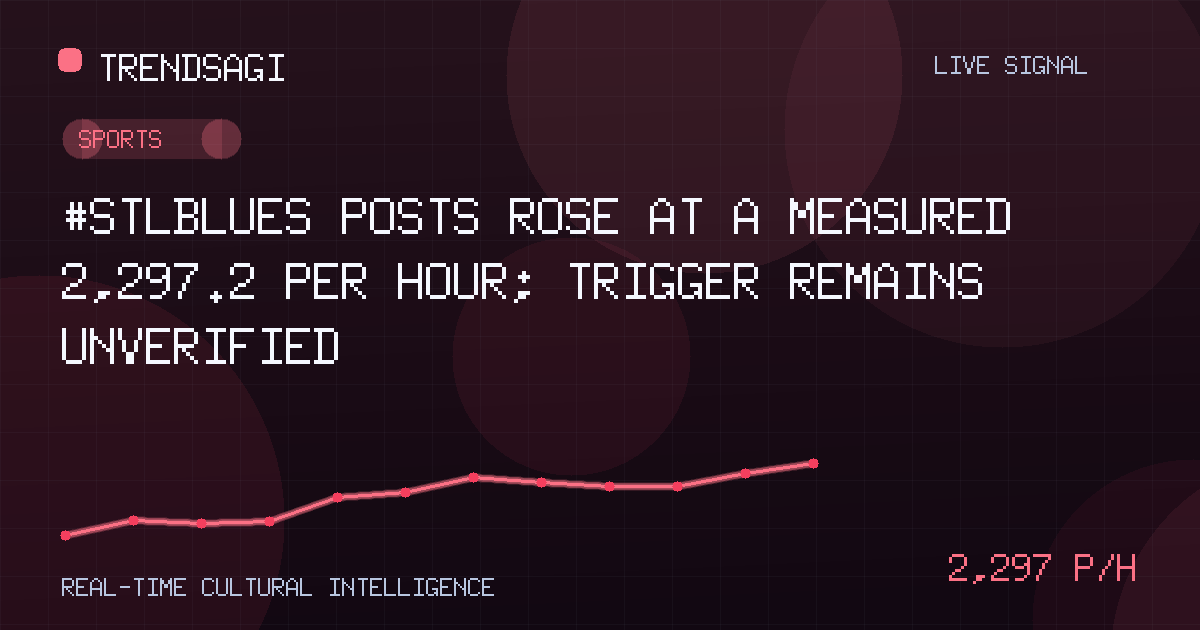
#stlblues posts rose at a measured 2,297.2 per hour; trigger remains unverified
#stlblues recorded 2,297.2 posts/hour in the latest measured snapshot; here is what the increase establishes and what to verify next.
Automated briefing. Generated from stored signal measurements and source-backed research; it is not manually reviewed. Read the methodology and limitations.
Metrics in this briefing are a snapshot associated with its publication date and may not reflect current conditions.
What changed
Posting activity under the sports hashtag #stlblues increased sharply in the latest measured window, but no specific trigger has been verified. The defensible conclusion is limited: tagged-post activity accelerated in the stored observations. The available record does not establish whether a match, team announcement, player development, controversy, fan campaign, or another event caused the increase.
The measured snapshot rate was 2,297.2 posts/hour over an exact 1810-second window using 3 stored observations, with the latest observation recorded at 2026-10-03T03:56:49Z. That figure is a historical, measured snapshot rate—not a live or current rate, forecast, reach estimate, engagement measure, or count of unique people. The separate latest snapshot volume was 1,440 posts.
| Observation time | Measured snapshot rate | Snapshot volume |
|---|---|---|
| 2026-10-03T03:56:49Z | 2,297.2 posts/hour | 1,440 posts |
Together, these values establish elevated short-window activity and provide a concrete monitoring lead. They do not identify the cause of the movement or show that the posts represented independent reactions rather than repeated, quoted, or automated content.
Why this topic may be moving
The cause remains unverified because the stored signal contains no post text, source concentration, event linkage, or corroborated public context. The tag may be associated with an St. Louis sports community, but the available evidence does not verify which team, league, player, match, or event is driving discussion.
Several explanations should therefore be tested rather than asserted:
- A scheduled sports event: reactions may be clustering around a match, result, lineup, or viewing experience. The relevant event and its timing would need confirmation.
- A team or player development: an official update, transaction, injury report, roster change, or media report could be prompting replies. No particular announcement is established here.
- A controversy or information cascade: a disputed claim, clip, or post may be spreading through quoting and repetition. That process would need to be visible in the originating posts.
- A measurement artifact: repeated content, coordinated posting, or a change in collection behavior could affect the observed rate without representing a broader event.
A measured posting spike can show where conversation accelerated, but it cannot identify the event, the people behind the posts, or the truth of any claim without source-level review.
Why it matters
The immediate value is prioritization: #stlblues warrants closer inspection, but it should not yet be presented to readers as a confirmed reaction to a particular development.
- Fan and community teams should determine whether the burst contains questions, misinformation, event reactions, or repeated material that requires a timely clarification.
- Sports reporters and editors can use the signal as a reporting lead while checking timestamps, named entities, original posts, and corroborating public reporting.
- Trend and moderation teams should distinguish original contributions from duplicated or automated content before judging whether the activity is genuinely broad.
- Supporters and residents should treat volume as evidence of attention, not consensus. A high rate can reflect repetition, outrage, excitement, or a small number of highly active accounts.
What to watch next
The most useful next checks move from quantity to provenance:
- Identify the earliest substantive posts. Review original contributions near the measured window and note which one introduced a fact, reaction, clip, claim, or call to action. A later wave of quotes is not necessarily the origin.
- Verify an external trigger. Check public search results and established reporting around the exact timestamp for a relevant team, league, player, venue, or event reference. A connection should be accepted only when dates and participants align.
- Measure source concentration. Determine whether posts come from many distinct accounts or a limited set repeatedly sharing the same material. Also separate original posts from quoted posts, reposts, and automated updates.
- Map the conversation. Classify a representative set by topic and stance: match discussion, roster news, ticketing, promotion, criticism, humor, or unrelated use of the tag. This reveals whether one issue explains the movement.
- Compare with a normal baseline. Examine the same hashtag during comparable periods and nearby sports events. Without that context, the latest rate cannot show whether this is exceptional for #stlblues or routine for the account.
Concrete watch signals
- Cause confirmation: an official update or credible reporting that predates the posting wave and clearly concerns the same topic.
- Broad participation: activity spread across distinct accounts and locations, rather than concentrated in repeated copies.
- Persistence: later snapshots remain elevated after the original trigger, indicating continuing discussion rather than a brief burst.
- Normalization: the measured rate falls back toward its normal pattern without a verified event, weakening any claim that the movement reflected durable interest.
Methodology and limitations
This briefing uses the canonical observation timestamped 2026-10-03T03:56:49Z, a latest snapshot volume of 1,440 posts, and a measured snapshot rate of 2,297.2 posts/hour calculated over an exact 1810-second window from 3 stored observations. The rate describes change within that historical sampling window; it should not be restated as the current speed of the topic.
The signal also does not establish unique authors, total audience, impressions, engagement, sentiment, geography, authenticity, or the factual accuracy of post claims. Snapshot volume is a level at the observation time, not a rate. Because no external trigger was verified, this briefing does not attribute the increase to a specific match, announcement, person, or controversy. The appropriate next step is source-level verification, not a stronger causal label based on volume alone.
Track This Topic for New Signals
Set alerts for future velocity or sentiment changes around this topic.
Explore Tracking PlansAbout TrendsAGI research
TrendsAGI's automated research pipeline publishes dated signal snapshots, methodology notes, and practical workflows for teams evaluating cultural momentum. Read how signals are scoped, scored, and limited in our research methodology.