1791-second window · 2 observations · Measured Sep 27, 2026, 7:55 PM UTC · Provider: go_recent_snapshot_v2
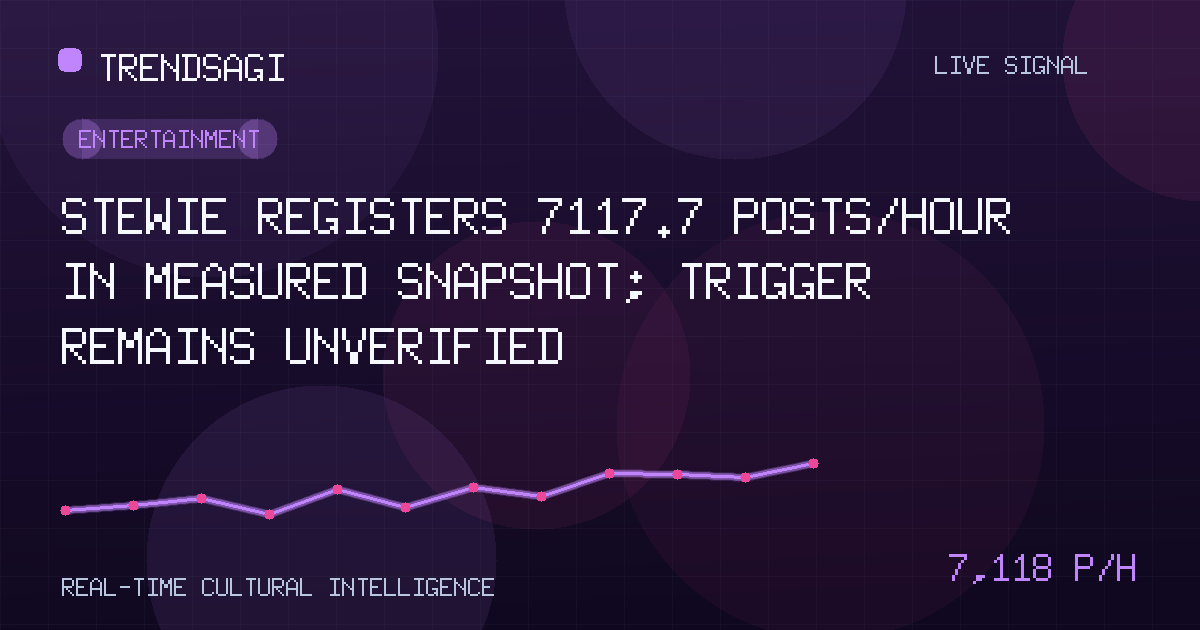
Stewie registers 7117.7 posts/hour in measured snapshot; trigger remains unverified
Stewie shows 7117.7 posts/hour over a 1791-second window and 3789 snapshot posts; this briefing explains the stored signal, unknown cause, and next checks.
Automated briefing. Generated from stored signal measurements and source-backed research; it is not manually reviewed. Read the methodology and limitations.
Metrics in this briefing are a snapshot associated with its publication date and may not reflect current conditions.
What changed
The clearest defensible read is that the entertainment topic labeled “Stewie” registered increased posting activity in the latest stored observation, but no cause has been verified. The evidence supports a short-window burst, not a claim about a specific event, identity, or audience.
At 2026-09-27T19:55:21Z, the latest snapshot volume was 3789 posts. Across an exact 1791-second window based on 2 stored observations, the measured snapshot rate was 7117.7 posts/hour. This is a historical measured rate for that observation—not a live or current rate, forecast, reach, engagement count, or unique-person count.
| Metric | Stored observation |
|---|---|
| Observation time | 2026-09-27T19:55:21Z |
| Measured snapshot rate | 7117.7 posts/hour |
| Measurement window | 1791 seconds; 2 stored observations |
| Latest snapshot volume | 3789 posts |
Why this topic may be moving
The cause remains unclear. The stored category is “Entertainment,” but the label is only one word and the stored signal description is empty. Neither field establishes which entity or event the posts concern.
Possible explanations include:
- a character, program, episode, clip, or release;
- a performer, creator, public figure, or account using the same name;
- a controversy, quotation, meme, or fan reaction;
- a quotation post, repost, reaction clip, or duplicated item;
- a collision between unrelated subjects sharing the label;
- a coordinated promotion or spam-like burst.
These are hypotheses, not findings about this signal. A useful verification pass would sample posts across the window, resolve which “Stewie” they describe, identify the earliest substantive references, and check whether independent public reporting supports the same event. Timing alone would not establish causation. Until that chain is complete, assigning the movement to a release, controversy, or platform incident would be speculation.
What the signal can establish
The signal establishes when the latest observation was taken, how many posts were present in that snapshot, and the supplied direction and magnitude of change across the measured window. The 3789 figure is a point-in-time count. The 7117.7 posts/hour figure is a measured snapshot rate. They answer different questions and should not be substituted for one another.
A measured snapshot rate is an alert to investigate, not proof that a particular event caused the activity or that the activity represents unique people.
The signal does not establish:
- the identity behind the one-word label;
- a normal historical posting baseline;
- whether the increase persisted beyond the window;
- the sentiment or substance of the posts;
- unique accounts, organic reach, or audience size;
- geographic or language distribution;
- whether duplicated or coordinated content inflated the count.
Why it matters
Editors should care because the movement merits prompt entity resolution, not because its cause is known. The first useful question is not simply “What happened?” but “What is being counted?” A wrong entity match could send a news, community, or reputation response toward the wrong subject.
Entertainment and social teams can use the alert to decide what to inspect: source posts, referenced media, account context, and the sequence of reposts. Those checks can reveal whether the signal reflects a shared event, recurring fan discussion, a name collision, or nonorganic repetition.
Analysts and media planners should treat 7117.7 posts/hour as a monitoring indicator, not as a measure of audience demand, market size, or campaign performance. The snapshot cannot support a forecast or show that organic reach expanded.
Teams with monitoring responsibilities should document the unresolved label and avoid publishing a causal explanation until both the entity and the source chain are verified.
What to watch next
The next useful checks are observable and concrete:
- Persistence: Compare subsequent stored observations. Check whether the measured snapshot rate remains elevated and whether the latest snapshot volume continues to grow, rather than judging the burst from this window alone.
- Entity consistency: Inspect a cross-section of posts and account descriptions. Determine whether they describe the same “Stewie” or several unrelated subjects being combined under one label.
- Source chronology: Find the earliest substantive posts and any media or event they reference. A credible trigger should recur across independent posts and align with verifiable public context.
- Post composition: Separate original commentary from quotations, reposts, clips, reactions, and duplicate text. This helps reveal whether conversation is developing or simply recycling material.
- Distribution pattern: Check for tightly clustered timestamps, repeated wording, shared links, or concentrated account activity. Those patterns would raise coordination or duplication questions without proving manipulation by themselves.
If later observations retain activity and the same referent, confidence in genuine topic growth improves. If volume persists but referents diverge, entity collision or ambiguous counting becomes more plausible. If the rate quickly fades, the signal may represent a short-lived reaction rather than sustained interest.
Methodology and limitations
The reported 7117.7 posts/hour is used exactly as supplied and was measured over 1791 seconds from 2 stored observations. The 3789 posts are the latest snapshot volume, not a rate. No conversion, extrapolation, or live update is applied.
The signal does not provide raw post text, account identities, source URLs, a historical baseline, sentiment, location, language, or deduplication information. With only 2 observations, it cannot establish a normal level, persistence beyond the window, or a statistically representative trend. The “Entertainment” category is useful for routing, but it does not resolve the one-word label.
No public trigger has been verified for this briefing. The responsible conclusion is therefore narrow: the label “Stewie” shows measurable short-window posting growth in the supplied snapshot, while its cause, persistence, and identity remain unresolved.
Track This Topic for New Signals
Set alerts for future velocity or sentiment changes around this topic.
Explore Tracking PlansAbout TrendsAGI research
TrendsAGI's automated research pipeline publishes dated signal snapshots, methodology notes, and practical workflows for teams evaluating cultural momentum. Read how signals are scoped, scored, and limited in our research methodology.