1805-second window · 3 observations · Measured Oct 1, 2026, 12:56 PM UTC · Provider: go_recent_snapshot_v2
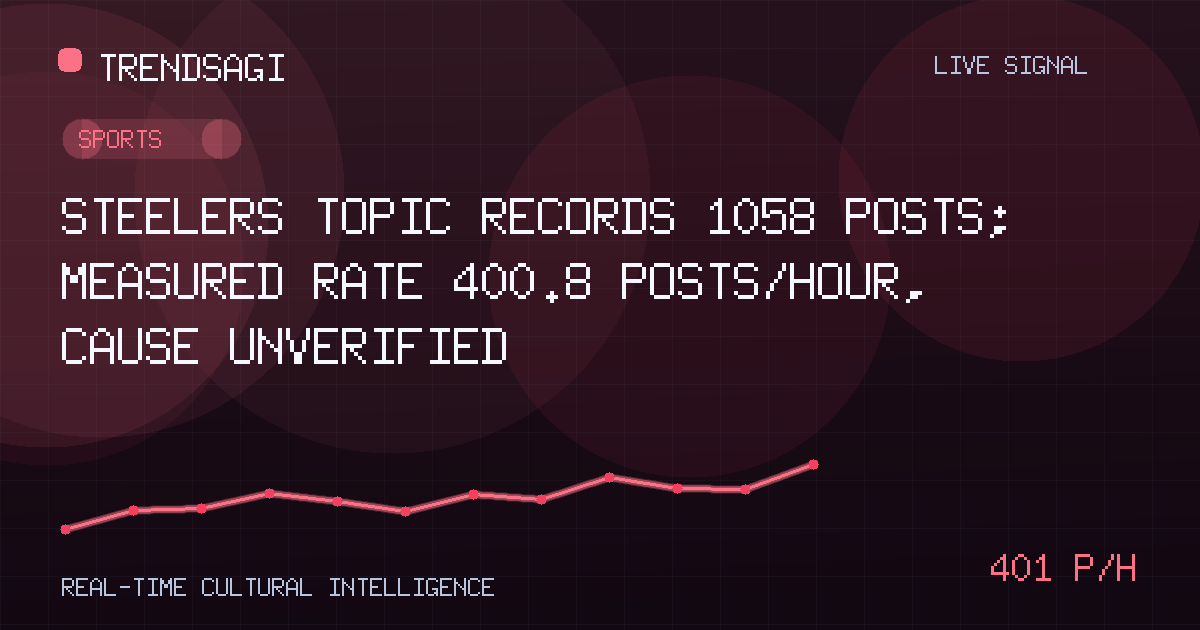
Steelers topic records 1058 posts; measured rate 400.8 posts/hour, cause unverified
The Steelers drew 1058 posts in the October 1 snapshot, with a measured 400.8 posts/hour rate; the trigger remains unverified. Here is what to check next.
Automated briefing. Generated from stored signal measurements and source-backed research; it is not manually reviewed. Read the methodology and limitations.
Metrics in this briefing are a snapshot associated with its publication date and may not reflect current conditions.
What changed
The Steelers topic is moving, but the reason is not verified. The latest stored snapshot, observed at 2026-10-01T12:56:40Z, had a snapshot volume of 1058 posts. That establishes how much conversation the collector captured at that moment. It does not establish who posted, how many people were involved, or what prompted the activity. No specific game, roster, injury, coaching, or media development has been tied to the burst with verified, time-matched public context.
The measured snapshot rate was 400.8 posts/hour over an exact 1805-second window using 3 stored observations. It is evidence of posting velocity during that window, not a live or current rate, forecast, reach estimate, engagement metric, or unique-person count. Because the record contains no historical baseline, the rate cannot be labeled normal, unusually high, or record-setting.
| Observation time | Measured snapshot rate | Latest snapshot volume |
|---|---|---|
| 2026-10-01T12:56:40Z | 400.8 posts/hour | 1058 posts |
Why this topic may be moving
The cause remains unclear. The stored record has no explanatory description, and the label The Steelers is broad enough to collect distinct subjects under one topic. Verified context would require a named publisher, a publication time, a specific development, and a plausible connection to the burst. A page that merely mentions the team does not meet that standard.
Possible explanations to test—not conclusions to publish—include:
- Event news: A timestamped team, league, or player update may align with the first burst, but no such update is verified here.
- Game discussion: A result, schedule, broadcast, or postgame reaction could concentrate posts; the record identifies none of these.
- Personnel news: Injuries, selections, releases, contracts, or coaching changes are plausible filters for team-focused conversation, not established causes.
- Amplification: Repetition, quote-posts, automated activity, or an older story recirculating could lift volume without a new event.
These are hypotheses, not findings. Search is useful only when it verifies the publisher and timeline and when the reported subject matches what posts are discussing. Without that alignment, an external story should not be presented as the trigger.
The evidence establishes observed posting velocity, not the event or sentiment behind it. This is a verification alert, not yet an explained news event.
Why it matters
Volume and speed make a topic editorially urgent, but they do not make its cause or importance self-evident.
- Journalists and editors: Verify the catalyst before tying coverage to the burst; a fast topic can still be narrow or repetitive.
- Community and reputation teams: Inspect themes and sentiment before responding; the label alone cannot distinguish celebration, criticism, concern, or noise.
- Researchers: Preserve the observation time and measurement window so later activity can be compared without changing the denominator.
- Fans and decision-makers: Do not read 1058 posts as 1058 people, public consensus, or evidence that an event is true.
The practical value is prioritization: this signal says to investigate now. It does not justify claims about public opinion, audience size, or real-world consequence.
What to watch next
The next useful checks should turn a fast cluster into a testable timeline:
- Anchor the time: Find the earliest credible publication or announcement associated with the team and compare its timestamp with the post cluster. Sequence matters more than keyword overlap.
- Check convergence: Look for a first-party statement or independent reputable reporting describing the same development. Repeated copies of one item are not separate confirmation.
- Take fresh snapshots: Record whether the measured rate remains elevated, recedes, or reverses. Keep every rate attached to its own window and do not carry 400.8 posts/hour forward.
- Audit composition: Where data permits, separate original posts from reposts and quotes, deduplicate accounts or text, inspect links, and check whether traffic is concentrated among a narrow set of posters.
- Resolve the label: Classify posts by subject—game, roster, injury, coaching, schedule, media, or unrelated use—and watch for a dominant theme, correction, official response, or shift in participation.
A causal explanation becomes more credible when the timing, subject, and source all align. If the cluster remains mixed or no credible development precedes it, the honest conclusion is still that the trigger is unknown.
Methodology and limitations
The measurement is narrow: an observation timestamp, 3 stored observations, an exact 1805-second window, a measured 400.8 posts/hour rate, and 1058 posts in the latest snapshot. Volume and rate answer different questions and should not be combined into a new calculation.
- No platform coverage, collection method, classifier rules, or historical comparison is supplied.
- No unique-account count, repost status, location, language, sentiment, or engagement data is available.
- The topic label may mix subtopics or unrelated uses of “Steelers.”
- The observations may be sensitive to a short-lived spike or a collection boundary.
The signal can establish a captured post count at the stated time and a measured snapshot rate for the stated window. It cannot establish typicality, authenticity, causation, sentiment, reach, or impact. Treat 400.8 posts/hour as the time-bounded measured snapshot rate, then remeasure before describing the topic as current.
Track This Topic for New Signals
Set alerts for future velocity or sentiment changes around this topic.
Explore Tracking PlansAbout TrendsAGI research
TrendsAGI's automated research pipeline publishes dated signal snapshots, methodology notes, and practical workflows for teams evaluating cultural momentum. Read how signals are scoped, scored, and limited in our research methodology.


