916-second window · 3 observations · Measured Oct 2, 2026, 7:21 PM UTC · Provider: go_recent_snapshot_v2
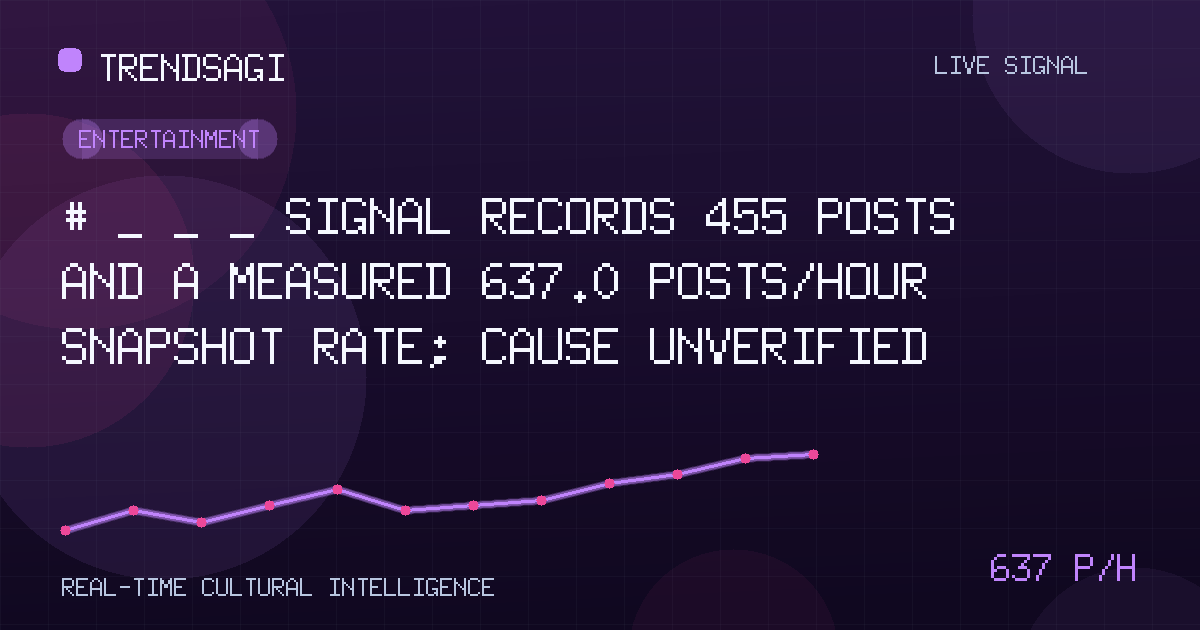
#스테이의_영원한_자부심_방찬 signal records 455 posts and a measured 637.0 posts/hour snapshot rate; cause unverified
A 455-post snapshot and measured 637.0 posts/hour rate make #스테이의_영원한_자부심_방찬 a monitoring lead, not proof of reach or cause.
Automated briefing. Generated from stored signal measurements and source-backed research; it is not manually reviewed. Read the methodology and limitations.
Metrics in this briefing are a snapshot associated with its publication date and may not reflect current conditions.
What changed
The stored signal for #스테이의_영원한_자부심_방찬 records a measured burst of captured posting activity during a short observation window, but it does not identify a verified event behind the increase. The latest snapshot contains 455 posts. That figure is snapshot volume, not a rate, reach figure, or count of unique people.
Across an exact 916-second window using 3 stored observations, the measured change rate was 637.0 posts/hour, measured at 2026-10-02T19:21:45Z. This is a measured snapshot rate, not a live or current rate, forecast, engagement total, reach estimate, or unique-person count. The direct answer is that the stored data shows a concentrated short-window burst; why the topic is moving remains unclear.
| Signal field | Stored value |
|---|---|
| Observation time | 2026-10-02T19:21:45Z |
| Measured change rate | 637.0 posts/hour |
| Observation window | Exact 916-second window using 3 stored observations |
| Latest snapshot volume | 455 posts |
Why this topic may be moving
The canonical record includes no signal description and no independently verified public context that connects the label to a named work, person, incident, or campaign. Its Entertainment category is a filing classification, not an explanation. The hashtag should be treated as a monitoring label rather than a verified event name.
Several mechanisms could produce a burst: a newly surfaced entertainment clip, a fan reaction, a meme or remix, a repost chain, a controversy, coordinated promotion, or a change in collection conditions. These are hypotheses to test, not facts about this label. The record does not identify the content being discussed or say which mechanism applies.
The figures establish timing within the captured data, not causality. A rate can reflect a real conversational moment, repeated distribution of the same item, or concentration of posts in the monitored sample. Without a preceding baseline, the original post, platform scope, or a verified external reference, a meaningful entertainment event cannot be distinguished from a measurement artifact. Attributing the movement to a particular release, person, or controversy would exceed the evidence.
Why it matters
For editors, fandom trackers, media teams, community managers, and rights holders, this is a triage signal rather than a conclusion. A short-window rate can help prioritize a verification check when the label is unfamiliar or the underlying event has not been identified. It can also keep a developing conversation from being overlooked while context is established.
Activity is not the same as impact. The 455-post snapshot does not establish reach, sentiment, credibility, or the number of people exposed. The 637.0 posts/hour rate does not show that posts were original, that authors were unique, or that the conversation represented a broad consensus. A publisher should avoid a confident reaction, and a brand should avoid treating the label as a mandate, until the subject and source are confirmed.
Even with an unexplained cause, the signal supports useful questions: What is the earliest identifiable post? Which account or work is referenced? Is volume concentrated or distributed? Is public reporting adding evidence? The signal becomes more valuable when those questions produce attributable facts rather than when speculation fills the gap.
What the signal can and cannot establish
- It establishes that the stored record contains 455 posts in the latest snapshot and a measured change rate of 637.0 posts/hour over the stated window.
- It establishes the observation timestamp, 2026-10-02T19:21:45Z, and the stored Entertainment category.
- It does not establish a platform-wide total, historical baseline, unique-author count, sentiment, content authenticity, or causation.
- It does not identify a particular work, person, organization, or incident from the hashtag label alone.
These limits matter because the signal uses 3 stored observations. A precise rate can describe its defined window without representing a longer trend. The record does not state collection coverage, sampling rules, deduplication, or whether repeated content was counted, so the figures should not be treated as a durable audience measure.
What to watch next
- Recover the beginning. Find the earliest captured posts and compare their timestamps with the 916-second window. Determine whether the first item is original content, a repost, a screenshot, or a repeated clip.
- Resolve the label. Search for distinctive wording, named entities, attached media, and references to a work or event. A match should be checked against an original or official source before it is used as context.
- Test the distribution. Check whether a small set of accounts accounts for much of the activity, whether the same media is repeated, and whether discussion crosses communities. Concentration is a clue, not proof of manipulation.
- Look for corroboration. Use Google Search to check exact-hashtag references, distinctive wording, and timestamps in reliable publishers or official channels. Compare publication times with the first observed posts. Do not treat an unattributed repost as confirmation.
- Take another measurement. Compare the next stored observation with this window. A similar or higher rate, a decline, a rebound, or migration to related terms would clarify whether the burst persists or changes shape. These are checks, not predictions.
- Set a response threshold. Before drafting a causal story, require an identifiable subject and a verifiable source. Official acknowledgement, independent reporting, and sustained original posts would be stronger signals than volume alone.
A measured acceleration is a reason to investigate faster, not permission to invent the explanation. The key distinction is between evidence that something changed and evidence of why it changed.
Methodology and limitations
This briefing uses only the canonical stored signal. The observation time is 2026-10-02T19:21:45Z; the latest snapshot volume is 455 posts. The measured change rate is 637.0 posts/hour over an exact 916-second window using 3 stored observations, measured at that timestamp. The stored category is Entertainment, and the stored signal description is blank.
No independently verified public context accompanies the supplied record, so the reason for movement is not established. The posts/hour figure is a measured snapshot rate, not a current platform rate, forecast, or reach estimate, while 455 posts are a snapshot volume rather than a unique-person count. The record does not provide enough detail about coverage, sampling, deduplication, or historical comparison to support a broader claim about public attention. Use the figures to prioritize verification, then use confirmed sources to explain the phenomenon.
Track This Topic for New Signals
Set alerts for future velocity or sentiment changes around this topic.
Explore Tracking PlansAbout TrendsAGI research
TrendsAGI's automated research pipeline publishes dated signal snapshots, methodology notes, and practical workflows for teams evaluating cultural momentum. Read how signals are scoped, scored, and limited in our research methodology.