903-second window · 3 observations · Measured Sep 25, 2026, 1:41 AM UTC · Provider: go_recent_snapshot_v2
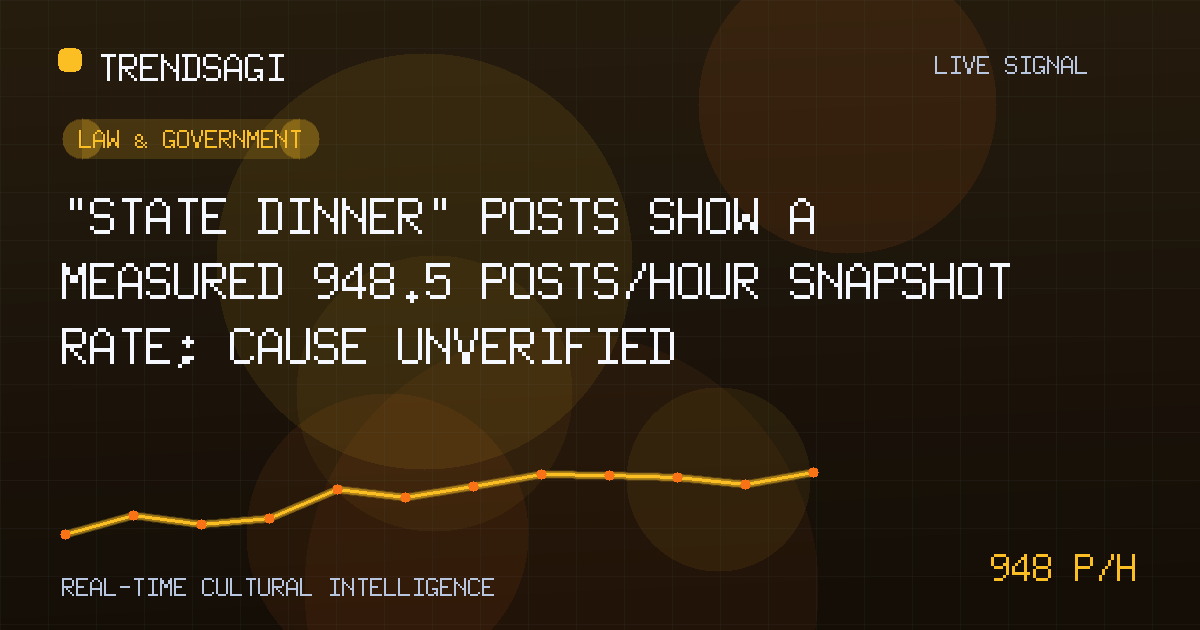
“State Dinner” posts show a measured 948.5 posts/hour snapshot rate; cause unverified
A “State Dinner” snapshot holds 631 posts and a measured 948.5 posts/hour rate; here is what is known, unknown, and worth checking.
Automated briefing. Generated from stored signal measurements and source-backed research; it is not manually reviewed. Read the methodology and limitations.
Metrics in this briefing are a snapshot associated with its publication date and may not reflect current conditions.
What changed
The recorded conversation labelled “State Dinner” shows increased posting activity, with a measured snapshot rate of 948.5 posts/hour over an exact 903-second window based on 3 stored observations. This is not a live or current rate, forecast, reach estimate or unique-person count.
The latest supplied snapshot is timestamped 2026-09-25T01:41:29Z and contains 631 posts. Those are different measurements: 631 is the snapshot count, while 948.5 posts/hour is the measured change rate. The reason for the movement is not established, and no verified public context is available to explain it.
| Observation time | Measured snapshot rate | Latest snapshot volume |
|---|---|---|
| 2026-09-25T01:41:29Z | 948.5 posts/hour | 631 posts |
Why this topic may be moving
The stored category is “Law & Government,” but that classification and the topic label do not identify a particular dinner, country, organization or policy dispute. A high measured rate establishes that the recorded count changed quickly; it does not supply the missing news context.
- Event-driven attention: A new publicly reported development could prompt many posts to use the same label. No particular announcement, statement or scheduled occasion is identified in the record, so none can be treated as the cause.
- Ambiguous grouping: Posts using the phrase may concern different subjects. Without a description or examples, the signal cannot show whether it represents one event, several conversations, or a shift in how an existing label is being used.
- Measurement effects: The collection method is not described. The record therefore cannot establish whether changes in sampling, classification or inclusion affected the snapshot.
These are possibilities to test, not verified findings. The defensible conclusion is narrower: posting activity under this label increased in the measured window, while its cause remains unclear.
Why it matters
For editors, the important finding is the mismatch between a strong activity signal and absent event context. It warrants verification, not a headline assigning the increase to an unconfirmed event. For government-affairs and public-policy teams, it is a prompt to check whether the label maps to a monitored institution or issue. For researchers, it offers a case to examine how conversation labels form around public attention.
The key distinction is between attention to a phrase and attention to a defined institution or issue. The 631-post snapshot may include repeated reactions, shared source material or separate subjects; the record does not identify their shares. The figures do not establish public approval, the number of participants, influence, or the importance of a dinner relative to other news.
For ordinary readers, the useful takeaway is practical: treat the spike as a reason to investigate, not as a substitute for knowing what happened. A verified event match would make the signal actionable; an unexplained label should remain a monitoring lead.
What to watch next
- Verify the observation record. Confirm that the timestamp, snapshot count and all 3 observations use the same label definition, time basis and collection method. Reproducing the supplied figures does not independently validate them.
- Identify the subject before explaining the movement. Establish which dinner, host, country and occasion the posts concern. Look for dated public reporting or direct statements that match the conversation, rather than relying on the broad category.
- Inspect the beginning of the increase. Review early matching posts to see whether they point to one event, a scheduled occasion, a reused news story or several unrelated conversations. Establish chronology before looking for explanations later in the burst.
- Check the label and collection process. Determine whether “State Dinner” captures one phrase consistently and whether any monitoring or classification change coincided with the measurement. A collection change would be a different explanation from a change in public attention.
- Test whether the activity persists. Compare later snapshots under the same method, and check whether discussion remains under this label or migrates elsewhere. The supplied record contains no subsequent observations, so persistence and any shift in interest are unknown.
Concrete signals that would strengthen the briefing
Useful confirming signals would be a specific, dated public report that matches the sampled posts and precedes the increase; consistent identification of the same event across a post sample; a documented collection-method change; or sustained later volume under an unchanged definition. Each would narrow the explanation. None is established here.
Conversely, unrelated sample content, a short-lived burst or a label change would weaken a simple event-driven interpretation. These are checks to run, not additional findings.
Methodology and limitations
The figures reproduced here are the supplied observation time of 2026-09-25T01:41:29Z, the latest snapshot volume of 631 posts and the measured snapshot rate of 948.5 posts/hour. The rate comes from 3 stored observations over an exact 903-second window. Snapshot volume answers how many posts were present in that observation; the measured rate answers how quickly the recorded count changed during the stated window.
A measured posting rate reports the pace of change in a record; it does not identify the event, the people posting, their motives, or the issue’s significance.
The observation is dated September 25, 2026, later than this briefing’s April 10, 2026 date. It is therefore a future-dated, supplied record requiring independent date and event verification, not independently confirmed news. No verified public context was available to identify a catalyst.
The signal also lacks a descriptive account, post-level examples, baseline detail, geography, language, engagement data and a collection-method note. It cannot establish unique authors, original posts, sentiment, reach, causation or relative news importance. All numerical statements describe the supplied record, not established present activity.
Track This Topic for New Signals
Set alerts for future velocity or sentiment changes around this topic.
Explore Tracking PlansAbout TrendsAGI research
TrendsAGI's automated research pipeline publishes dated signal snapshots, methodology notes, and practical workflows for teams evaluating cultural momentum. Read how signals are scoped, scored, and limited in our research methodology.