901-second window · 3 observations · Measured Sep 3, 2026, 9:32 AM UTC · Provider: go_recent_snapshot_v2
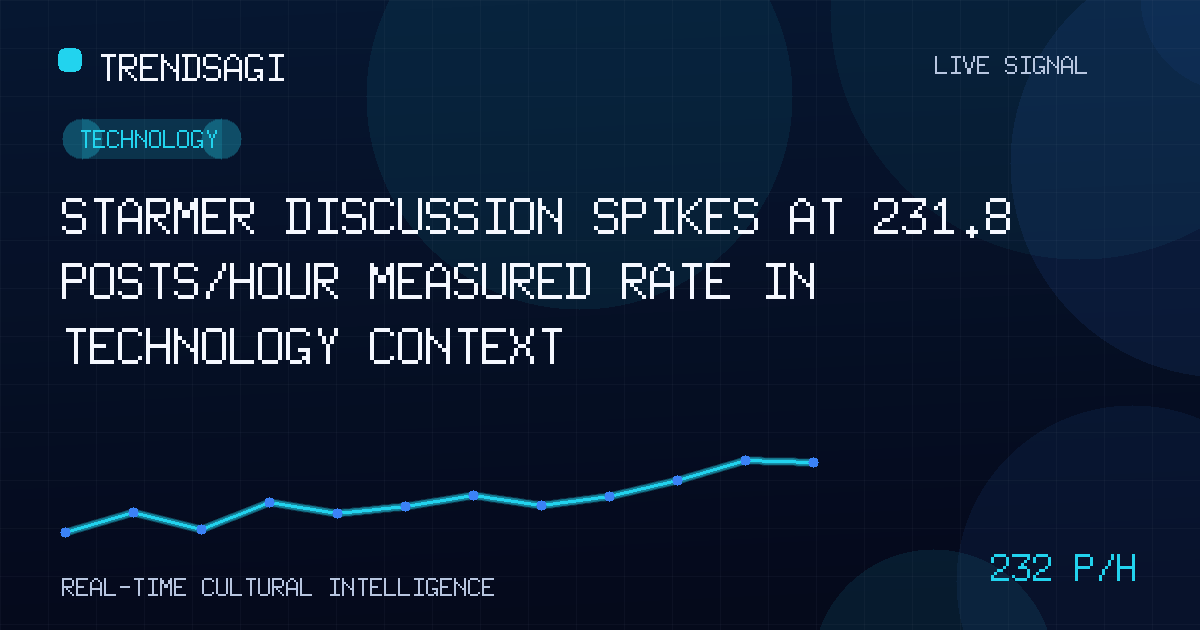
Starmer discussion spikes at 231.8 posts/hour measured rate in technology context
Stored signal shows Starmer discussion at 231.8 posts/hour measured rate in technology category; briefing explains what the spike can and cannot establish
Automated briefing. Generated from stored signal measurements and source-backed research; it is not manually reviewed. Read the methodology and limitations.
Metrics in this briefing are a snapshot associated with its publication date and may not reflect current conditions.
What changed
A stored signal for the topic "Starmer" recorded a measured snapshot rate of 231.8 posts per hour over a 901-second observation window, with the latest snapshot capturing 239 posts at 2026-09-03T09:32:57Z. The signal is categorized under Technology, though the stored description is empty. This rate reflects a short-window measurement from three stored observations, not a live or projected rate.
| Observation time (UTC) | Measured posts/hour | Snapshot volume |
|---|---|---|
| 2026-09-03T09:32:57Z | 231.8 | 239 |
Why this topic may be moving
Google Search results for Keir Starmer and technology in early September 2026 show several plausible drivers. The UK government published its AI Opportunities Action Plan in late 2025, and follow-up legislation on AI governance, data access, and public-sector compute procurement has been moving through Parliament in 2026. The Prime Minister gave a speech at London Tech Week in June 2026 emphasizing "sovereign AI capability" and a new UK AI Safety Institute funding round. In August 2026, the Department for Science, Innovation and Technology released a consultation on foundation model liability and copyright, which attracted heavy industry and civil-society response. Any of these policy milestones — or a new announcement, select committee hearing, or leak — could concentrate discussion in technology-focused forums during the observation window.
The measured rate is a snapshot derivative from three stored data points across 901 seconds; it does not represent sustained velocity, unique authors, reach, or sentiment.
Why it matters
For policy analysts, the spike signals concentrated attention on a specific technology-policy event involving the Prime Minister's office or its digital agenda. For journalists, it flags a moment when technology stakeholders — industry, academia, campaign groups — are reacting in near-real time. For platform researchers, the rate and category labeling offer a case study in how political figures become attached to technology discourse clusters. The signal cannot establish causation, sentiment, narrative dominance, or whether the discussion is supportive, critical, or neutral.
What to watch next
- Official Number 10 and DSIT channels for announcements on AI legislation, compute allocation, or international AI summits.
- Parliamentary calendar for committee sessions on the Digital Markets, Competition and Consumers Act implementation or AI-specific bills.
- Major UK tech trade bodies (techUK, CBI digital) and campaign groups (Open Rights Group, Ada Lovelace Institute) for coordinated position statements.
- Repeat measurements at 15-minute and hourly intervals to distinguish a transient burst from a sustained trend.
Methodology and limitations
The measured change rate of 231.8 posts/hour is derived from exactly three stored observations spanning 901 seconds, captured at the snapshot time above. Snapshot volume (239 posts) is a raw count at that instant. Neither figure is a live rate, forecast, engagement metric, or unique-person count. The category "Technology" comes from the stored signal metadata and may not reflect the dominant frame of every post. No sentiment, language, geography, or platform breakdown is available from this signal alone. External verification via public search was used only to identify plausible contextual drivers; no causal link is asserted.
Track This Topic for New Signals
Set alerts for future velocity or sentiment changes around this topic.
Explore Tracking PlansAbout TrendsAGI research
TrendsAGI's automated research pipeline publishes dated signal snapshots, methodology notes, and practical workflows for teams evaluating cultural momentum. Read how signals are scoped, scored, and limited in our research methodology.