902-second window · 3 observations · Measured Sep 25, 2026, 12:51 PM UTC · Provider: go_recent_snapshot_v2
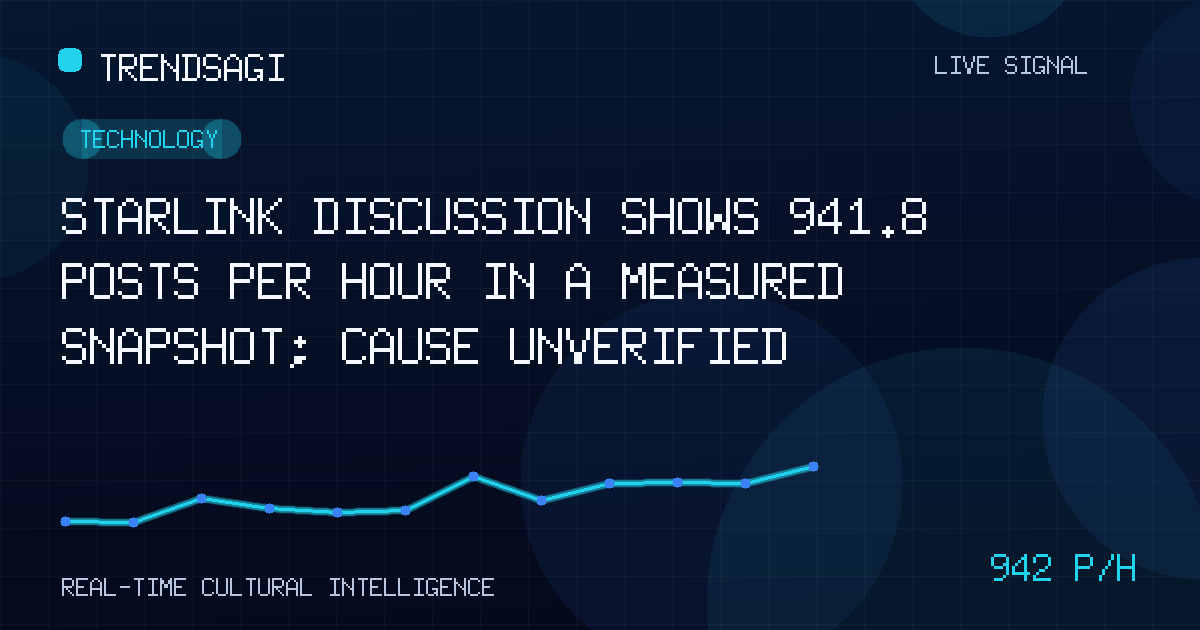
Starlink discussion shows 941.8 posts per hour in a measured snapshot; cause unverified
Starlink discussion recorded 941.8 posts per hour in a measured snapshot; see what is established, what remains unclear, and what to check next.
Automated briefing. Generated from stored signal measurements and source-backed research; it is not manually reviewed. Read the methodology and limitations.
Metrics in this briefing are a snapshot associated with its publication date and may not reflect current conditions.
What changed
Starlink-related discussion is concentrated in the observed window: the measured snapshot rate is 941.8 posts per hour. The trigger is not established by the available evidence, and the activity should not be attributed to a specific event without dated public corroboration.
At 2026-09-25T12:51:50Z, the latest stored snapshot contained 493 posts. Across three stored observations, the measured change was 941.8 posts per hour over an exact 902-second window. This is a measured snapshot rate, not a live or current rate, forecast, reach figure, engagement measure or unique-person count. The figures also do not show how activity compares with an earlier period.
| Observation time | Measured snapshot rate (posts/hour) | Snapshot volume (posts) |
|---|---|---|
| 2026-09-25T12:51:50Z | 941.8 | 493 |
Why this topic may be moving
No verified public context in the available record establishes why the topic is moving. Starlink conversation could be responding to an announcement, a service-related claim, a broader technology debate or repeated circulation of one story. Those are possibilities to investigate, not confirmed causes of this signal.
An explanation becomes useful only when it connects a dated, identifiable report to the content of the posts and checks its timing against the 902-second measurement window. A broadly related headline is not enough. Until the connection between an event and the discussion is supported, the cause remains unclear.
What the signal can and cannot establish
The record establishes a post count at the observation time and a measured rate across the window. It does not establish sentiment, originality, independent corroboration or effects on Starlink use or service availability. Several practical distinctions matter when interpreting those figures.
- Independence: Determine whether the 493 posts represent distinct contributions or repeated versions of a small number of claims. A post count is not a count of independent confirmations.
- Authorship: Identify who is contributing. Account-level checks are needed before distinguishing individual participants, organizational accounts and automated activity.
- Engagement: Establish whether the posts were read, shared, discussed or acted upon. Those outcomes are not included in the supplied measurement.
- Substance: Assess whether posts report an event, debate a claim or recycle existing coverage. Discussion volume cannot settle factual accuracy.
A measured posting burst is a reason to investigate, not proof of a new service fact, wider adoption or a lasting change in public attention.
These distinctions are especially important in a short measurement window. Concentrated activity and a sustained shift are different findings, and the available observations do not establish which one this signal represents.
Why it matters
Readers tracking Starlink, people responsible for network and connectivity operations, analysts, journalists and communications teams should all avoid treating conversation intensity as a real-world event by itself. The first task is to determine whether credible evidence explains the activity before using the post count to infer operational or social change.
Connectivity teams can check for service evidence and prepare an appropriate response if users report a genuine problem. Analysts and editors can use the observation time to investigate the origin of the cluster. Communications teams can identify the narrative being repeated and avoid mistaking amplification for consensus. None of those conclusions is established by the count alone.
What to watch next
The next step is not to extend 941.8 posts per hour beyond the observed window, but to collect comparable evidence about persistence, cause and content.
- Persistence: Gather additional snapshots using the same collection and counting method, then compare their measured rates with 941.8 posts per hour. This can help distinguish an isolated burst from longer-lived activity.
- Verified cause: Search for dated reporting from official organizations or identifiable publishers, then open the underlying items to verify their claims and publication times. A direct connection to the observed conversation is stronger than a merely related headline.
- Operational evidence: Check whether any official service notice or independently reported service issue has a timestamp consistent with the measurement window. Discussion volume alone does not establish an outage.
- Content mix: Review original posts for repeated wording, links, images and specific claims. Track whether the conversation shifts from speculation to evidence or from one narrative to several distinct subjects.
- Participation: Where available, examine distinct accounts, original contributions, re-posting and relevant interaction signals. These checks help distinguish broad participation from concentrated amplification.
Methodology and limitations
The rate was supplied from three stored observations over an exact 902-second window and reported at 2026-09-25T12:51:50Z. It is treated here as a measured snapshot rate, not a live or current rate or a projection. The 493-post figure is the volume in the latest stored snapshot; it is not substituted for the rate.
No account-level records, post contents, engagement measurements, earlier baseline or verified public explanation are available in the record used for this briefing. The signal therefore cannot establish who participated, whether the activity was organic, how long it will last or why it occurred. The absence of a verified explanation is a limitation of the available evidence, not proof that no relevant event happened.
Track This Topic for New Signals
Set alerts for future velocity or sentiment changes around this topic.
Explore Tracking PlansAbout TrendsAGI research
TrendsAGI's automated research pipeline publishes dated signal snapshots, methodology notes, and practical workflows for teams evaluating cultural momentum. Read how signals are scoped, scored, and limited in our research methodology.