922-second window · 3 observations · Measured Oct 1, 2026, 8:55 PM UTC · Provider: go_recent_snapshot_v2
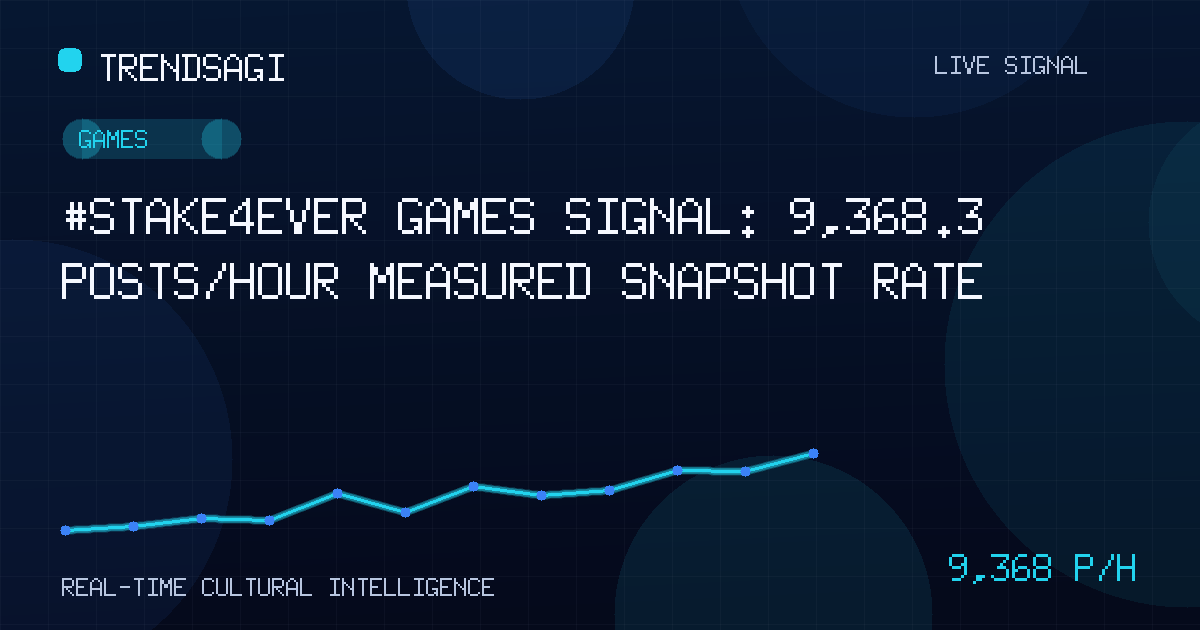
#STAKE4EVER Games signal: 9,368.3 posts/hour measured snapshot rate
#STAKE4EVER recorded a measured snapshot rate of 9,368.3 posts/hour; review what changed, what is unverified, and the next checks.
Automated briefing. Generated from stored signal measurements and source-backed research; it is not manually reviewed. Read the methodology and limitations.
Metrics in this briefing are a snapshot associated with its publication date and may not reflect current conditions.
What changed
#STAKE4EVER shows a concentrated posting burst at the observed snapshot in the stored Games signal, but its trigger cannot be verified. No signal description or verified public context links the hashtag to a particular game, tournament, creator, update, controversy, or announcement. The defensible conclusion is narrow: the topic was moving during the observed window, while the reason it was moving remains unclear.
The measured change is 9,368.3 posts/hour. This is a measured snapshot rate over an exact 922-second window using 3 stored observations at 2026-10-01T20:55:35Z. The latest snapshot volume is 6,000 posts. The figures are not interchangeable: 6,000 is the snapshot post count, while 9,368.3 posts/hour is the measured rate for the stated window. Neither should be read as a live or current rate, forecast, reach estimate, engagement total, or count of unique people.
| Observation time | Measured snapshot rate | Snapshot volume |
|---|---|---|
| 2026-10-01T20:55:35Z | 9,368.3 posts/hour | 6,000 posts |
Why this topic may be moving
No verified catalyst is attached to the signal, so explanations must remain conditional rather than factual. A gaming hashtag can rise around a match result, patch note, stream clip, creator dispute, viral meme, or scheduled event, but none of those possibilities is established here.
It is also possible that #STAKE4EVER is an evergreen community phrase rather than a news-linked label. In that case, concentrated activity inside the observation window could reflect recurring conversation, coordinated promotion, or repeated posting without a single breaking event. The signal alone cannot separate those cases.
The stored Games classification makes a game-related context plausible, but it does not identify the game or prove that game news caused the increase. Likewise, the form of the hashtag does not establish whether it names a person, team, event, community, or general expression.
A measured posting burst can justify investigation, but it cannot identify the event behind the burst. That requires timed, attributable evidence in the posts and verified public context.
The rate's decimal precision should not be mistaken for causal precision. It measures posting velocity, not the origin, importance, legitimacy, or organic character of the conversation.
Why it matters
For editors and social-listening analysts, the immediate value is triage: the signal says the hashtag merits examination before it is assigned a narrative. For gaming community teams, it may identify a moment requiring monitoring. For moderators and audience researchers, the same burst can have different implications depending on whether it consists of distinct discussion, duplicated reactions, or automated activity.
- Timeliness: The exact window can surface a fast-moving conversation, but persistence cannot be inferred without later observations.
- Scale: Snapshot volume and measured snapshot rate describe posts, not how many people saw, authored, or participated in the discussion.
- Quality: The record supplies no sentiment, language, geography, account concentration, originality, or evidence of coordination.
- Causality: A category label and posting rate can prioritize investigation but cannot verify the catalyst.
The signal is therefore useful but not self-sufficient. It establishes observed posting activity at a specified time and supports a disciplined follow-up; it does not independently explain the activity or establish a broader trend.
What to watch next
Use the next checks in this order:
- Inspect the earliest substantive posts and replies to find the first point at which a named game, team, player, creator, event, or claim appears. That material is generally more useful for causal investigation than later reaction posts.
- Check originality and account concentration. Determine whether captured posts are original contributions, quotations or reposts, near-duplicates, or responses copied from one source. Repeated text can increase apparent conversation without demonstrating broader participation.
- Identify the originating platform and resolve the hashtag's meaning there and across public sources. Confirm whether it is an official tag, creator or community label, event phrase, or unrelated usage. Exact-match searches should be interpreted alongside the observation timestamp so older recurring uses are not mistaken for the catalyst.
- Seek time-stamped corroboration from official accounts and independent publishers. Record whether an announcement, match, release, clip, or controversy occurred before the measured window. Timing is necessary for a causal case, but it is not sufficient by itself.
- Collect follow-up snapshots and a longer baseline. Watch for persistence beyond the 922-second window, decay, another wave, or migration into related hashtags. A burst confined to the observed window and a durable shift are different findings.
- Treat specific developments as watch signals: a named entity recurring in original posts, verified reporting or an official announcement, participation by distinct accounts, concentration of identical text, or a clear sentiment shift. Each should be checked against its timestamp and source before being presented as an explanation.
If no causal link emerges, the cause should remain unclear rather than being filled with the most dramatic nearby gaming story.
Methodology and limitations
The result is based on 3 stored observations covering the exact 922-second window and a latest snapshot containing 6,000 posts at 2026-10-01T20:55:35Z. The 9,368.3 posts/hour figure is the supplied measured snapshot rate. It is not extrapolated here, and the 6,000-post snapshot volume is not presented as a rate. The record does not establish that both figures share the same sampling boundary, so they should not be reconciled through arithmetic.
The signal does not specify the platform, collection method, query scope, historical baseline, previous rate, geographic or language distribution, account totals, sentiment, or authenticity checks. Because the collection boundary is unspecified, the snapshot cannot be treated as the complete universe of discussion. No verified external context explaining the movement is attached to the record.
Most importantly, the measurement establishes posting activity, not why it occurred. A responsible briefing should preserve that distinction: report the observed burst, identify what remains unverified, and name the evidence required before assigning wider significance.
Track This Topic for New Signals
Set alerts for future velocity or sentiment changes around this topic.
Explore Tracking PlansAbout TrendsAGI research
TrendsAGI's automated research pipeline publishes dated signal snapshots, methodology notes, and practical workflows for teams evaluating cultural momentum. Read how signals are scoped, scored, and limited in our research methodology.