901-second window · 3 observations · Measured Sep 25, 2026, 8:21 PM UTC · Provider: go_recent_snapshot_v2
Sports “Titles” Snapshot: 2250 Posts and a 2996.4 Posts/Hour Measured Change
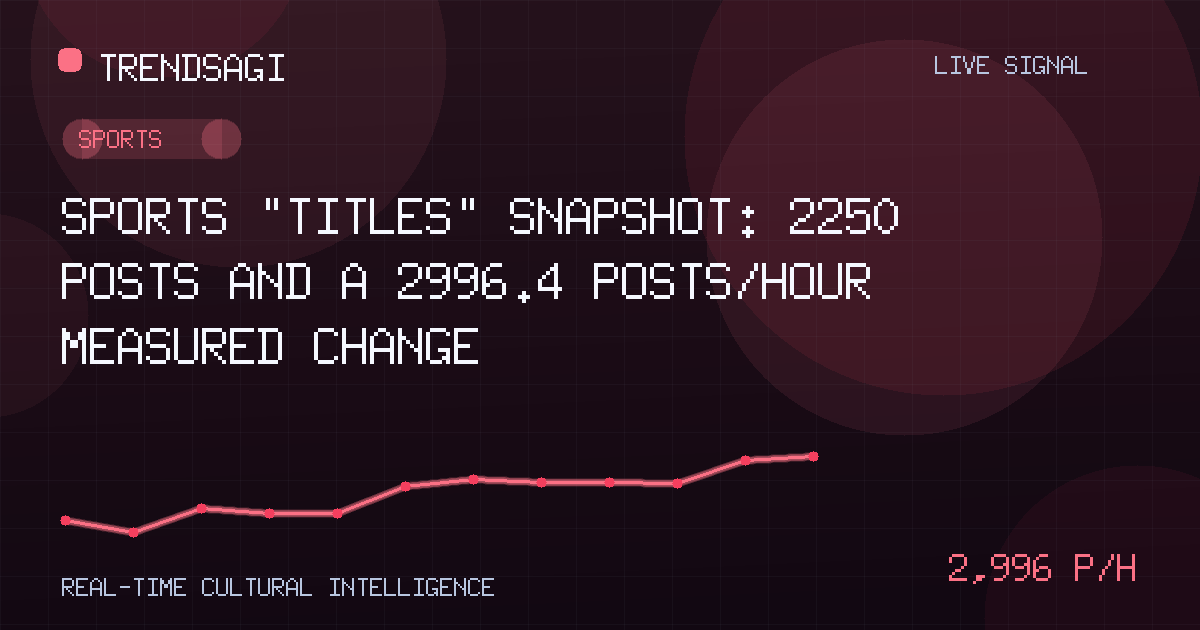
The Sports topic labeled “Titles” had 2250 posts in its latest snapshot and a measured 2996.4 posts/hour change; cause and persistence need verification.
Automated briefing. Generated from stored signal measurements and source-backed research; it is not manually reviewed. Read the methodology and limitations.
Metrics in this briefing are a snapshot associated with its publication date and may not reflect current conditions.
What changed
The latest stored snapshot for the Sports topic labeled “Titles” contains 2250 posts at 2026-09-25T20:21:48Z. The practical takeaway is a measured short-window rise in monitored posting activity, not a fully identified story. Because the record supplies no title, event, team, athlete, or description, it cannot support attribution to a particular match, competition, award, or announcement.
That change measured 2996.4 posts/hour over an exact 901-second window using 3 stored observations, measured at 2026-09-25T20:21:48Z. This is a measured snapshot rate, not a live or current rate, forecast, reach, engagement result, or count of unique people. It supports triage for a possible burst, but it does not establish that attention will persist.
| Observation time | 2026-09-25T20:21:48Z |
|---|---|
| Measured snapshot rate | 2996.4 posts/hour |
| Latest snapshot volume | 2250 posts |
| Rate window | Exact 901-second window using 3 stored observations |
Why this topic may be moving
No verified public context establishes the cause, so it remains unclear. “Titles” is a broad label, and the only classification supplied is Sports. It could be associated with a result, a title race, an award, a media release, or a taxonomy that combines several subjects. Those are hypotheses only; none is confirmed by the stored record.
A useful diagnosis would connect the burst to something externally observable. An editor could test whether candidate event terms co-occur in the posts and whether a dated report from a publisher or organizer aligns with the observation window. A Google Search check should verify such a candidate against public reporting, not infer an explanation merely because related pages exist. Until that match is found, the responsible description is “unexplained activity under the label Titles.”
What the signal can—and cannot—establish
The signal provides a useful measurement, but its meaning depends on what the collection and classification system captured.
- Scale at one timestamp: 2250 posts were present in the latest stored snapshot. This is a volume, not an hourly rate or audience count.
- Short-window direction: the stored observations produced a measured change rate of 2996.4 posts/hour. That is evidence of increased posting activity during the measured interval.
- A monitoring priority: the combination warrants checking for an event, breaking development, or data-quality issue. It does not, by itself, show any of them.
Equally important, the record does not establish the topic’s cause, participating entities, sentiment, locations, source platforms, organic-versus-automated mix, or duplicate rate. It provides no ordinary baseline for this label, so the measured rate cannot be classified as unusually high or low relative to normal. The timestamp is the observation time; it is not proof that all 2250 posts were published then.
The useful signal is not “Titles is trending” as a story claim. It is that a narrowly labeled Sports stream produced 2250 posts in the latest snapshot and registered 2996.4 posts/hour over a short measured window. The next editorial value comes from identifying the underlying subject and testing persistence, not from assigning the label a cause.
Why it matters
Sports desks and audience teams need to know whether this is a genuine public-interest burst, a narrow conversation, or a classification artifact. If posts are concentrated around a verified result or announcement, timely coverage may be warranted. If the label is combining unrelated conversations, acting on it could misdirect coverage. Communications and competition teams can use the same check to determine whether the activity aligns with a known development. Analysts should preserve the distinction between the snapshot count and the measured rate when briefing others.
The immediate decision is therefore not whether to publish a definitive cause. It is whether the signal has enough specificity for verification. On the present record, it does not.
What to watch next
- Inspect the posts behind the label. Extract frequently co-occurring names, phrases, event terms, links, and timestamps. This is the fastest way to determine whether “Titles” maps to one coherent subject or several unrelated streams.
- Check distribution and concentration. Break the activity down by source, account type, language, geography, and minute where permitted. Broad participation across independent sources would support a broader conversation; concentration in a few accounts would narrow the interpretation.
- Test for duplication and automation. Separate original posts from reposts, syndicated copies, and likely automated activity. Do not treat repeated content as independent evidence of wider interest.
- Verify a candidate public event. Use Google Search to confirm a specific event with a dated report from a credible publisher or the responsible organizer. Require a close match in subject and timing; popularity alone is not a cause.
- Collect subsequent stored observations. Look for the same direction in later windows before calling the movement sustained. A single short burst can fade quickly, especially when the rate rests on only 3 stored observations.
- Compare with a proper baseline. Add normal-volume and normal-rate references for the same label, source scope, and time period. Without that comparison, there is no defensible basis for words such as “record,” “unprecedented,” or “spiking.”
Concrete escalation signals would be a coherent event phrase, independent source participation, a timestamp-aligned public report, and continued positive movement in later stored windows. Warning signals would be heavy duplication, single-account concentration, unrelated co-occurring terms, or a category mismatch.
Methodology and limitations
This briefing uses the latest stored snapshot and the supplied short-window measurement. The latest volume is 2250 posts at 2026-09-25T20:21:48Z. The rate is 2996.4 posts/hour, calculated from an exact 901-second window using 3 stored observations. The same timestamp accompanies the reported measurement.
Only 3 observations underpin the rate, so the result may be sensitive to when collection occurred. No platform coverage, query logic, taxonomy definition, historical baseline, account-level deduplication, or audience measurement is supplied. The figure therefore describes captured post activity, not the behavior of everyone online. Public context has not been verified, and the cause of movement should remain explicitly unknown until a dated, subject-matched source is confirmed.
Track This Topic for New Signals
Set alerts for future velocity or sentiment changes around this topic.
Explore Tracking PlansAbout TrendsAGI research
TrendsAGI's automated research pipeline publishes dated signal snapshots, methodology notes, and practical workflows for teams evaluating cultural momentum. Read how signals are scoped, scored, and limited in our research methodology.


