901-second window · 3 observations · Measured Sep 2, 2026, 9:48 AM UTC · Provider: go_recent_snapshot_v2
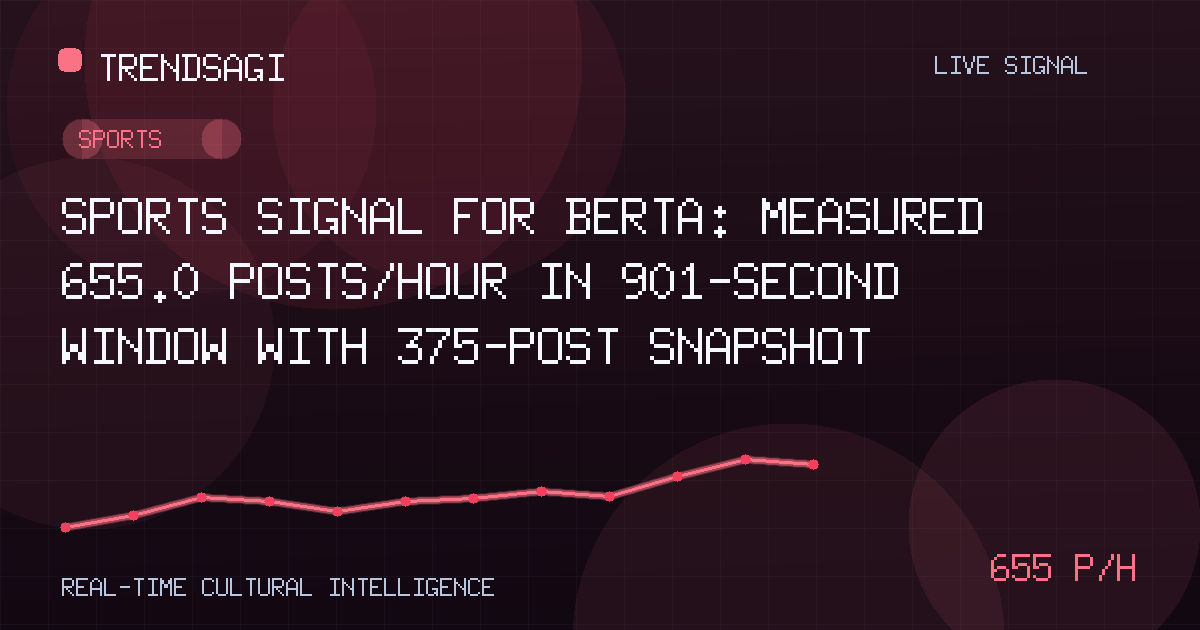
Sports signal for Berta: measured 655.0 posts/hour in 901-second window with 375-post snapshot
A sports topic label 'Berta' showed 375 posts in a snapshot and a measured 655.0 posts/hour rate over 901 seconds; cause remains unverified.
Automated briefing. Generated from stored signal measurements and source-backed research; it is not manually reviewed. Read the methodology and limitations.
Metrics in this briefing are a snapshot associated with its publication date and may not reflect current conditions.
What changed
The observed change is a short-window surge in posts tied to the stored topic label "Berta" in a stored Sports category. The stored record holds a snapshot volume of 375 posts and a measured change rate of 655.0 posts/hour, calculated from three stored observations over an exact 901-second window ending at 2026-09-02T09:48:18Z. In practical terms, the signal is best read as a temporary increase in posting velocity around that timestamp, not as a confirmed live trend, a forecast, an engagement score, or a count of unique people.
| Observation time | 2026-09-02T09:48:18Z |
|---|---|
| Measured posts/hour | 655.0 |
| Snapshot volume | 375 posts |
| Observation basis | 3 stored observations over 901 seconds |
Why this topic may be moving
The stored signal does not include a description, so the cause is still unclear. The only reliable contextual clue is the stored category, Sports, which suggests the label may be connected to an athlete, club, match, injury, transfer, fan reaction, or local sports event. However, without verified public reporting, it would be unsafe to assign a specific cause.
"Berta" can appear in sports coverage in several ways: a player's name or nickname, a team-related figure, a social media handle, a local reference, or a misclassified label. A short 901-second window is also sensitive to bursty behavior: one match moment, a viral quote, a line-of-sport update, or a small coordinated discussion can raise the measured rate without indicating a long-term trend.
A measured posts-per-hour value describes posting velocity in a narrow observed window; it does not by itself identify why the conversation started, who is driving it, or whether it will persist.
Because the topic label is sparse, the editorial judgment is to treat the signal as a detection flag rather than a conclusion. The safest interpretation is: something associated with "Berta" in a sports context generated a visible increase in posting activity around the observation time.
What the signal can and cannot establish
The signal can establish a few things:
- A snapshot volume of 375 posts was stored at the observation time.
- A measured rate of 655.0 posts/hour was calculated from the stored observations.
- The calculation window was 901 seconds, and the measurement was made at 2026-09-02T09:48:18Z.
- The stored category is Sports, which helps narrow but does not confirm the subject.
The signal cannot establish:
- Whether "Berta" refers to a specific person, team, place, product, or event.
- Whether the 375 posts represent unique users, repeated posts, bots, duplicates, or a mix.
- Whether the rate is current, accelerating, decaying, or already over.
- Whether the activity is organic, promotional, algorithmic, or misclassified.
- Which league, country, or sport is involved.
That distinction matters. A posts-per-hour number is useful for spotting short-lived movement, but it is not evidence of reach, sentiment, credibility, or future importance.
Why it matters
For sports editors, this kind of signal is useful as an early-warning metric. If a name or label appears in a sports bucket and the posting rate rises sharply, it may merit a quick check for a match incident, roster change, injury report, transfer window, disciplinary news, fan reaction, or local sports controversy. The value is speed: the briefing can identify a conversation that deserves follow-up before it becomes obvious or before it disappears.
For researchers, the item is also a small case study in how weak labels behave. "Berta" is not a highly specific sports term, so the system may be grouping related posts based on keyword presence rather than a clear entity. That can produce meaningful signals, but it also creates ambiguity. The correct response is not to invent a story; it is to define the next verification steps.
For readers tracking sports coverage, the main takeaway is modest: a sports-related conversation may be moving faster than usual around the timestamp, but the public reason is not yet established by the stored signal alone.
Practical next checks
If the goal is to confirm why the topic is moving, the next checks should be narrow and source-based:
- Check the latest public sports search results for "Berta" near 2026-09-02, especially official league sites, club announcements, and credible sports outlets.
- Compare the same label across adjacent categories, such as Sports, Local, or General, to see whether the activity is concentrated in sports or being misrouted.
- Look for a matching time stamp in match schedules, injury reports, transfer windows, disciplinary lists, or fan-community posts.
- Check whether "Berta" is linked to a full name, team, city, sponsor, or event that clarifies the subject.
- Measure whether the posts-per-hour rate rises, falls, or returns to baseline over the next several observation windows.
If those checks do not identify a cause, the editorial status should remain: unverified, sports-related, short-window signal.
Concrete watch signals
- A new snapshot volume well above 375 posts in a subsequent window.
- A sustained measured rate above 655.0 posts/hour for more than one short window.
- Appearance of the same label in official sports announcements or multiple independent outlets.
- A clear entity match, such as a full athlete name, club, league, or location.
- Shift from Sports to another category, which would suggest the label is broader than the stored category.
- Emergence of named opponents, teams, venues, or match events connected to the label.
These signals would move the item from "possible short burst" to "confirmable sports story" only if the public evidence lines up with the stored timing and category.
Methodology and limitations
The figures in this briefing come from a stored signal. The snapshot volume is 375 posts at the stated observation time. The measured change rate is 655.0 posts/hour, derived from three stored observations over an exact 901-second window and measured at 2026-09-02T09:48:18Z. The rate is a snapshot-based measurement, not a live rate, forecast, reach metric, engagement metric, or unique-person count.
The main limitation is the lack of a stored signal description. The topic label is also short and potentially ambiguous. Because the category is Sports, the briefing frames the signal in that context, but it does not assert that the subject is a known athlete or event. External facts are omitted unless they can be verified, and no specific public cause is claimed here.
The practical reading is therefore conservative: there was a measurable short-window increase in posts associated with "Berta" in a Sports bucket, and the next step is verification, not speculation.
Track This Topic for New Signals
Set alerts for future velocity or sentiment changes around this topic.
Explore Tracking PlansAbout TrendsAGI research
TrendsAGI's automated research pipeline publishes dated signal snapshots, methodology notes, and practical workflows for teams evaluating cultural momentum. Read how signals are scoped, scored, and limited in our research methodology.


