911-second window · 3 observations · Measured Oct 1, 2026, 8:40 PM UTC · Provider: go_recent_snapshot_v2
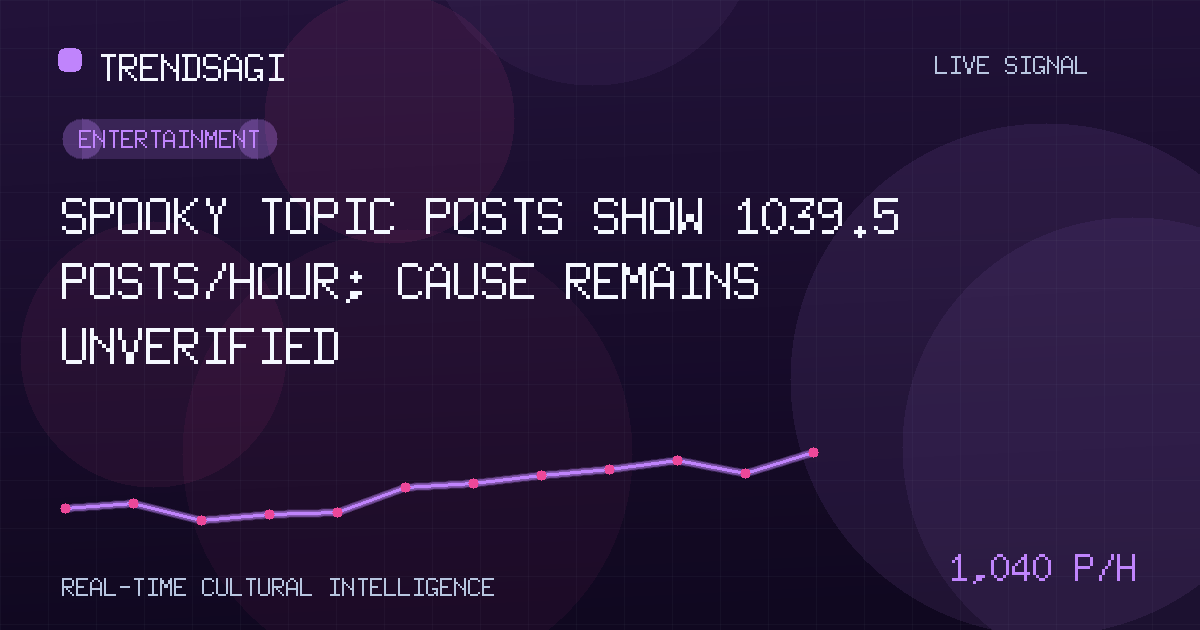
Spooky topic posts show 1039.5 posts/hour; cause remains unverified
The stored Spooky signal recorded 1674 posts and a measured 1039.5 posts/hour over 911 seconds, but no verified driver.
Automated briefing. Generated from stored signal measurements and source-backed research; it is not manually reviewed. Read the methodology and limitations.
Metrics in this briefing are a snapshot associated with its publication date and may not reflect current conditions.
What changed
The stored signal shows increased posting activity around the Spooky topic, but it does not establish why it is moving. The latest snapshot contains 1674 posts. The measured snapshot rate is 1039.5 posts/hour over an exact 911-second window using 3 stored observations, measured at 2026-10-01T20:40:28Z. The defensible conclusion is narrow: movement is measurable, while the cause is unverified.
| Observation time | Measured posts/hour | Snapshot volume |
|---|---|---|
| 2026-10-01T20:40:28Z | 1039.5 posts/hour | 1674 posts |
The posts/hour figure is a measured snapshot rate, not a live or current rate, forecast, reach, engagement, or unique-person count. The 1674 figure is snapshot volume, meaning the posts in the stored observation, not a rate. Keeping those measures separate prevents a concentrated change from being presented as audience size or impact.
Why this topic may be moving
The stored category is Entertainment, but the signal description is empty, and the supplied record contains no verified public context linking the increase to a named event. The cause is therefore unclear. It would be premature to credit a seasonal occasion, entertainment release, celebrity item, controversy, or platform change without evidence tied to the observed period.
Several mechanisms could produce this pattern. These are hypotheses to test, not findings:
- Event linkage. A verified announcement or occurrence could explain a rapid cluster, but no such link is established here.
- Cross-topic ignition. Interest may have started elsewhere and migrated into the Spooky label rather than originating there.
- Amplification. A campaign, publisher, creator, or prominent account may be driving repeated discussion; source concentration is unknown.
- Label effects. Broad usage, slang, reactions, or duplicate or reposted material may inflate apparent topic activity without a single cultural event.
A measured posting rate can justify investigation, but it cannot name the event, audience, or intent behind the posts. Until those are verified, increased activity and a verified cause are separate editorial claims.
What the signal can establish
At face value, this is a useful alert for further review. It confirms the recorded change rate, the size of the latest post snapshot, and the time at which the measurement was made. Together, those fields show where investigation should begin. They do not show who participated, whether people were distinct, whether the posts were original, or whether any response was favorable.
- Use it to trigger verification. The topic merits attention because a distinct measured rate was recorded.
- Use it to prioritize sampling. Reviewing the actual posts can reveal whether the label reflects one subject or several unrelated uses.
- Do not use it as a demand proxy. Posting volume alone does not demonstrate audience demand, commercial interest, or reach.
Why it matters
Editors, social producers, and audience researchers should care about the distinction between a fast-moving signal and an explained event. The first can shape monitoring and verification work. The second can support a specific story. For entertainment teams, an unexplained cluster may indicate a timely conversation worth reviewing, but it is not yet evidence of a broader cultural shift.
- Entertainment editors can inspect whether the discussion maps to a verifiable story.
- Social and newsroom teams can avoid repeating an unverified origin claim while checking the cluster.
- Audience teams can wait for evidence of breadth, persistence, and source diversity before changing plans.
What to watch next
The next useful step is a sequence of checks that can confirm or weaken the signal:
- Check persistence. Compare subsequent stored observations over equivalent windows. A brief cluster that quickly recedes is weaker evidence of sustained interest than continued elevated activity.
- Audit the posts themselves. Sample the counted items and classify their meanings, formats, sources, and any duplicated wording. This tests whether Spooky is a coherent topic or a loose label match.
- Measure source breadth. Determine whether activity comes from many independent accounts or a small set repeatedly publishing. Account counts must not be described as unique people unless identity and duplication controls support that conclusion.
- Locate a verified trigger. Check public context tied closely to the observation time for a named announcement, release, broadcast, campaign, or other event. Attribute a driver only when a publisher verifies it.
- Separate volume from response. Review interactions only if the underlying data supplies them. A high post count does not show that readers watched, clicked, agreed, or acted.
- Watch for narrative convergence. If sampled posts repeatedly reference the same subject, the topic becomes easier to explain; if references diverge, treat the aggregate as a broad label effect.
Methodology and limitations
The reported rate comes directly from the supplied measurement: 1039.5 posts/hour across an exact 911-second window using 3 stored observations, measured at 2026-10-01T20:40:28Z. It is not recalculated or projected here. Snapshot volume is reported separately as 1674 posts.
The record does not provide a comparison baseline, calculation formula, platform mix, geography, language balance, account uniqueness, engagement, or a content sample. Those omissions prevent assessment of representativeness and causal attribution. The topic label and stored category organize the count, but they do not verify the meaning of each post.
Accordingly, this should be reported as increased posting activity of unknown cause. The next evidence needed is a representative post sample, comparable follow-up observations, and verified public context connected to the measured window.
Track This Topic for New Signals
Set alerts for future velocity or sentiment changes around this topic.
Explore Tracking PlansAbout TrendsAGI research
TrendsAGI's automated research pipeline publishes dated signal snapshots, methodology notes, and practical workflows for teams evaluating cultural momentum. Read how signals are scoped, scored, and limited in our research methodology.