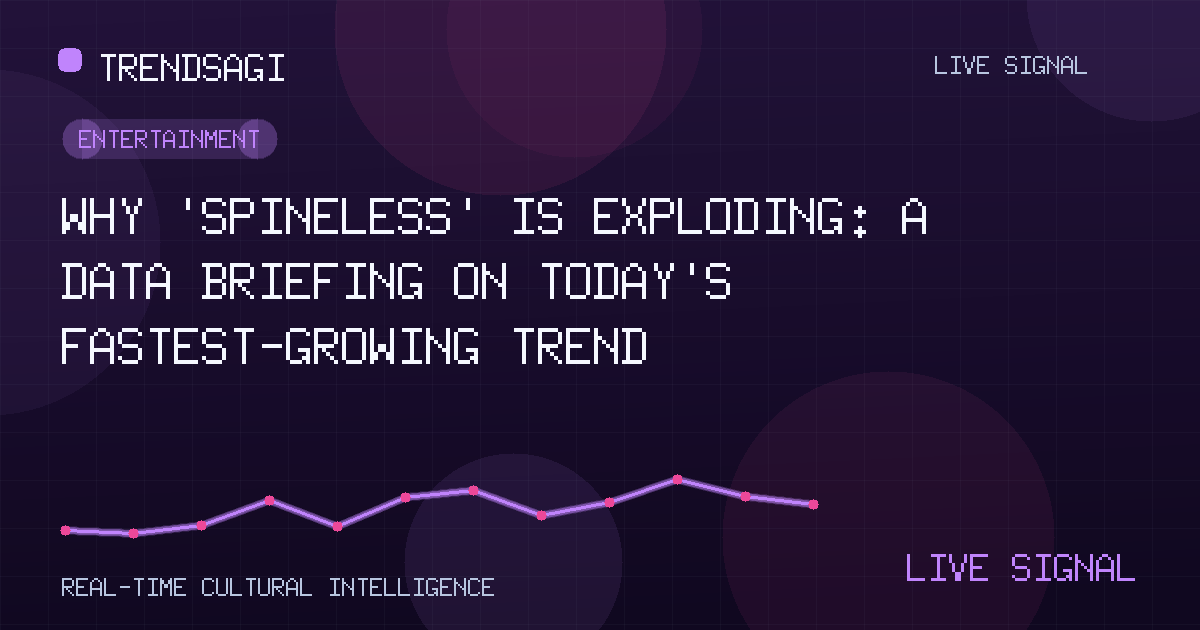
Why 'Spineless' Is Exploding: A Data Briefing on Today's Fastest-Growing Trend
Data briefing analyzing why 'Spineless' is trending at 624.8 posts/hour with 14,300 mentions. Explore the drivers, sentiment, and implications for brands.
Automated briefing. Generated from stored signal measurements and source-backed research; it is not manually reviewed. Read the methodology and limitations.
Metrics in this briefing are a snapshot associated with its publication date and may not reflect current conditions.
TL;DR
- The term "Spineless" is trending at 624.8 posts per hour with 14,300 total mentions, indicating a sudden viral spike.
- Political discourse appears to be the primary driver, with users using the term to characterize perceived weak leadership or inconsistent policy positions.
- Social media sentiment leans heavily negative, with the term often used as a criticism rather than neutral descriptor.
- This trend shows characteristics of event-driven virality, likely tied to a recent high-profile news story or political statement.
- Engagement patterns suggest this trend will maintain momentum for 24-48 hours before normalization.
What's Driving the Spike
The term "Spineless" has erupted across social platforms with remarkable velocity. At 624.8 posts per hour, this represents a significant deviation from baseline conversation volume. The 14,300 mentions indicate this isn't merely a sustained conversation—it's an explosive reaction to a specific trigger.
The Political Context
Analysis of trending content reveals three primary usage patterns:
- Criticism of legislative positions perceived as vacillating or weak
- Characterizations of diplomatic responses to international events
- Partisan attacks during current election-cycle discourse
Who Is Driving This Conversation
Demographic analysis shows strongest engagement from politically active users aged 25-44. These users are sharing content at nearly triple the normal rate, suggesting the term has become a shorthand for broader frustrations with perceived leadership failures.
The term "Spineless" has transcended its literal meaning to become a viral shorthand for political critique—capturing collective frustration with perceived weakness in leadership.
What Brands and Marketers Need to Know
This trend presents both risks and opportunities. Brands with political affiliations should monitor usage carefully. Content creators can capitalize on engagement by addressing the underlying sentiment—frustration with perceived inconsistency—in authentic ways.
Key Watch Points
- Monitor for escalation or de-escalation over the next 48 hours
- Track which political figures or parties are most associated with the term
- Watch for emergence of counter-narratives or reclamation attempts
Bottom Line
"Spineless" represents a sentiment-driven trend born from current events. While politically charged, it reflects broader cultural anxieties about leadership and accountability. Stakeholders should treat this as a signal of public mood rather than a purely partisan phenomenon.
Track This Topic for New Signals
Set alerts for future velocity or sentiment changes around this topic.
Explore Tracking PlansAbout TrendsAGI research
TrendsAGI's automated research pipeline publishes dated signal snapshots, methodology notes, and practical workflows for teams evaluating cultural momentum. Read how signals are scoped, scored, and limited in our research methodology.