1809-second window · 2 observations · Measured Sep 27, 2026, 6:55 PM UTC · Provider: go_recent_snapshot_v2
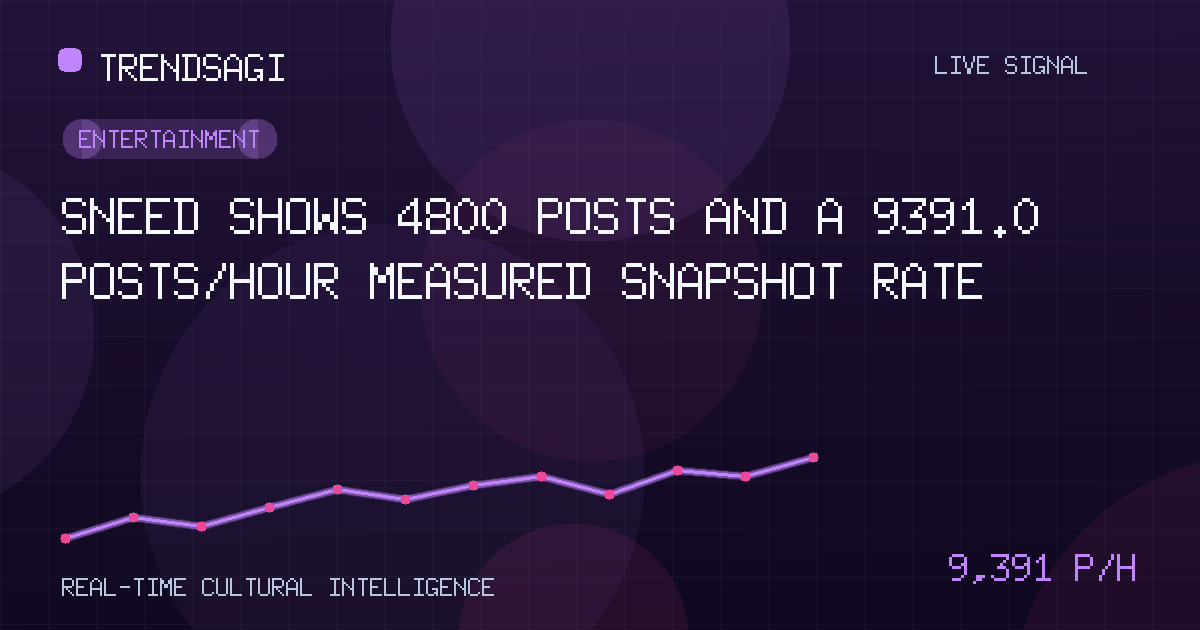
Sneed shows 4800 posts and a 9391.0 posts/hour measured snapshot rate
“Sneed” shows 4800 posts in the latest snapshot and a 9391.0 posts/hour measured snapshot rate; the cause remains unverified.
Automated briefing. Generated from stored signal measurements and source-backed research; it is not manually reviewed. Read the methodology and limitations.
Metrics in this briefing are a snapshot associated with its publication date and may not reflect current conditions.
What changed
“Sneed” is moving in the stored signal, but the reason has not been verified. The latest snapshot contains 4800 posts, while the separate change calculation reports a measured snapshot rate of 9391.0 posts/hour. The practical conclusion is narrow: “Sneed” merits immediate identity checking, but the signal does not establish who or what the label denotes.
The 9391.0 posts/hour figure was measured at 2026-09-27T18:55:21Z over an exact 1809-second window using 2 stored observations. It is a measured snapshot rate—not a live or current rate, forecast, reach, engagement figure, or count of unique people. The 4800 figure is the volume in the latest snapshot, not an hourly rate. With no comparison baseline, the available data cannot establish percentage growth, how long the activity has lasted, or what caused it.
| Observation time | 2026-09-27T18:55:21Z |
|---|---|
| Measured snapshot rate | 9391.0 posts/hour |
| Latest snapshot volume | 4800 posts |
| Measurement window | 1809 seconds |
| Stored observations used | 2 |
Why this topic may be moving
The stored signal includes no attributable public context that verifies why the increase is happening, so the cause remains unclear. A single surname-like label can point to different people, works, places, phrases, or unrelated uses. Even the stored “Entertainment” category is only a classification; it does not prove that the posts concern a particular release, performance, character, or event.
Several explanations are possible, but none is a finding:
- Entity collision: posts may use the same short label for entirely different subjects.
- Context compression: users may discuss a larger story while posting only the label, leaving the trigger invisible in the count.
- Repetition or duplication: repeated or copied posts may amplify volume without showing the same level of independent interest.
- A possible news or entertainment trigger: an announcement, appearance, controversy, or release could be driving discussion, but no such trigger has been verified here.
Until one of these explanations is substantiated, the defensible statement is that posting around an ambiguous label changed during the measured window—not that a specific person or event is trending.
The signal establishes that posting around an ambiguous label changed during a measured window. It does not yet establish a shared identity, a trigger, or a continuing trend.
Why it matters
The signal is useful as an alert even without a narrative. It tells editors that the label has a measured change worth checking while withholding the context needed to explain it. That makes this a verification task, not yet a publishable causal claim.
- For entertainment editors: resolve the subject and timing before naming people, works, or events in a headline.
- For trend analysts: use 9391.0 posts/hour as a trigger for another like-for-like collection, but do not infer persistence from 2 observations.
- For social and community teams: inspect surrounding language for entity collisions, copied text, or an identifiable story.
- For communications teams and readers: remember that 4800 posts does not establish importance, authenticity, sentiment, or audience size.
What to watch next
The next checks should either turn the ambiguous count into a defensible finding or show that it should be discarded. For public context, use Google Search to test whether results around the observation timestamp converge on the same subject rather than assuming the label is self-explanatory.
- Resolve the identity: Search the exact label and inspect results around the observation date. Determine whether publishers and posts refer to the same person, work, place, or event. If they do not converge, the label remains unresolved.
- Find the trigger: Look for a contemporaneous, attributable item that explicitly connects the label to an announcement, appearance, release, controversy, or other event. Do not infer a trigger merely from posting volume.
- Check alternative identifiers: Compare spelling, initials, handles, aliases, and titles found in matching posts. Any identity expansion should remain consistent across sources rather than being selected merely because it is convenient.
- Test persistence: Take a later observation using the same collection method. Compare whether the measured rate remains near the 9391.0 posts/hour reference, falls, or rebounds. A later observation would not turn the original figure into a live rate.
- Audit volume quality: Establish how posts were counted and whether repeated or copied content was included. If deduplicated figures become available, report them separately; do not reinterpret 4800 as unique people.
- Require corroboration: Seek several timestamped references naming both the same subject and the same event. Attributable publisher or first-party context should align with them before the movement receives a named explanation.
Concrete positive watch signals would be consistent identity expansion, a verified trigger, sustained activity in a later measurement window, and stable collection rules. Concrete warning signals would be conflicting identities, copied text, unrelated search results, or a sharp reversal after the observed window.
Methodology and limitations
This briefing uses the supplied observation and rate without recalculation. The rate reflects change between 2 stored observations across the stated 1809-second window and was measured at 2026-09-27T18:55:21Z. The table keeps snapshot volume separate from the rate because they represent different measures. The observation time marks the snapshot; it does not identify when the activity began.
No external cause is asserted because no attributable explanation has been verified. The main limitations are entity ambiguity, only 2 observations, no comparison baseline, and unspecified collection rules. The signal cannot establish which subject was discussed, whether the activity was organic, how many people participated, what sentiment dominated, or whether momentum continued. The defensible editorial status is therefore an unexplained measured spike pending identity resolution and a later like-for-like observation.
Track This Topic for New Signals
Set alerts for future velocity or sentiment changes around this topic.
Explore Tracking PlansAbout TrendsAGI research
TrendsAGI's automated research pipeline publishes dated signal snapshots, methodology notes, and practical workflows for teams evaluating cultural momentum. Read how signals are scoped, scored, and limited in our research methodology.