914-second window · 3 observations · Measured Oct 7, 2026, 5:12 PM UTC · Provider: go_recent_snapshot_v2
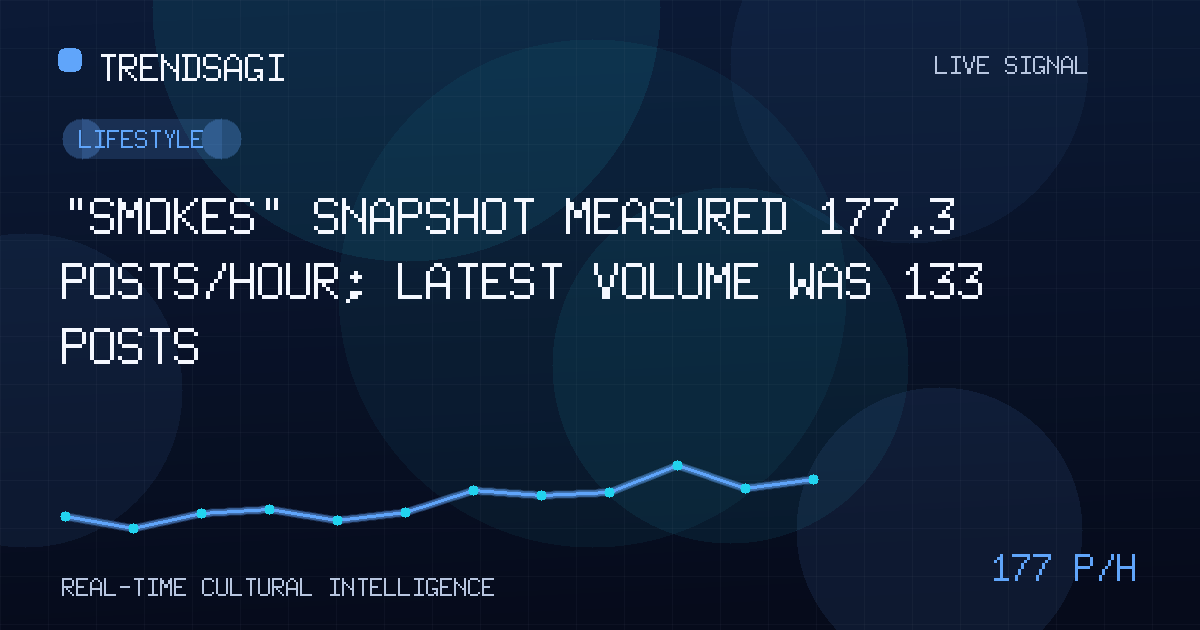
“Smokes” snapshot measured 177.3 posts/hour; latest volume was 133 posts
The stored “Smokes” signal measured 177.3 posts/hour over 914 seconds; this briefing separates recorded activity from unresolved causes.
Automated briefing. Generated from stored signal measurements and source-backed research; it is not manually reviewed. Read the methodology and limitations.
Metrics in this briefing are a snapshot associated with its publication date and may not reflect current conditions.
What changed
The stored Lifestyle-category signal labeled “Smokes” recorded a measured snapshot rate of 177.3 posts/hour over an exact 914-second window, using 3 stored observations and ending at 2026-10-07T17:12:03Z. The direct conclusion is narrow: posting activity was captured under this label at that measured snapshot rate, but the stored record does not identify the subject or establish a cause.
The latest snapshot contained 133 posts. That figure is snapshot volume—not a rate, reach, engagement total, or unique-person count. The reason for the movement remains unclear because the signal has no stored description and no verified public context is attached. “Smokes” is an observed label, not yet a validated account of a broader social trend.
| Metric | Recorded value |
|---|---|
| Snapshot observation time | 2026-10-07T17:12:03Z |
| Measured snapshot rate | 177.3 posts/hour |
| Measurement basis | Exact 914-second window; 3 stored observations |
| Latest snapshot volume | 133 posts |
Interpretation: The 177.3 figure is a measured snapshot rate for the supplied window. It is not a live rate, forecast, or measure of the topic’s normal baseline.
Why this topic may be moving
No causal catalyst can be verified from the canonical record alone. The label does not define its referent: posts may concern literal smoking, a name, an expression, or another subject. Without representative text and verified reporting tied to the observation time, assigning the activity to health news, policy, entertainment, or any other event would be speculation.
A sensible verification pass starts with exact-label Google searches around 2026-10-07T17:12:03Z and then examines representative posts to identify the dominant referent. If a candidate event emerges, its timing and meaning should be confirmed through a primary announcement or reputable publisher. Search visibility alone would not establish that the event caused the posting cluster.
Other explanations also require evidence. The cluster could reflect a scheduled conversation, a reaction to breaking news, ordinary use of an ambiguous word, or repetitive or automated posting. These are hypotheses, not findings. The current record cannot distinguish among them.
What the signal can—and cannot—establish
The signal establishes that posts were captured under the stored label, the record has a precise observation time, and the supplied sample produced a measured snapshot rate. Those facts justify a verification pass, but they do not supply a story by themselves.
- Relative scale: Without a baseline, 177.3 posts/hour cannot be described as above or below normal activity for this label.
- Cause: The rate shows that posting occurred, but it does not reveal whether a news event, scheduled activity, or repeated content produced it.
- Audience: The 133-post snapshot is not a unique-person count and does not establish reach, engagement, or public attention.
- Persistence: A short measurement window cannot show whether the activity continued, accelerated, or quickly subsided.
- Meaning and provenance: The record does not resolve the label’s semantics, platform, geography, sentiment, account quality, or possible coordination.
The strongest defensible conclusion is not that “Smokes” has become broadly important, but that the stored sample recorded repeated activity under an ambiguous label at a specific moment. The next editorial task is to determine what those posts were about and whether the same pattern persists.
Why it matters
For news and lifestyle editors, this is a triage signal rather than a publishing assignment. The fastest responsible response is to inspect the underlying posts, identify what they actually discuss, and seek a credible explanation before presenting the label as a trend.
- Public-health and policy teams should treat the signal as relevant only if post-level review confirms that the discussion concerns smoking, health, or a related policy matter.
- Community and platform-trust teams should check for duplicated phrasing, repetitive account behavior, or coordinated posting before interpreting volume as organic interest.
- Trend and communications analysts should compare the observation with a stable historical baseline and consistent collection rules before estimating significance.
What to watch next
- Resolve the meaning. Review the raw post text, named entities, links, and dominant uses. Determine whether “Smokes” refers to one subject or combines unrelated conversations.
- Check persistence. Collect later observations using the same label, platform, and cadence. Compare subsequent measured snapshot rates with 177.3 posts/hour and later snapshot volumes with 133 posts.
- Measure breadth and authenticity. Look at the mix of distinct accounts, sources, and posting patterns. Repeated content from a narrow account base would have a different meaning from broad, independently authored discussion.
- Verify an external catalyst. Use exact-label Google searches around the observation time, then check whether a credible source actually connects the event or phrase to the sampled posts.
- Establish a baseline. Compare the signal with earlier windows collected under equivalent rules. Without that comparison, “rising,” “unusual,” and “breakout” remain unsupported descriptions.
- Apply a decision rule. Escalate the signal only when post meaning, temporal persistence, and credible external context converge. If the label remains semantically mixed or activity is driven by repetition, retain it as an unresolved monitoring signal.
Methodology and limitations
The measured snapshot rate is taken directly from the canonical record as 177.3 posts/hour, based on an exact 914-second window and 3 stored observations. It was not recalculated or extended into a live estimate. The latest snapshot volume is separately reported as 133 posts; the two figures answer different questions and should not be combined as though they measure the same thing.
The record does not provide raw posts, the collection query, platform, geography, historical baseline, account-level deduplication, sentiment, or engagement data. It therefore cannot establish total conversation volume, unique participants, authenticity, or a sustained trajectory. No public catalyst is asserted because the cause could not be verified from the available context.
Track This Topic for New Signals
Set alerts for future velocity or sentiment changes around this topic.
Explore Tracking PlansAbout TrendsAGI research
TrendsAGI's automated research pipeline publishes dated signal snapshots, methodology notes, and practical workflows for teams evaluating cultural momentum. Read how signals are scoped, scored, and limited in our research methodology.