803-second window · 3 observations · Measured Oct 4, 2026, 9:53 PM UTC · Provider: go_recent_snapshot_v2
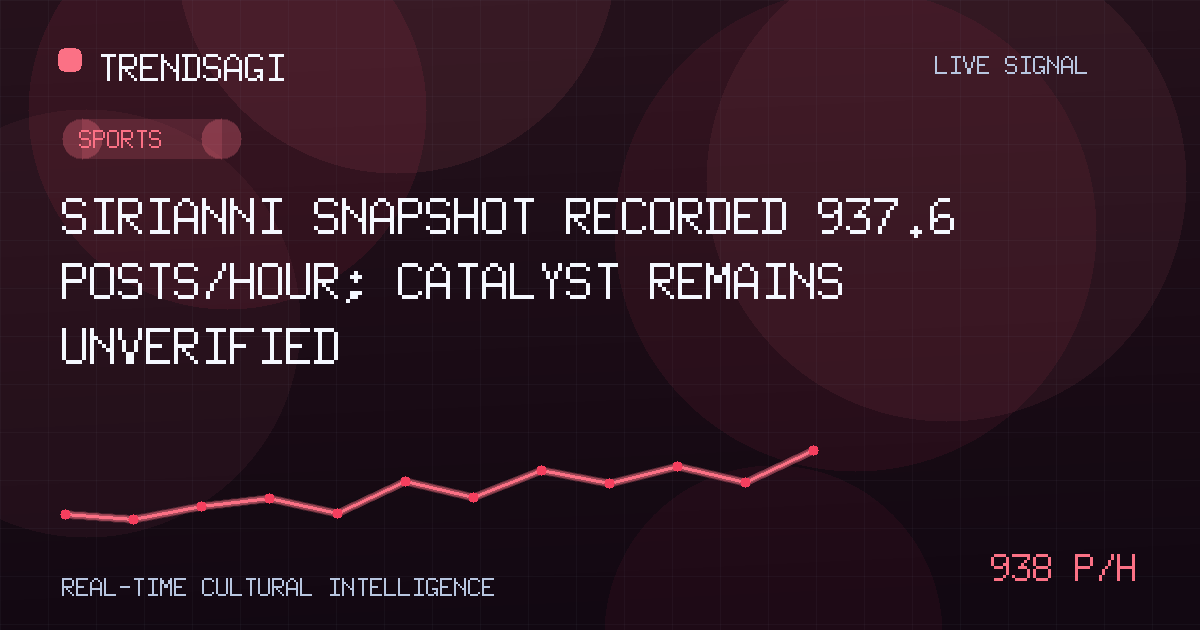
Sirianni snapshot recorded 937.6 posts/hour; catalyst remains unverified
Sirianni registered a measured 937.6 posts/hour in the latest snapshot; the cause is unverified, and these checks help editors verify it.
Automated briefing. Generated from stored signal measurements and source-backed research; it is not manually reviewed. Read the methodology and limitations.
Metrics in this briefing are a snapshot associated with its publication date and may not reflect current conditions.
What changed
The stored signal shows a concentrated burst of Sirianni-related posting, but it does not identify which Sirianni is involved or establish a public event behind the rise. The defensible finding is fast measured activity in the Sports category, not a confirmed news trend.
The measured snapshot rate was 937.6 posts/hour over an exact 803-second window using 3 stored observations, observed at 2026-10-04T21:53:53Z. This is a retrospective snapshot measure, not a live rate, forecast, reach, engagement figure, or unique-person count. The separate latest snapshot volume was 620 posts.
| Measure | Value |
|---|---|
| Observation time | 2026-10-04T21:53:53Z |
| Measured snapshot rate | 937.6 posts/hour over an exact 803-second window using 3 stored observations |
| Latest snapshot volume | 620 posts |
Why this topic may be moving
No verified public catalyst is established in the stored record, and the signal has no description naming a person, team, competition, or location. “Sports” supplies broad context only. It is therefore unsafe to attribute the rise to a match result, roster move, controversy, or viral clip without further evidence.
- Identity is unresolved. The surname alone may not distinguish the intended person from unrelated people or entities, so aggregation can combine separate conversations.
- A timely post may be the focal point. A result, announcement, clip, or mistake could direct traffic toward the label, but none is verified here.
- Amplification may be distorting the volume. Reposts, duplicated text, automated activity, or a highly followed account can raise post count faster than distinct discussion.
- The window is brief. The 803-second interval is useful for detecting speed, but it cannot show whether attention persists, repeats, or quickly fades.
These are hypotheses to test, not established explanations. A reliable attribution would require the full identity of the relevant Sirianni, a dated development, and credible confirmation that the activity began around the measured window.
A high posts-per-hour figure establishes the speed of accumulation in one observed window; it does not identify the event, audience size, consensus, or importance of the discussion.
Why it matters
The immediate value is triage: the signal tells monitoring teams where to look, not what happened. That distinction matters because a fast keyword burst can prompt a headline before the underlying subject is even known.
- Sports desks and editors should verify the named subject, event, and timing before reporting a breaking development or presenting the label as a broader public trend.
- Clubs, athletes, teams, or other named parties should check whether the conversation refers to them, whether claims are accurate, and whether a correction is needed.
- Audience and reputation teams should distinguish substantive reactions from copied posts, coordinated promotion, identity confusion, or unsupported allegations.
Readers also need caution. A high posting rate signals intense activity in one observed window, but it does not show consensus, importance, sentiment, or whether the underlying claim is true.
What to watch next
The next useful step is to turn the label into a verifiable event trail, then test whether public reporting and new observations align with it.
- Resolve the referent. Review representative posts for full names, teams, roles, competition names, locations, and cited sources. Remove conversations that only share the surname.
- Reconstruct timing. Compare the earliest relevant posts with the start of the measured window and the 2026-10-04T21:53:53Z observation. Check whether reporting follows the social burst or precedes it.
- Verify a catalyst. Seek confirmation from a directly relevant official party or established publisher. A social post may identify a claim, but it does not authenticate that claim.
- Inspect the content mix. Separate original reporting, reactions, reposts, clips, jokes, and identity-confusion posts. This shows what is driving volume and whether the conversation is coherent.
- Check propagation. Look for repeated wording, common source accounts, sudden account bursts, or unrelated posts converging on the same label. Repetition should not automatically be counted as independent attention.
- Test persistence. Add later stored observations using the same counting method. Determine whether activity remains elevated, declines, splits into subtopics, or resolves after an authoritative update.
Concrete watch signals
- A full name and context become consistent across credible posts.
- A dated official update aligns with the start of the burst.
- Independent reporting confirms the same event rather than repeating one post.
- Later snapshots show continuing activity rather than only copied content.
- A correction or clarification changes the dominant interpretation.
Until those signals appear, the useful conclusion is the measured pace and the uncertainty—not an assumed explanation.
Methodology and limitations
This briefing uses the stored snapshot at 2026-10-04T21:53:53Z, its reported volume of 620 posts, and the supplied measured rate of 937.6 posts/hour across 803 seconds and 3 observations. The rate is reported exactly as provided. Snapshot volume and measured rate answer different questions and should not be substituted for one another.
The signal cannot reveal who posted, whether people were unique, how sentiment split, where activity occurred, which language dominated, or whether an item was organic. It also provides no baseline from earlier periods, so the data establishes a rapid change within the measured window but not its historical scale. No external fact is used to name a catalyst because a public explanation was not verified.
The cause of the Sirianni burst therefore remains unclear. The supportable conclusion is a fast, short-window posting spike requiring identity and source verification.
Track This Topic for New Signals
Set alerts for future velocity or sentiment changes around this topic.
Explore Tracking PlansAbout TrendsAGI research
TrendsAGI's automated research pipeline publishes dated signal snapshots, methodology notes, and practical workflows for teams evaluating cultural momentum. Read how signals are scoped, scored, and limited in our research methodology.