914-second window · 3 observations · Measured Sep 1, 2026, 4:07 PM UTC · Provider: go_recent_snapshot_v2
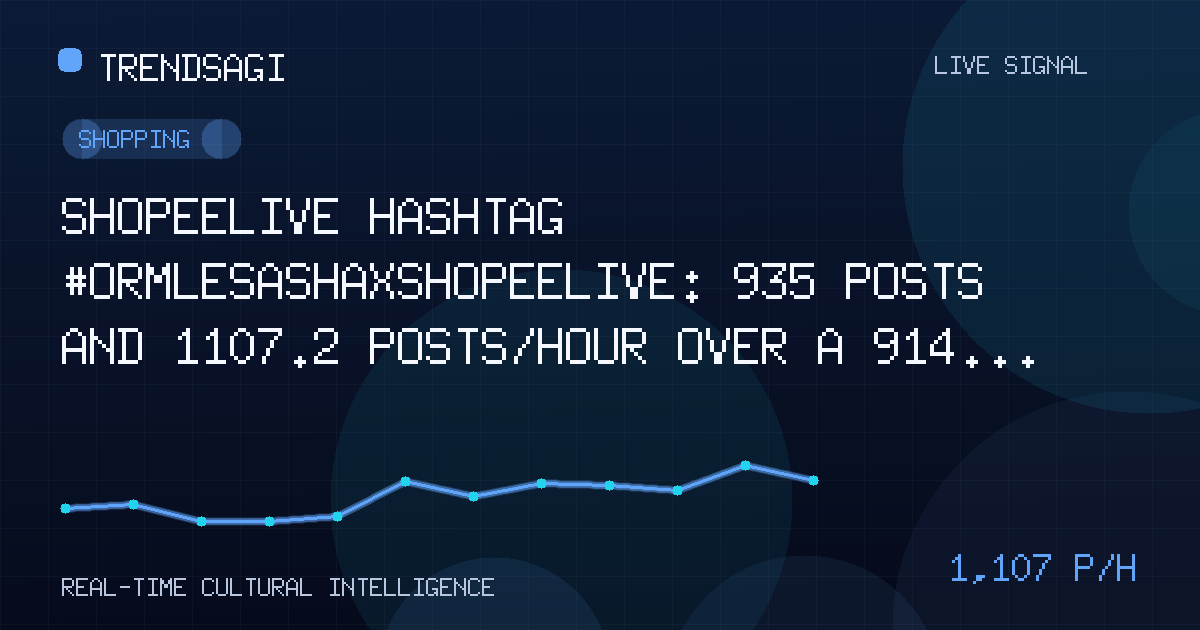
ShopeeLive hashtag #OrmLESASHAXShopeeLive: 935 posts and 1107.2 posts/hour over a 914-second snapshot
ShopeeLive hashtag #OrmLESASHAXShopeeLive logged 935 posts and 1107.2 posts/hour over 914 seconds; cause remains unverified.
Automated briefing. Generated from stored signal measurements and source-backed research; it is not manually reviewed. Read the methodology and limitations.
Metrics in this briefing are a snapshot associated with its publication date and may not reflect current conditions.
What changed
The ShopeeLive shopping hashtag #OrmLESASHAXShopeeLive shows a compact burst of measured activity. The stored signal records a snapshot volume of 935 posts and a measured snapshot rate of 1107.2 posts per hour, calculated over an exact 914-second window and observed at 2026-09-01T16:07:16Z. The important qualifier is the word measured: this is a snapshot rate derived from stored observations, not a live current rate, a forecast, an engagement metric, or a count of unique people.
| Observation time | 2026-09-01T16:07:16Z |
| Measured posts/hour | 1107.2 |
| Snapshot volume | 935 posts |
Why this topic may be moving
The hashtag points to a live shopping context, and the stored category reinforces that reading. The ShopeeLive element suggests a live streaming, seller showcase, limited-time offer, host interaction, or campaign hashtag used to encourage viewers to post, tag, or join a promotion. The unusual token in the hashtag suggests it may be a campaign-specific identifier rather than a generic brand tag.
However, the stored signal alone does not establish why the volume moved. A verified public cause would require checking whether a specific Shopee Live session, seller promotion, celebrity or creator event, regional campaign, or platform incentive was active at the same time. Without that context, the spike could reflect a normal promotional moment, a user-generated contest, an automated posting pattern, a data anomaly, or a brief surge tied to one live stream.
A short shopping-hashtag spike is best treated as a prompt to verify, not as proof of cause. The most important distinction is between observed posting volume and verified campaign activity.
Why it matters
For commerce and brand teams, a measured snapshot rate of 1107.2 posts per hour in a shopping hashtag is a useful early signal that a live shopping moment may be generating visible participation. It can prompt a quick operational check: Is a broadcast running? Are offers visible? Are customer questions or complaints appearing? Is the hashtag being used correctly, or is it being spammed, misused, or tied to a misleading claim?
For analysts, the value is not in the single number alone but in the pattern. A 935-post snapshot can be meaningful if it arrives at a campaign start, a host announcement, a price drop, or a challenge prompt. It can also be misleading if it is produced by automated accounts, a broken repost loop, or a temporary platform issue. The category and hashtag make shopping relevant, but the observed rate does not prove demand, revenue, conversion, or audience satisfaction.
Who should care
Retail and e-commerce operators should care because a live shopping burst can reveal whether a promotion is being noticed and whether the execution needs support. Brand and creator teams should care because a hashtag tied to a person or campaign can quickly turn into a reputation issue if the volume is driven by spam or misinformation. Analysts and platform watchers should care because a compact spike in a shopping tag can be an early indicator of a campaign mechanic, a technical anomaly, or a change in user behavior around live commerce.
What the signal can and cannot establish
- It can establish that a stored observation captured 935 posts for the hashtag at the stated time.
- It can establish a measured snapshot rate of 1107.2 posts per hour over the stated 914-second window.
- It cannot establish a live current rate, a future trend, total reach, unique user count, purchase intent, or business impact.
- It cannot identify the cause without verified public context.
Practical next checks
- Check whether the hashtag was associated with a scheduled Shopee Live session, seller page, or campaign page during the observation window.
- Look for a host, brand, creator, or seller name in the posts to determine whether the topic is tied to one entity or many.
- Compare the burst to earlier baselines for the same hashtag or similar ShopeeLive tags to see if 1107.2 posts per hour is unusual.
- Sample a small set of posts to classify them as organic, promotional, automated, complaint-driven, or event-related.
- Review platform notices, campaign pages, or seller announcements that were publicly available at the same time, while attributing any confirmed cause to its publisher.
What to watch next
- Whether the snapshot volume continues, flattens, or decays after the observation time, which would help distinguish a one-time burst from a sustained campaign.
- Whether new posts mention a specific offer, livestream link, seller, or creator, suggesting a coordinated shopping event.
- Whether sentiment shifts toward confusion, complaints, or duplicate content, which could indicate spam, misinformation, or an operational problem.
- Whether similar ShopeeLive hashtags show comparable rates at the same time, which could point to a platform-wide event rather than one hashtag.
Methodology and limitations
The figures come from a stored signal observed at 2026-09-01T16:07:16Z. The volume figure is a snapshot volume of 935 posts. The rate figure is a measured snapshot rate of 1107.2 posts per hour, based on an exact 914-second window using 3 stored observations. That rate should not be described as a live current rate, a forecast, a reach metric, an engagement score, or a unique-person count.
The main limitation is that the stored signal does not include a verified explanation for the movement. It also does not provide author counts, geographic breakdowns, post sentiment, purchase data, or a full time series. If a public cause exists, it must be confirmed by a verifiable publisher before the briefing can attribute the movement to a specific campaign, creator, seller, or platform event.
Track This Topic for New Signals
Set alerts for future velocity or sentiment changes around this topic.
Explore Tracking PlansAbout TrendsAGI research
TrendsAGI's automated research pipeline publishes dated signal snapshots, methodology notes, and practical workflows for teams evaluating cultural momentum. Read how signals are scoped, scored, and limited in our research methodology.