902-second window · 3 observations · Measured Oct 1, 2026, 1:56 PM UTC · Provider: go_recent_snapshot_v2
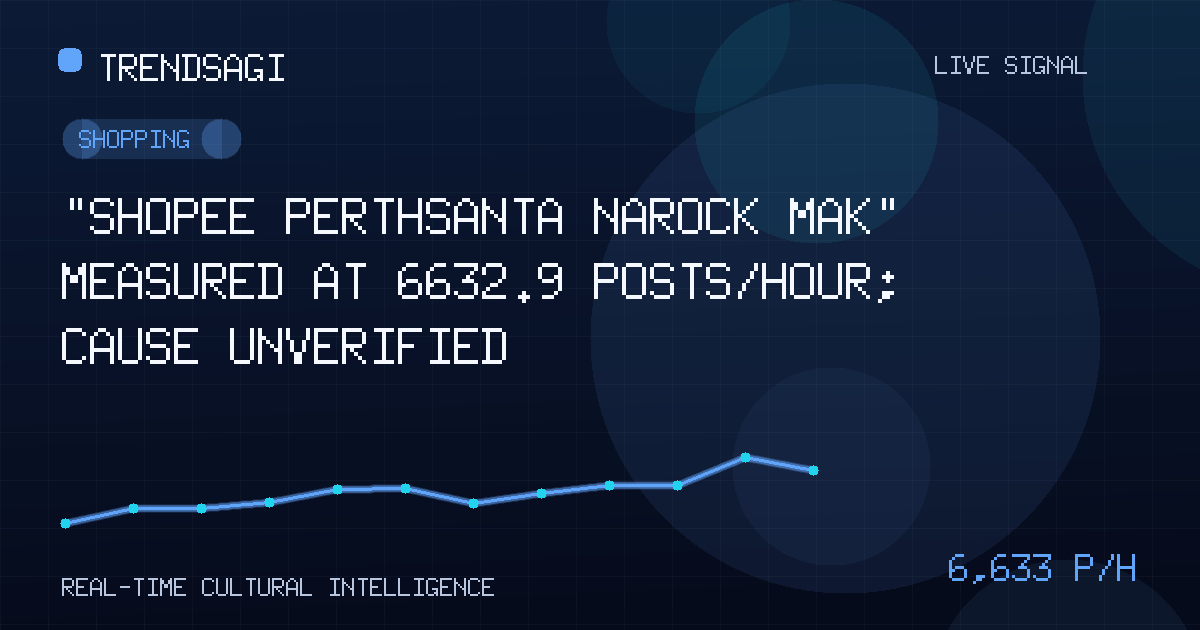
“SHOPEE PERTHSANTA NAROCK MAK” measured at 6632.9 posts/hour; cause unverified
“SHOPEE PERTHSANTA NAROCK MAK” measured 6632.9 posts/hour over 902 seconds; the latest snapshot had 7200 posts, but cause is unverified.
Automated briefing. Generated from stored signal measurements and source-backed research; it is not manually reviewed. Read the methodology and limitations.
Metrics in this briefing are a snapshot associated with its publication date and may not reflect current conditions.
What changed
The stored Shopping signal labeled “SHOPEE PERTHSANTA NAROCK MAK” recorded a measured snapshot rate of 6632.9 posts/hour across an exact 902-second window using 3 stored observations. The latest snapshot was observed at 2026-10-01T13:56:32Z and contained 7200 posts.
The direct answer is that the sampled conversation was moving rapidly at that recorded moment, but the reason is not established. No verified public context in the available record ties this exact label to a Shopee campaign, platform incident, location, announcement, or user action. The rate supports a claim of concentrated short-window activity, not a causal story or a statement about Shopee as a whole.
| Observation time | 2026-10-01T13:56:32Z |
|---|---|
| Measured snapshot rate | 6632.9 posts/hour |
| Latest snapshot volume | 7200 posts |
Why this topic may be moving
The metric contains no explanatory annotation, and the label itself is not self-explanatory. That makes interpretation especially fragile: “SHOPEE” may be the clear subject, while “PERTHSANTA NAROCK MAK” may be a phrase, malformed token sequence, transcription artifact, or combination of terms. None of those possibilities is confirmed.
Candidate explanations to test—not findings—include:
- Brand or product conversation: Posts may concern a Shopee promotion, feature, seller, order, or marketplace event. The signal does not show which.
- Customer-service or policy concern: A complaint, outage, refund problem, or policy reaction could create rapid posting. No such issue is verified here.
- Campaign amplification: Posts may have been copied, reposted, or coordinated around the same wording. That would raise conversation volume without necessarily raising unique interest.
- Label construction: Search or extraction boundaries may have joined unrelated words. If so, the apparent Shopee trend could be partly a classification artifact.
- External news: A breaking report or public statement may have triggered discussion, but no verified publisher or Shopee source in the available record connects the exact label to an event.
A fast keyword rate is evidence of velocity, not explanation. Before naming a campaign, complaint, or platform event, the wording must be traced to raw posts and matched by a verifiable source.
Why it matters
The signal matters first as a monitoring alert. A fast change in a sampled term can help Shopee customer-support, social, seller-operations, and community teams decide where to inspect the underlying posts. It can also alert commerce analysts and journalists that a phrase warrants checking. It does not, by itself, show that customers took action, that sellers gained or lost business, or that the topic is important beyond the sampled corpus.
- Support teams should look for repeated order, delivery, payment, refund, or account themes before treating the label as a service issue.
- Shopee social and seller teams should determine whether the phrase appears in campaign copy, product listings, marketplace notices, or ordinary buyer posts.
- Trend analysts should compare the term with a normal baseline and adjacent Shopee-related phrases; otherwise, “fast” has no historical scale.
- Community moderators should inspect repetition, account overlap, and posting patterns to distinguish organic discussion from mechanically duplicated content.
- Publishers should avoid turning an unexplained keyword burst into a named event until a source explicitly matches the wording.
This separation is important: conversation velocity is a prompt to investigate, while verified reporting requires attributable evidence.
What to watch next
The next useful step is not another headline; it is to validate the signal layer by layer.
- Inspect raw context. Read the posts containing the label, preserving punctuation and line breaks. Determine whether Shopee is being discussed directly or merely co-occurring with unrelated text.
- Test token boundaries. Search exact-label and natural punctuation variants within the corpus, then review whether alternate segmentation produces the same result. Do not silently “correct” the phrase.
- Build the timeline. Compare the 902-second window with earlier and later stored observations. Persistence would support a continuing event; a brief cluster would remain an unexplained burst.
- Audit composition. Check account diversity, repeated text, repost timing, geography, and language. These fields can show whether the rate reflects broad participation or concentrated distribution.
- Seek causal corroboration. Use Google Search for the exact label, sensible variants, official Shopee channels, and named publishers. Count a source as explanatory only when it explicitly connects its event or statement to the same wording.
- Set a comparison baseline. Use the same collection method for ordinary Shopee terms and the platform’s normal activity level. That gives the 6632.9 figure meaning without presenting it as a universal benchmark.
Concrete watch signals
- Later snapshots that preserve a similarly high measured rate, rather than a single short-lived cluster.
- Independent accounts adding substantive context, with less repeated wording.
- A stable, clearer phrase emerging across posts and credible coverage.
- An official Shopee statement or named publisher report that explicitly matches the label.
- A shift from keyword-level chatter to verifiable actions, such as cited service disruptions or documented campaign details.
Methodology and limitations
The rate was measured from 3 stored observations over the exact 902-second window and reported at 2026-10-01T13:56:32Z. It is a measured snapshot rate, not a live or current platform rate, forecast, reach estimate, engagement measure, or count of unique people. The 7200-post figure is snapshot volume, not a rate; the available definitions do not show how that volume relates to the measurement window, so the figures should not be combined.
No earlier baseline, sentiment series, account-level export, geographic breakdown, or causal annotation is provided in the record. The signal can establish that sampled posting activity changed quickly at the stated observation time. It cannot establish why, how long the movement lasted, whether posts were unique or organic, or what effect the conversation had. Until raw-post inspection and verified public context resolve those gaps, the responsible description is a fast-moving Shopee-labeled signal with an unverified cause.
Track This Topic for New Signals
Set alerts for future velocity or sentiment changes around this topic.
Explore Tracking PlansAbout TrendsAGI research
TrendsAGI's automated research pipeline publishes dated signal snapshots, methodology notes, and practical workflows for teams evaluating cultural momentum. Read how signals are scoped, scored, and limited in our research methodology.


