903-second window · 2 observations · Measured Oct 8, 2026, 12:56 AM UTC · Provider: go_recent_snapshot_v2
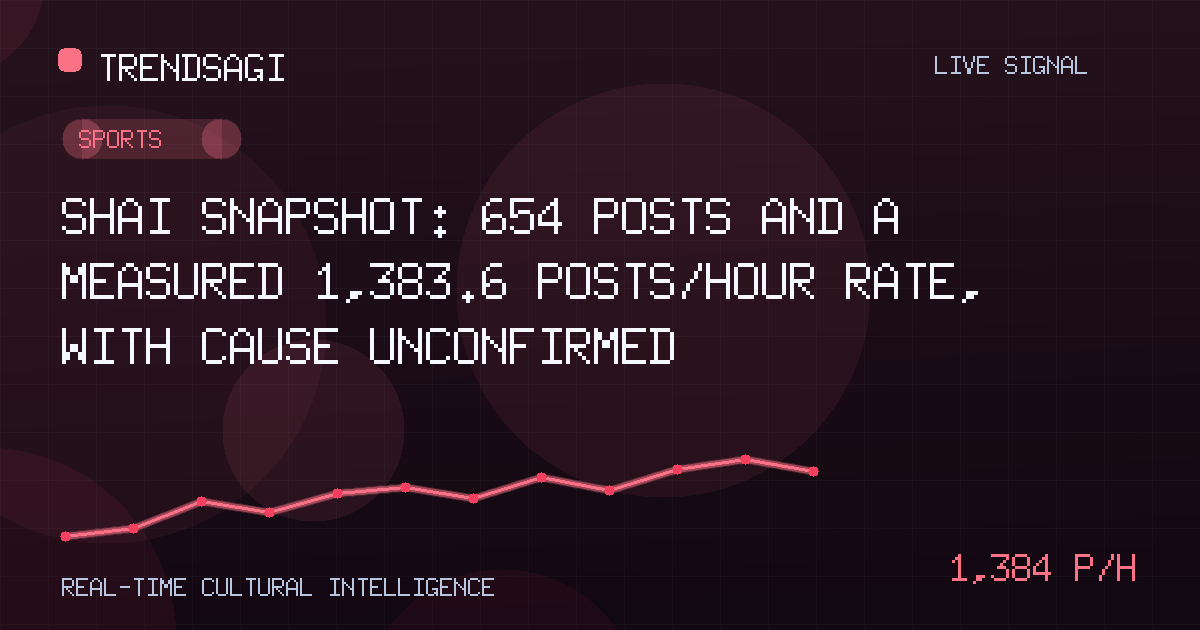
Shai snapshot: 654 posts and a measured 1,383.6 posts/hour rate, with cause unconfirmed
The latest Shai snapshot records 654 posts and a measured 1,383.6 posts/hour rate; here is what is verified, unclear, and worth checking next.
Automated briefing. Generated from stored signal measurements and source-backed research; it is not manually reviewed. Read the methodology and limitations.
Metrics in this briefing are a snapshot associated with its publication date and may not reflect current conditions.
What changed
The latest stored signal for “Shai” shows 654 posts at 2026-10-08T00:56:24Z. Across an exact 903-second window based on 2 stored observations, captured volume increased at a measured snapshot rate of 1,383.6 posts/hour. This is a historical snapshot measurement—not a live or current rate, forecast, reach, engagement total, or unique-person count.
The direct editorial answer is that captured posting activity rose, but the trigger is unconfirmed. The record classifies the topic as Sports; no verified public context connects a specific game, result, announcement, person, or original post to the observation window. “Shai” is a monitored label, not a verified event explanation.
| Observation time | 2026-10-08T00:56:24Z |
|---|---|
| Measured snapshot rate | 1,383.6 posts/hour |
| Snapshot volume | 654 posts |
What the signal can establish
The record is sufficient to prioritize a verification check, not to announce a cause. It provides an endpoint count, the measured direction and snapshot rate of change, and a broad category, while leaving the underlying event unresolved.
- Observed volume: The latest snapshot contained 654 posts.
- Measured change: Captured volume rose at 1,383.6 posts/hour over 903 seconds using 2 stored observations.
- Stored classification: The topic is assigned to Sports, which narrows the context but does not identify the subject.
- Missing explanation: No dated event or verified public source is attached to the signal.
The signal cannot establish how many unique people posted, whether the posts were original or duplicated, where they came from, their sentiment, or whether an automated or coordinated process contributed. It also cannot show that activity remained high after the observation.
A measured snapshot rate can justify checking for a developing story, but it cannot identify the story or measure audience reach.
Why this topic may be moving
No verified external context explains the observation window, so the following are hypotheses to test rather than facts to publish:
- Identity collision: A short name can refer to more than one person or subject, mixing otherwise separate conversations in one label.
- Breaking sports event: If the label resolves to an athlete or team, a result, roster move, injury update, or announcement could drive responses.
- Highlight circulation: A clip, screenshot, statistic, or quote can produce a fast reaction wave without a new official development.
- Repost amplification: Reactions may repeatedly quote an earlier source, making captured volume rise faster than original reporting.
- Collection effects: Collection timing, query scope, or duplicate handling could affect the observed change even if posting behavior did not shift.
None of these explanations should enter a headline until a dated public source and the exact identity behind “Shai” agree with the signal.
Why it matters
A rapid snapshot change is an editorial alert, not a measure of importance. The figure tells desks where to look; it does not tell them what happened, how influential the posts were, or whether the activity is trustworthy.
- News editors should resolve the name and find primary confirmation before framing the movement as a story.
- Sports and community teams should monitor for name mix-ups, copied claims, and unsupported reactions.
- Audience researchers should not treat posts as people, reach, or sentiment without separate data.
- Trend and platform teams should compare source mix and persistence before classifying the signal as sustained.
What to watch next
The next checks should produce evidence that can confirm, narrow, or reject the signal:
- Resolve the identity. Match “Shai” to a full name and relevant sports context; rule out unrelated or misspelled matches.
- Locate a primary item. Check official team, league, athlete, or event material, plus any primary announcement or filing dated before or during the observation window.
- Align the timeline. The public development should precede the rise, not merely appear afterward in response to coverage.
- Check independent pickup. Look for multiple credible outlets adding original reporting rather than copying one viral post.
- Inspect post composition. Separate original posts from quotes, reposts, reactions, duplicates, and automated activity.
- Take new snapshots. Compare later captured volume and measured snapshot rate under the same topic definition and collection method.
- Establish a baseline. Compare this window with earlier windows; without one, do not call the signal a record, unusually large, or broadly mainstream.
Stronger watch signals would include a verified full-name match, a primary source timestamped before the rise, independent pickup, a high share of original posts, and later snapshots showing continued growth.
Methodology and limitations
The 1,383.6 posts/hour figure is a measured snapshot rate derived from 2 stored observations across an exact 903-second window ending at the listed observation time. It describes change in captured volume. It should not be described as a live rate, publication velocity, forecast, engagement, reach, or a count of unique authors.
The signal does not disclose collection coverage, deduplication, language, geography, or query settings. Those omissions matter because short labels, repeated content, and collection timing can shape the pattern. No public cause has been verified here, so the defensible conclusion is limited: the stored signal shows a measured rise around “Shai,” while the identity and trigger remain unconfirmed.
Track This Topic for New Signals
Set alerts for future velocity or sentiment changes around this topic.
Explore Tracking PlansAbout TrendsAGI research
TrendsAGI's automated research pipeline publishes dated signal snapshots, methodology notes, and practical workflows for teams evaluating cultural momentum. Read how signals are scoped, scored, and limited in our research methodology.


