857-second window · 3 observations · Measured Oct 9, 2026, 11:54 PM UTC · Provider: go_recent_snapshot_v2
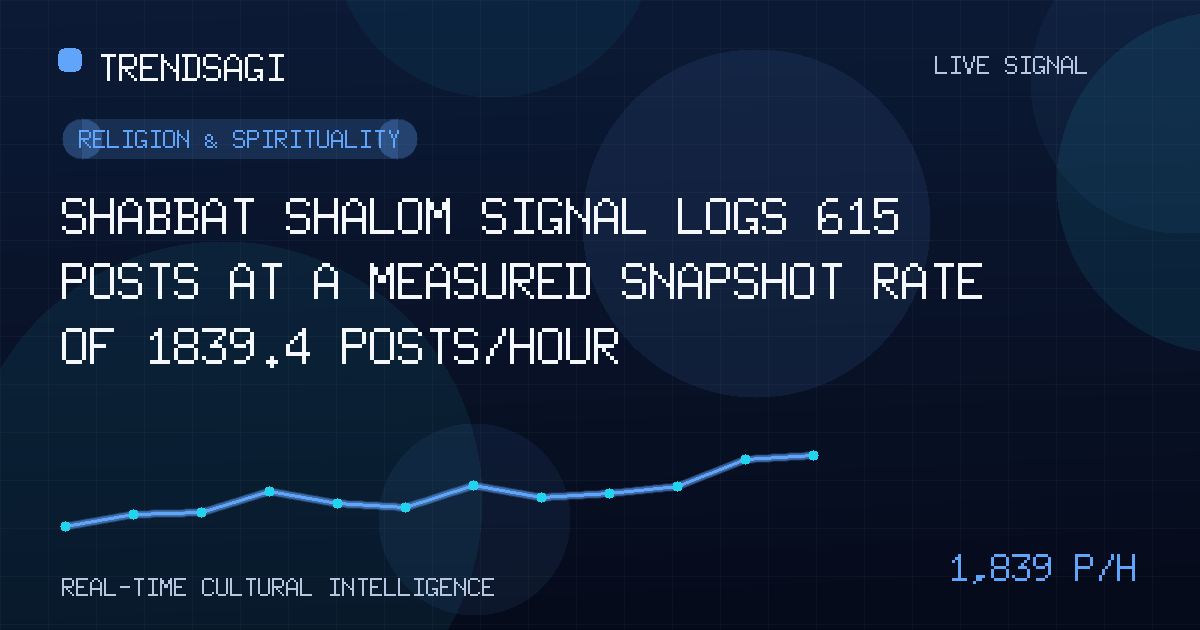
Shabbat Shalom signal logs 615 posts at a measured snapshot rate of 1839.4 posts/hour
Shabbat Shalom logged 615 posts and a measured 1839.4 posts/hour rate; this briefing separates the signal from unverified causes.
Automated briefing. Generated from stored signal measurements and source-backed research; it is not manually reviewed. Read the methodology and limitations.
Metrics in this briefing are a snapshot associated with its publication date and may not reflect current conditions.
What changed
The clearest answer is that the stored Shabbat Shalom signal shows a rapid, short-window burst of posts, while its cause remains unverified. The record contains no confirmed public event, announcement, or news development that explains the movement. It is too early to present the signal as a broad conversation, a reaction to a specific catalyst, or a sustained shift in interest.
The measured snapshot rate is 1839.4 posts/hour over an exact 857-second window using 3 stored observations, measured at 2026-10-09T23:54:53Z. The latest snapshot volume is 615 posts. These are separate measures: 615 is a volume, not a rate; 1839.4 posts/hour is a stored measured snapshot rate, not a live or current rate, forecast, reach figure, engagement total, or count of unique people.
| Measure | Stored value |
|---|---|
| Observation time | 2026-10-09T23:54:53Z |
| Measured snapshot rate | 1839.4 posts/hour |
| Latest snapshot volume | 615 posts |
Why this topic may be moving
Because no verified public trigger appears in the stored record, the defensible conclusion is limited: the feed moved quickly in the measured window, but the reason is not established. Several explanations can be tested without being reported as facts.
- Timing: A recurring observance, routine community practice, or planned communication cycle could concentrate posts. That is a hypothesis to test against matched historical windows, not an established explanation.
- Public reaction: A news event or controversy might prompt use of the phrase. No specific event is verified here, so naming one would go beyond the evidence.
- Distribution effects: A resharing cascade, recommendation change, or coordinated burst could lift volume without equivalent organic participation. The stored figures do not distinguish those patterns.
- Measurement effects: Changes in labeling, deduplication, collection coverage, or category assignment could alter the count. The Religion & Spirituality category identifies the stored routing, not the motivation or authenticity of individual posts.
The most useful next step is therefore not to choose the most plausible story. It is to test timing, provenance, distribution, and measurement stability, then attribute movement only when verified public context supports the connection.
Why it matters
Religious publishers, faith-community managers, editors, and social-listening teams should treat this as a verification trigger. A concentrated snapshot can justify checking public context, source mix, and platform coverage before publishing a causal explanation or changing community messaging.
The signal is useful for directing attention, but it is not sufficient evidence of a broad event, a sustained trend, or an audience shift.
For a trend desk, the value is prioritization: this window merits a fast validation pass. For community teams, the value is awareness: a phrase may need monitoring even when the cause is unknown. In both cases, confidence should rise only as additional observations and verified context accumulate.
The data do not show who posted, whether accounts are unique, whether content was original, or whether people engaged beyond posting. They also do not reveal sentiment, geography, language distribution, or the platform’s counting method. The signal can flag where to look; it cannot establish why people looked there.
What to watch next
A disciplined follow-up should preserve the query, category, language and geography settings, collection method, and counting rules wherever possible. Then run the checks below.
- Persistence: Collect additional observations under the same settings. The current 1839.4 posts/hour figure establishes only the supplied window; repeated elevated measured snapshot rates would provide stronger evidence that movement continued.
- Baseline: Compare matched 857-second windows before and after the snapshot, along with comparable prior periods. This would show whether the observed rate is exceptional relative to the same feed rather than treating one window as a baseline.
- Post provenance: Review the earliest substantive items and distinguish original posts from duplicates, reposts, and coordinated-looking sequences. Account concentration can then be described without converting post volume into a unique-person estimate.
- Public trigger: Check primary statements and reputable reporting, compare their timestamps with the onset of the signal, and attribute a catalyst only when the connection is explicit and verifiable.
- Source spread: Determine whether the movement appears in independent datasets or only in the stored collection. A cross-source pattern would reduce the risk of mistaking a collection artifact for a wider phenomenon.
- Content mix: Inspect a structured sample for greetings, discussion, reactions to news, memorial or institutional uses, and irrelevant or automated content. The topic label and category alone cannot perform that classification.
Concrete watch signals
Concrete signs that confidence should increase would include:
- Additional independent windows showing sustained elevation against a matched baseline.
- A verified public catalyst whose timing precedes the onset and whose reporting explicitly supports the connection.
- Original posts, rather than duplicates or reposts, accounting for more of the observed activity.
- Stable results when query, category, deduplication, and collection settings remain unchanged.
- Post-level evidence supporting conclusions about audience, geography, language, or sentiment.
Methodology and limitations
This briefing uses the supplied signal: 3 stored observations across an exact 857-second window, with a measured snapshot rate of 1839.4 posts/hour at 2026-10-09T23:54:53Z and latest snapshot volume of 615 posts. The figures are reproduced as stored and have not been recalculated.
No verified public context was available in the supplied record, so no external cause is assigned. The signal description is empty, and the topic label and Religion & Spirituality category provide classification rather than evidence of motive.
The principal limitations are the small observation set, short measurement window, and absence of a longer series, baseline, sampling method, post-level sample, and verified trigger. Snapshot volume and measured snapshot rate answer different questions and should not be combined into an unsupported estimate of audience size. The result is a monitoring signal that warrants validation, not a forecast.
Track This Topic for New Signals
Set alerts for future velocity or sentiment changes around this topic.
Explore Tracking PlansAbout TrendsAGI research
TrendsAGI's automated research pipeline publishes dated signal snapshots, methodology notes, and practical workflows for teams evaluating cultural momentum. Read how signals are scoped, scored, and limited in our research methodology.