30-minute window · 3 observations · Measured Oct 8, 2026, 11:41 PM UTC · Provider: go_recent_snapshot_v2
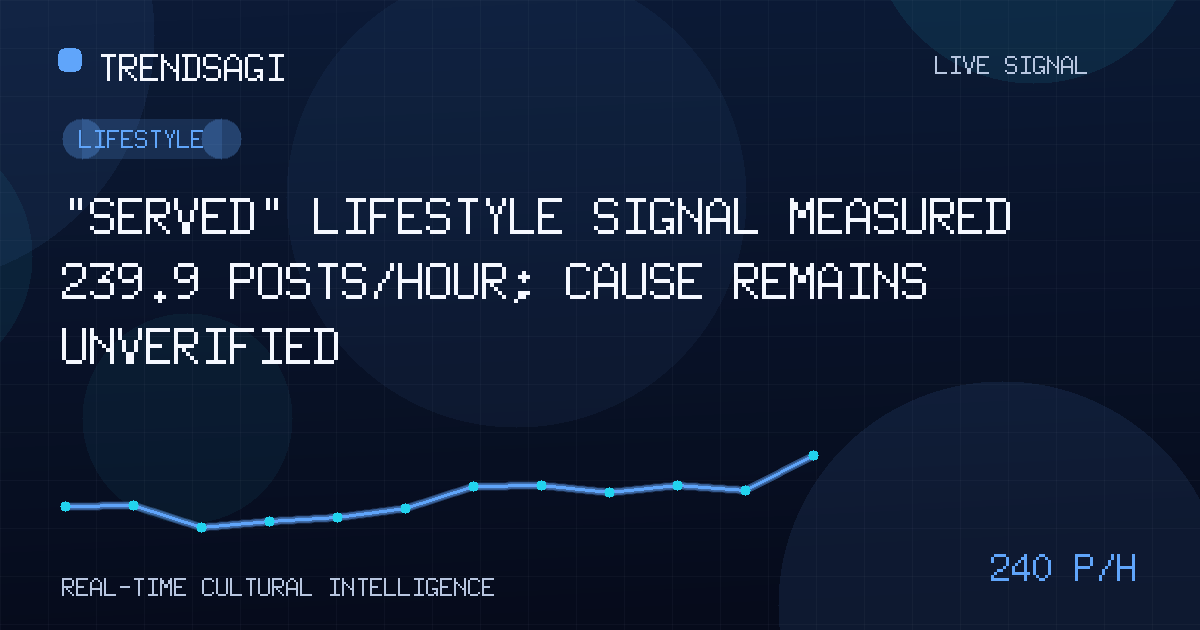
“Served” Lifestyle signal measured 239.9 posts/hour; cause remains unverified
The “Served” Lifestyle signal measured 239.9 posts/hour in a 1800-second window; its cause is unverified and needs context.
Automated briefing. Generated from stored signal measurements and source-backed research; it is not manually reviewed. Read the methodology and limitations.
Metrics in this briefing are a snapshot associated with its publication date and may not reflect current conditions.
What changed
The clearest conclusion is narrow: the Lifestyle topic labeled “Served” showed active posting at 2026-10-08T23:41:32Z, but the available context does not establish what the label captures or why it was moving.
The measured change rate was 239.9 posts/hour over an exact 1800-second window using 3 stored observations, and the latest snapshot contained 533 posts. This is a measured historical snapshot rate—not a live rate, forecast, reach, engagement level, or unique-person count.
| Observation time | Measured snapshot rate | Snapshot volume |
|---|---|---|
| 2026-10-08T23:41:32Z | 239.9 posts/hour | 533 posts |
Why this topic may be moving
The defensible causal answer is unresolved. The observation supplies a topic label and category but no verifiable event, person, product, publication, or public announcement that can be tied to the movement. The label is also context-poor: “Served” could have been collected around an ordinary verb, part of a title or slogan, service-related language, or an entity whose identity is not recoverable from the label. The volume alone cannot separate those possibilities.
Possible explanations include a specific news event, a phrase entering heavier use, a change in platform collection or query matching, coordinated amplification, or the pooling of unrelated meanings. These are testable hypotheses, not findings. No verified public context establishes which mechanism produced the observed rate.
Why it matters
Posting velocity is useful as a triage signal, but it is not a substitute for subject identification. A fast-moving label tells analysts where to investigate; it does not tell readers what happened, what people believe, or whether the activity represents broad interest.
- Media and lifestyle editors need the underlying phrase and context before treating “Served” as a news-led topic.
- Social and community teams need to distinguish genuine conversation from repeated excerpts, coordinated posting, or collection artifacts.
- Researchers need the matching method and query scope to judge whether the signal reflects language use or an automated category.
- Editorial, communications, and market teams should avoid making reputational or demand decisions from an ambiguous label alone.
Interpretation: The measured rate shows how quickly records entered this signal, not why they appeared or what people believed. A causal headline without phrase-level evidence and independent corroboration would outrun the available record.
What the signal can—and cannot—establish
It supports a narrow operational reading:
- The collection categorized under the Lifestyle label “Served” contained 533 posts at the stated observation time.
- Its measured change rate was 239.9 posts/hour during the specified 1800-second window.
- The rate was calculated from 3 stored observations associated with that window.
It does not establish:
- The precise subject, intended meaning, or identity represented by “Served.”
- Whether the rate exceeded the topic’s normal baseline or constituted a surge.
- Sentiment, geography, language share, audience demographics, or broader public opinion.
- Reach, unique authors, unique people, or the proportion of original versus duplicated material.
- Whether the posts were organic, automated, coordinated, or unrelated items merged under the same label.
- When the movement began, whether it persisted, or whether the observation represented a peak.
Practical next checks
Before assigning a cause or using the signal in a headline, decision, or campaign, analysts should:
- Inspect the captured records themselves, beginning with a representative sample across the full observation window.
- Confirm how “Served” was matched: exact phrase, case handling, semantic grouping, exclusions, and any attached names or entities.
- Cluster posts by wording, linked subject, source, account, and timestamp. Check for duplicates, reposts, near-identical text, and repeated source material.
- Compare the result with earlier and subsequent windows collected under the same rules. Without that baseline, the observed pace cannot be classified as unusually fast.
- Check whether any primary announcement or independently published report predates and aligns with the posting clusters, and whether it discusses the same meaning of “Served.”
- Audit the collection pipeline for labeling errors, time-zone handling, bot filtering, trending-list assignment, and changes in the source set.
What to watch next
Several observable developments would make the signal more useful:
- Persistence: activity remains near the measured pace in later windows collected with the same method.
- Referent clarity: posts repeatedly resolve to a specific event, person, product, work, or phrase rather than several unrelated uses of the word.
- Distribution: conversation appears across independent accounts and sources rather than concentrating around one origin.
- Timing: dense posting clusters align with a verifiable announcement, release, performance, or other public event.
- Label migration: the discussion shifts into a more specific topic label, giving the original signal a clearer identity.
- Reversion: a quick decline weakens an interpretation of sustained interest, though it still would not identify the original cause.
Methodology and limitations
The reported 239.9 posts/hour is a measured snapshot rate derived from 3 stored observations across an exact 1800-second window and measured at 2026-10-08T23:41:32Z. It describes historical collection activity only. It is not a live or current rate, and it should not be presented as a forecast, total audience, engagement, reach, or unique-person count.
The separate snapshot volume of 533 posts is a point-in-time count of records under the label. It is not the hourly rate, and it does not establish that every record was unique, original, or publicly relevant. The observation timestamp also does not necessarily mark the beginning, end, or peak of the movement.
No prior baseline, post-level sample, semantic definition, or verified public trigger is supplied. The rate can therefore identify a topic as a monitoring priority, but it cannot by itself show acceleration, consensus, or causation. Until the context checks above produce consistent evidence, the cause of the “Served” movement should be stated plainly as unresolved.
Track This Topic for New Signals
Set alerts for future velocity or sentiment changes around this topic.
Explore Tracking PlansAbout TrendsAGI research
TrendsAGI's automated research pipeline publishes dated signal snapshots, methodology notes, and practical workflows for teams evaluating cultural momentum. Read how signals are scoped, scored, and limited in our research methodology.