1884-second window · 2 observations · Measured Oct 5, 2026, 11:56 PM UTC · Provider: go_recent_snapshot_v2
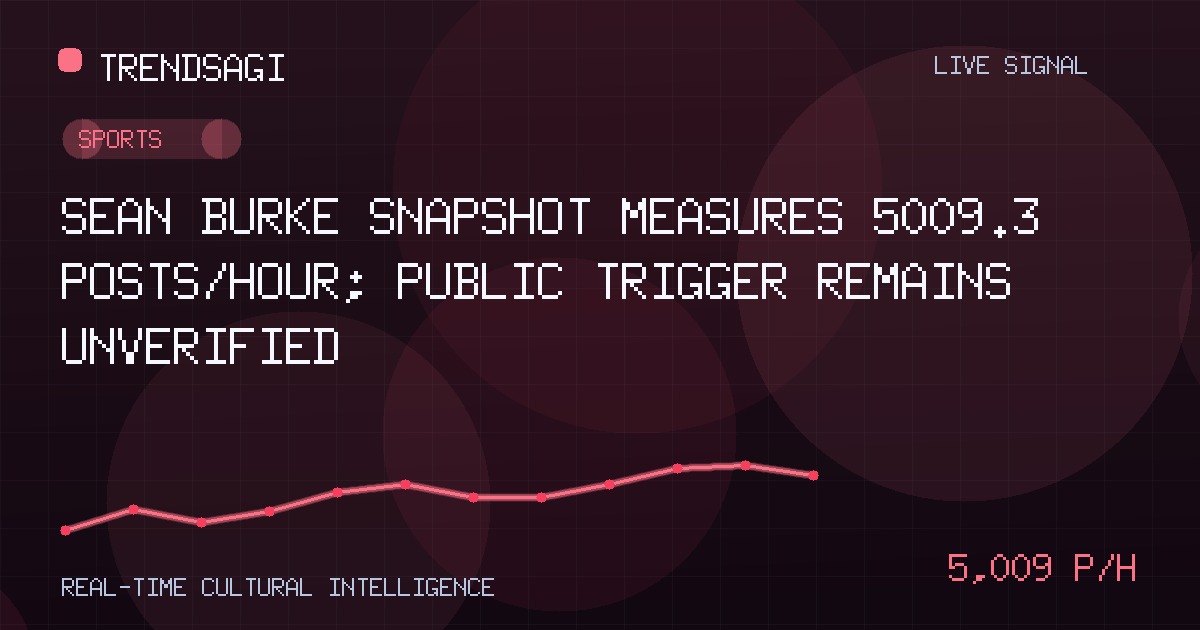
Sean Burke snapshot measures 5009.3 posts/hour; public trigger remains unverified
Sean Burke snapshots show 5009.3 posts/hour over 1884 seconds; this briefing separates the verified change from the unknown cause.
Automated briefing. Generated from stored signal measurements and source-backed research; it is not manually reviewed. Read the methodology and limitations.
Metrics in this briefing are a snapshot associated with its publication date and may not reflect current conditions.
What changed
The direct answer is that the Sean Burke topic registered a measured snapshot rate of 5009.3 posts/hour at the recorded observation. The change was measured over an exact 1884-second window using 2 stored observations, with the latest snapshot taken at 2026-10-05T23:56:34Z. This documents a posting-rate change within that interval; it does not by itself establish a sustained trend.
The latest snapshot contains 3000 posts. Volume tells you how many items were present in that captured snapshot, while the measured rate describes the posting change between observations. Neither figure is a live count, forecast, reach, engagement total, unique-person count, or proof of what caused attention. The public trigger is not established, so attributing the movement to a game, announcement, controversy, or other event would go beyond the evidence.
| Observation time | 2026-10-05T23:56:34Z |
|---|---|
| Measured snapshot rate | 5009.3 posts/hour |
| Snapshot volume | 3000 posts |
For an editor, this is a priority verification lead, not a ready-made news conclusion. The immediate task is to determine whether the label points to one identifiable sports figure and whether a real event aligns with the observed interval.
Why this topic may be moving
The available record attaches the category Sports, but it provides no explanatory description. That is enough to prioritize investigation, not enough to identify a team, role, announcement, or incident. No verified public context ties the label to a specific event at the observation time, so the reason for the movement remains unclear.
- Event-driven attention: A match, roster move, injury, disciplinary matter, or announcement may be prompting posts, but none is verified here.
- Identity mixing: Posts may concern different people who share the Sean Burke name, or may use the phrase in another context.
- Secondary amplification: Quotes, reactions, or repeated reposts may be extending an earlier item even if no new event occurred.
These are verification hypotheses, not established explanations. The Sports label can help narrow a search, but it cannot resolve the identity of the person being discussed or show that an event occurred near the snapshot.
The measurement establishes that posting activity changed at a measured snapshot rate; it does not establish which Sean Burke the posts concern, why the change occurred, or whether the pace persisted.
Why it matters
The value of this signal is triage, not explanation. A measured rate can tell an assignment desk that a label deserves checking sooner; it cannot tell the desk which headline is accurate. Before publication, an editor should resolve the person being referenced and verify a matching event. Otherwise, discussion about multiple namesakes could be combined into one misleading story.
Volume and rate also require disciplined language. The 3000-post figure is the size of the captured snapshot. The 5009.3 posts/hour figure is the measured snapshot rate for the stated window. Neither should be presented as the total public audience, the current pace, or a measure of impact.
- Sports editors and reporters can use the change to prioritize identity and event checks.
- Trend and audience analysts can use the interval as a prompt for additional same-method observations.
- Audience safety and communications teams may need to review the posts, but the label alone does not reveal sentiment, harm, or coordination.
What to watch next
The next useful work is verification and persistence testing, not simply repeating the headline figure.
- Resolve the entity. Review a representative sample of the captured posts and record which Sean Burke each item appears to reference. Separate direct discussion, quotation, criticism, and unrelated uses of the name. Do not treat the Sports category as identity evidence.
- Find a time-aligned public event. Use Google Search for the exact name, observation date, and any disambiguating sport, team, or role found in the posts. Confirm every candidate explanation on the reporting publisher's page before presenting it as the reason for the movement.
- Collect more comparable snapshots. Use the same query, collection method, and measurement window. Additional observations can show whether the measured interval was persistent, isolated, or already fading; the current 2 observations cannot answer that.
- Inspect post composition. Distinguish original posts from quotations and reposts, look for repeated text, and examine whether activity is concentrated in a small set of accounts. These checks can reveal amplification patterns, but they cannot independently prove automation.
- Compare timing. Check when a verified event was first published relative to the measured interval. Context that appeared after the activity began may describe the response, but it cannot by itself explain why the activity started.
Concrete watch signals include repeated same-method measurements remaining near this pace, verified coverage converging on one resolved person and event, or the label splitting into discussion about multiple referents. A sharp decline after a verified event would suggest a short response cycle, while continued activity without matching context would make identity confusion or platform amplification more important possibilities to test.
Methodology and limitations
The reported 5009.3 posts/hour rate comes from 2 stored observations across an exact 1884-second window and is recorded at 2026-10-05T23:56:34Z. The separate snapshot volume is 3000 posts. These quantities measure different aspects of collection and should not be substituted for one another.
The record provides no historical baseline, post-level sample, account-level evidence, identity resolution, sentiment distribution, geography, or verified public event. It therefore cannot establish a usual baseline, the peak of attention, the total extent of discussion, unique participants, engagement, causation, or whether the movement continued beyond the measured window.
The defensible conclusion is narrow: Sean Burke showed a measured snapshot rate of 5009.3 posts/hour at the stated observation. Why it moved remains unverified and should be resolved before the signal is used to frame coverage.
Track This Topic for New Signals
Set alerts for future velocity or sentiment changes around this topic.
Explore Tracking PlansAbout TrendsAGI research
TrendsAGI's automated research pipeline publishes dated signal snapshots, methodology notes, and practical workflows for teams evaluating cultural momentum. Read how signals are scoped, scored, and limited in our research methodology.