1727-second window · 3 observations · Measured Sep 29, 2026, 3:53 PM UTC · Provider: go_recent_snapshot_v2
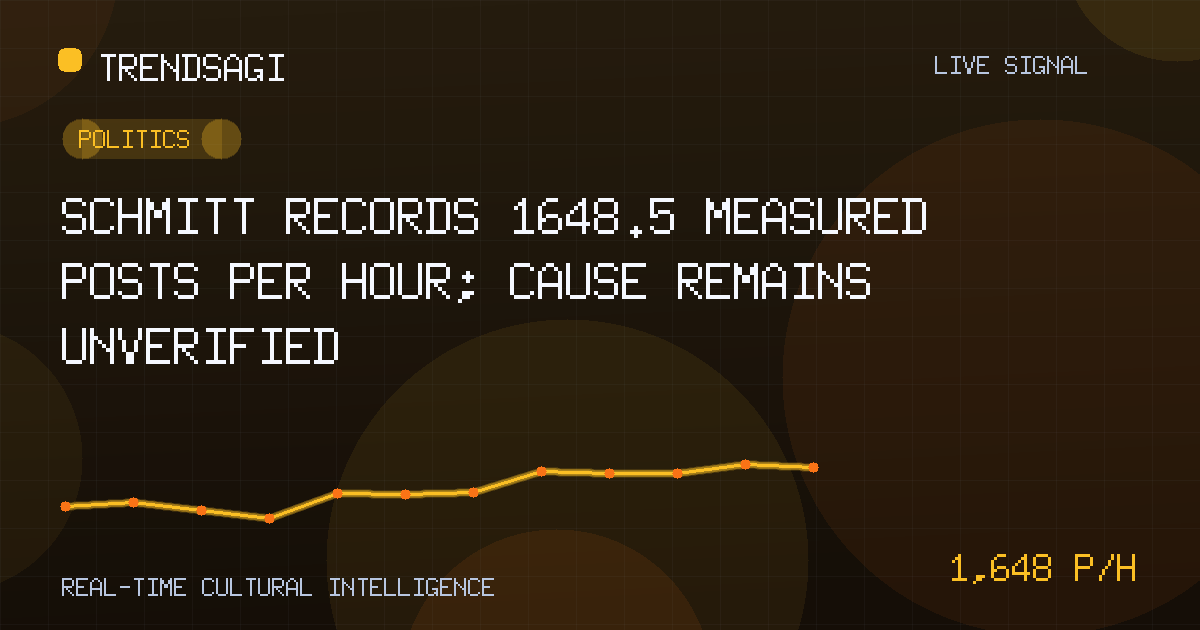
Schmitt records 1648.5 measured posts per hour; cause remains unverified
Schmitt shows a measured 1648.5 posts/hour; the unresolved entity and trigger define the checks editors should make next.
Automated briefing. Generated from stored signal measurements and source-backed research; it is not manually reviewed. Read the methodology and limitations.
Metrics in this briefing are a snapshot associated with its publication date and may not reflect current conditions.
What changed
The stored signal shows a rapid concentration of posts around the label “Schmitt,” but it does not identify the person, organization, place, or event behind those posts. No verified public source in the record explains the movement, so its cause remains unclear and should not be inferred from the name or category alone.
The measured snapshot rate was 1648.5 posts/hour over an exact 1727-second window based on 3 stored observations. The latest snapshot contained 1411 posts at 2026-09-29T15:53:02Z. This is a historical snapshot measurement—not a live or current rate, forecast, reach estimate, engagement total, or unique-person count.
| Measure | Stored value |
|---|---|
| Observation time | 2026-09-29T15:53:02Z |
| Measured snapshot rate | 1648.5 posts/hour |
| Snapshot volume | 1411 posts |
| Measurement basis | 1727 seconds; 3 stored observations |
Why this topic may be moving
“Schmitt” is an under-specified label. It could refer to multiple entities or to a misspelling, and the stored record includes no sample text, quoted name, link, or descriptive note that resolves the reference. The category “Politics” supplies broad context but does not establish which development prompted the posts or whether the classification is precise.
Several mechanisms could produce the pattern: a public statement, a live event, renewed discussion, a wave of reactions, repeated syndication, or a collision with another topic bearing the same name. None is verified here. A responsible causal account would need a relevant public source, its publication time, and evidence that the collected posts refer to that event. Until those checks are complete, report the observed posting activity and explicitly leave the trigger unresolved.
A measured post rate shows how quickly records accumulated around a label; it does not establish the identity, cause, sentiment, or civic importance of what was discussed.
What the signal can—and cannot—establish
The defensible takeaways are narrow: at the stated observation time, the store held 1411 posts associated with “Schmitt”; across the defined window, its measured accumulation rate was 1648.5 posts/hour; and the signal was assigned to the “Politics” category. This is enough to flag the label for editorial review, not to characterize the underlying event.
- Who or what “Schmitt” denotes.
- Whether posts expressed support, criticism, news reporting, or neutral mention.
- Whether activity was organic, automated, copied, or amplified by one source.
- Whether the pattern persisted beyond the measured window.
- How many people saw, authored, or engaged with the posts.
Because the record provides no comparison rate, it also cannot support a claim that activity was accelerating, declining, or exceptional relative to normal. The rate belongs only to the supplied window and observations.
Why it matters
For editors and communications teams, the immediate risk is misattribution. A label collision can attach a fast-moving political conversation to the wrong person or issue, producing misleading coverage. For people and organizations that may be associated with the name, an unexplained burst can affect monitoring, response planning, and reputational risk assessment. For researchers, the case illustrates why high-volume labels require entity resolution before interpretation.
The prudent response is not to amplify the term, but to improve the evidence around it. Confirm identity, timing, and provenance before drawing conclusions or issuing a reaction.
What to watch next
- Resolve the entity. Inspect representative posts and record the exact surrounding words, names, locations, and links. Group posts by the Schmitt they reference; do not merge different entities simply because the label matches. If no dominant reference emerges, report the topic as ambiguous.
- Find the earliest relevant items. Review the observations around the start of the window to identify what appeared first. Distinguish an originating post from replies, quotations, screenshots, and follow-on coverage. A source that predates the measured activity is more useful than one published afterward.
- Verify public context. Search the exact label and defensible spelling variants around the observation time, then open the underlying publisher page. Attribute a cause only when a source’s wording, timestamp, and subject clearly match the post cluster. Search-result snippets alone should not carry the causal claim.
- Check duplication and amplification. Look for repeated text, common source links, coordinated wording, or sudden one-account copying. Those patterns can change the interpretation of volume without showing broader public interest. Treat this as a quality check, not as proof of automation.
- Establish a baseline. Compare the same label across adjacent, equally defined windows and against similarly named topics with comparable collection coverage. Without that context, “moving” means activity occurred in the measured snapshot, not that its rate increased.
- Watch persistence and classification. Check whether another 1727-second window remains elevated, whether the burst stops abruptly, and whether a clearer entity or event emerges. Also verify that the “Politics” label remains appropriate. These changes would materially improve confidence.
Methodology and limitations
This briefing uses the supplied stored snapshot and its stated measurement. The observation time is 2026-09-29T15:53:02Z; the latest snapshot volume is 1411 posts. The measured change rate is 1648.5 posts/hour, calculated by the source over an exact 1727-second window from 3 stored observations. “Posts” are collection units, not verified authors or people.
The short window and limited observation count constrain claims about duration and trajectory. Snapshot volume is a stored count at one time, while posts/hour is a rate for the defined measurement window; neither should be described as current activity. No verified external source was available in the stored record to explain why the label moved, and no cause, sentiment, or broader trend is asserted.
Track This Topic for New Signals
Set alerts for future velocity or sentiment changes around this topic.
Explore Tracking PlansAbout TrendsAGI research
TrendsAGI's automated research pipeline publishes dated signal snapshots, methodology notes, and practical workflows for teams evaluating cultural momentum. Read how signals are scoped, scored, and limited in our research methodology.