6045-second window · 2 observations · Measured Oct 7, 2026, 1:51 AM UTC · Provider: go_recent_snapshot_v2
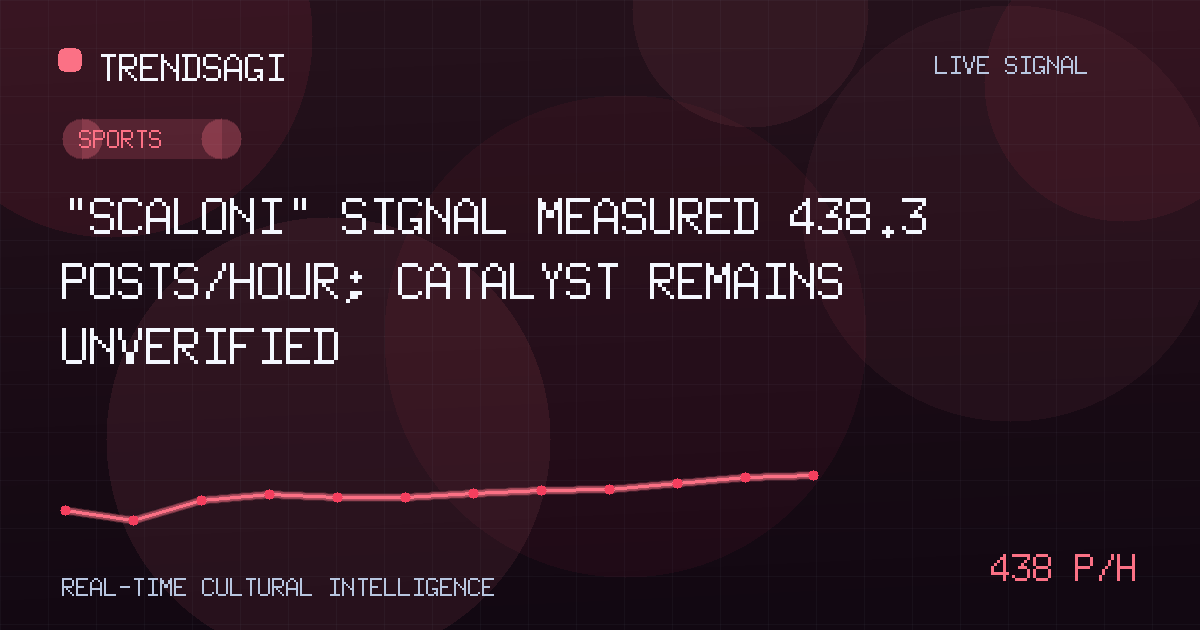
“Scaloni” signal measured 438.3 posts/hour; catalyst remains unverified
The stored “Scaloni” sample recorded a measured 438.3 posts/hour; here is what is known, what is not, and what to verify next.
Automated briefing. Generated from stored signal measurements and source-backed research; it is not manually reviewed. Read the methodology and limitations.
Metrics in this briefing are a snapshot associated with its publication date and may not reflect current conditions.
What changed
The stored “Scaloni” topic produced a measured snapshot rate of 438.3 posts/hour. The figure comes from 2 stored observations over an exact 6045-second window associated with 2026-10-07T01:51:56Z. It shows rising post activity in the monitored sample, but not the identity of the subject or the news driving it.
| Observation time | 2026-10-07T01:51:56Z |
|---|---|
| Measured snapshot rate | 438.3 posts/hour |
| Measurement window | 6045 seconds |
| Stored observations | 2 |
| Latest snapshot volume | 1636 posts |
The two volume measures answer different questions. The 1636-post figure is the volume attached to the latest snapshot, not a speed. The 438.3 posts/hour figure is a measured snapshot rate, not a live rate, forecast, reach estimate, engagement total, or count of distinct authors. Together, they make “Scaloni” worth checking; they do not explain it.
Why this topic may be moving
No verified public catalyst is established in the available material, so the cause remains unclear. The stored Sports category supplies context but no explanation. The surname may identify several kinds of people or organizations, and no full name or description links the posts to a specific event. Treating the label as a particular individual would therefore be unsupported.
The timestamp, exact measurement window, and rate tell editors when and how quickly to check. Candidate triggers could include an announcement, result, controversy, or breaking post, but none is established here. Timing becomes evidence only if contemporaneous public records align with the measured interval.
If identity checks point to football, appropriate search targets include a match report, team selection, competition development, interview, or criticism involving the relevant person. If those checks do not resolve the name, the signal could represent a broad-name collision or an unrelated use of the surname. The category is a routing clue, not a causal finding.
The defensible conclusion is not that “Scaloni” has broken a specific kind of news. It is that posts carrying this label increased quickly in the monitored sample, while identity and cause still require confirmation.
Why it matters
Editors and sports media outlets should care because a concentrated burst can affect coverage timing, search demand, and community conversation. Support teams can use the signal to prioritize moderation or clarification. Readers should care because a fast-moving label may be either an early sign of a meaningful event or an ambiguous name collision.
The signal is most useful as a triage alert. It says verification is warranted, not that a particular claim is true. Acting on the label alone could amplify misinformation, confuse unrelated people, or give disproportionate attention to duplicated content. A short verification pause is more useful than a speculative headline.
Analysts should not equate post counts with audience size. Quotation, copying, automated posting, or repeated activity from one account can lift volume without representing broad interest. Without platform, query, language, geography, and collection details, the signal cannot distinguish those patterns.
What the signal can and cannot establish
The evidence supports 3 narrow conclusions:
- A specific label was present in the monitored sample at the stated observation time.
- The latest stored snapshot contained 1636 posts.
- The supplied comparison yielded a measured snapshot rate of 438.3 posts/hour over 6045 seconds using 2 observations.
It does not establish the label’s referent, a catalyst, sentiment, factual accuracy, organic versus automated activity, or how unusual the rate is compared with normal activity. It also cannot show how many people were reached or whether the same accounts produced multiple posts.
There is no historical baseline in the supplied evidence. A large post count can be ordinary for a busy topic, while a smaller count can be unusual for a quiet one. The measured rate establishes direction within this interval, but broader significance requires comparisons with prior windows collected in the same way.
What to watch next
Use the next checks in this order:
- Resolve the identity. Inspect a sample of posts for full names, handles, teams, competitions, and quoted context. Use exact-label Google Search queries around 2026-10-07 and open underlying pages instead of relying on snippets. Reject an identity that does not recur across the sample.
- Align the clock. Compare the observation time with the publication time of candidate announcements, events, interviews, or reporting. A plausible cause should precede the measured interval and fit the relevant geography and time zone.
- Corroborate independently. Look for a primary event record or statement and a separate established publisher identifying the same person and development. One viral post, one search snippet, or several copies of one report is insufficient.
- Audit composition. Separate original posts from quotations, reposts, reactions, and duplicates. Determine whether discussion converges on one explanation or scatters across unrelated meanings of the surname.
- Test persistence. Take comparable snapshots using identical settings. Compare both the measured rate and snapshot volume; sustained activity across multiple windows supports a real trend more strongly than a single burst.
Concrete watch signals include:
- A candidate event timestamp preceding the observation and receiving primary and independent confirmation.
- Posts repeatedly converging on the same full name, event, and explanation.
- Comparable subsequent windows remaining elevated under the same collection method.
- The measured rate cooling while snapshot volume stays high, indicating fading momentum rather than disappearance.
- Conflicting identities or chronology, in which case the causal explanation should remain withheld.
Methodology and limitations
This briefing reports the supplied measurements: observation time 2026-10-07T01:51:56Z, latest snapshot volume of 1636 posts, 2 stored observations, a 6045-second window, and a measured snapshot rate of 438.3 posts/hour. None of those figures is converted into reach, uniqueness, engagement, or a forecast.
No external causal claim met the verification standard for this briefing, so none is attributed to a publisher. The Sports classification and bare surname do not establish whose activity is being tracked. With only 2 observations, no historical baseline, and no platform or collection details, the result should be treated as a monitoring signal that warrants verification—not as a settled news event.
Track This Topic for New Signals
Set alerts for future velocity or sentiment changes around this topic.
Explore Tracking PlansAbout TrendsAGI research
TrendsAGI's automated research pipeline publishes dated signal snapshots, methodology notes, and practical workflows for teams evaluating cultural momentum. Read how signals are scoped, scored, and limited in our research methodology.