959-second window · 2 observations · Measured Sep 4, 2026, 12:08 AM UTC · Provider: go_recent_snapshot_v2
SAWADIKA OUT NOW: 14,400-post snapshot and 9,013.8 posts/hour measured rate on 2026-09-04
Stored signal shows 14,400 posts for SAWADIKA OUT NOW and a measured 9,013.8 posts/hour over a 959-second window; cause unverified.
Automated briefing. Generated from stored signal measurements and source-backed research; it is not manually reviewed. Read the methodology and limitations.
Metrics in this briefing are a snapshot associated with its publication date and may not reflect current conditions.
What changed
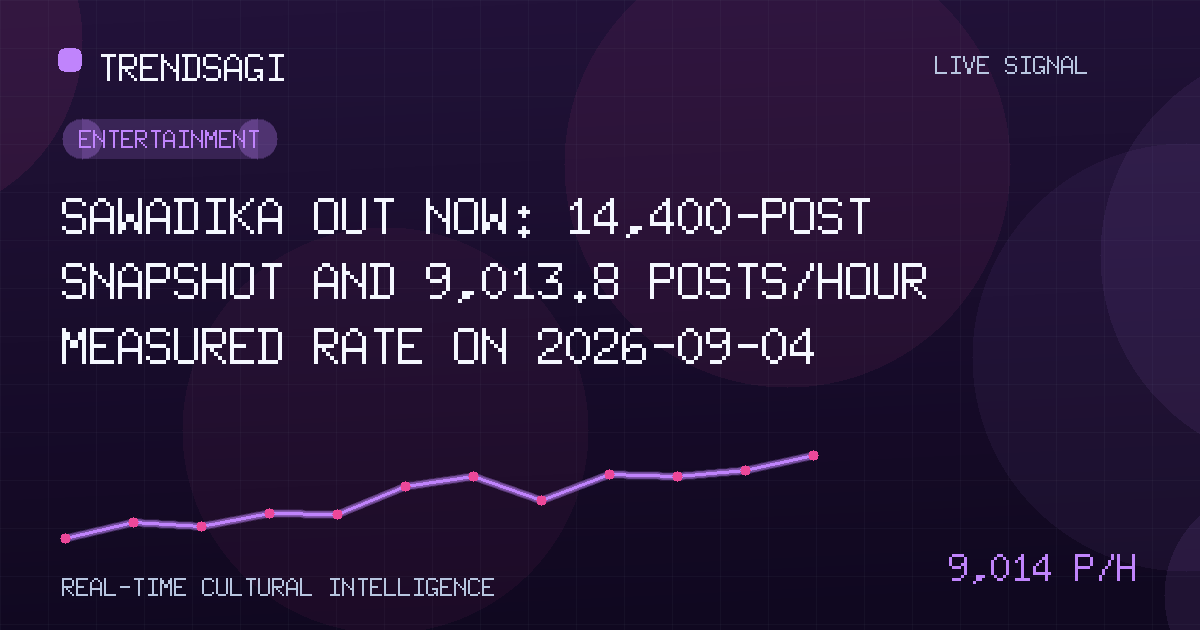
The stored signal for “SAWADIKA OUT NOW” reached 14,400 posts in the latest snapshot observed at 2026-09-04T00:08:13Z. The paired two-observation window shows a measured change of 9,013.8 posts per hour over an exact 959-second window, measured at the same timestamp. That figure is a snapshot rate from two stored observations, not a live current rate, forecast, reach metric, engagement score, or count of unique people.
Because the stored topic description is empty and no verified public explanation is available in this briefing, the safest reading is that “SAWADIKA OUT NOW” became a prominent phrase in the monitored post stream. The wording resembles a release announcement, but the label alone does not confirm whether it refers to a song, video, product, event, brand, meme, or local announcement.
| Observation time | 2026-09-04T00:08:13Z |
|---|---|
| Measured posts/hour | 9,013.8 |
| Snapshot volume | 14,400 posts |
Why this topic may be moving
The phrase “SAWADIKA OUT NOW” has the cadence of a launch line: a proper noun followed by “out now.” In public discussion, that pattern often appears when a creative work, product, app, episode, album, film, or branded item becomes available. It can also appear when a user community, meme page, or localized group amplifies a release with the same exact wording.
Without verified external context, the cause remains unclear. The signal can establish that the phrase is moving rapidly in the observed post sample. It cannot establish who created “Sawadika,” what “out now” announces, which platform drove the volume, or whether the posts are organic, coordinated, or promotional.
A spike is a detection event: it tells you that a phrase is circulating, but it does not tell you what “SAWADIKA OUT NOW” refers to, who is promoting it, or whether the volume is organic.
If the topic is a release, the likely early drivers may include official accounts, fan communities, press posts, social proof links, short-form video, or a localized audience reacting to the availability announcement. If it is not a release, the same phrase could still spike because of repetition, quote-tweeting, or a viral call-to-action.
Why it matters
For trend analysts, the value is not the phrase itself but the shape of the movement. A measured 9,013.8 posts/hour over a short window is a strong enough signal that the phrase crossed into a measurable cluster, even if the meaning remains ambiguous. For communications teams, it matters because “out now” language is time-sensitive: if it is a product or media release, the first hours often shape the story around discovery, sentiment, and what the audience calls the item.
For consumer and brand monitoring, the phrase may indicate a new demand signal. If “Sawadika” is a brand, it could be a launch or campaign asset. If it is a creator or artist, the spike may indicate an audience moment that can inform distribution, community response, and follow-up content. For risk monitoring, it matters because short, all-caps phrases can spread before context is established, making early classification important.
The topic may also matter because the stored category is “Other” and the description is empty. That means the system has not yet assigned a meaningful entity or intent. In practical terms, this is a case where a small amount of manual context can convert a noisy label into a useful watch item.
What to watch next
- Check whether the phrase is associated with a named artist, product, film, game, album, app, or campaign in the next several hours.
- Look for repeated metadata: release dates, credits, hashtags, handles, URLs, platform names, or location tags attached to the phrase.
- Compare the rate over the next few windows. A short spike may decay quickly, while a sustained or repeated rate suggests a longer-running topic.
- Watch for sentiment shifts. Early posts may be celebratory, confused, critical, or promotional; later posts often reveal the substance of the topic.
- Identify the first credible context: an official announcement, a major outlet, or a platform-native release page. If none appears, keep the topic as an unclassified phrase trend.
- Monitor derivative spellings and case variations, such as “Sawadika,” “Sawadika out,” and “Sawadika out now,” to determine whether the exact phrase is the core driver.
Practical next checks include reviewing the highest-volume posts for repeated links or media, checking official accounts named Sawadika, and looking for a launch timestamp near the observation time. If the posts are mostly screenshots, short clips, or reposts, the topic may be a secondary amplification of an event that happened elsewhere.
Methodology and limitations
The briefing uses the stored snapshot and the stored two-observation rate. The snapshot volume is 14,400 posts at 2026-09-04T00:08:13Z. The rate is 9,013.8 posts per hour, measured over an exact 959-second window using two stored observations. The rate is a calculated change between observations, not a live counter and not a projection of future posts.
The signal cannot establish unique users, impressions, engagement, sentiment, geographic origin, or the cause of the movement. It also cannot confirm what “SAWADIKA OUT NOW” means. External context was not verified in this article, so no publisher, person, platform, or product claim is asserted. The editorial response is to describe the measurable movement and outline the checks needed before treating the topic as a confirmed release or branded event.
Track This Topic for New Signals
Set alerts for future velocity or sentiment changes around this topic.
Explore Tracking PlansAbout TrendsAGI research
TrendsAGI's automated research pipeline publishes dated signal snapshots, methodology notes, and practical workflows for teams evaluating cultural momentum. Read how signals are scoped, scored, and limited in our research methodology.


