2694-second window · 2 observations · Measured Oct 9, 2026, 9:10 PM UTC · Provider: go_recent_snapshot_v2
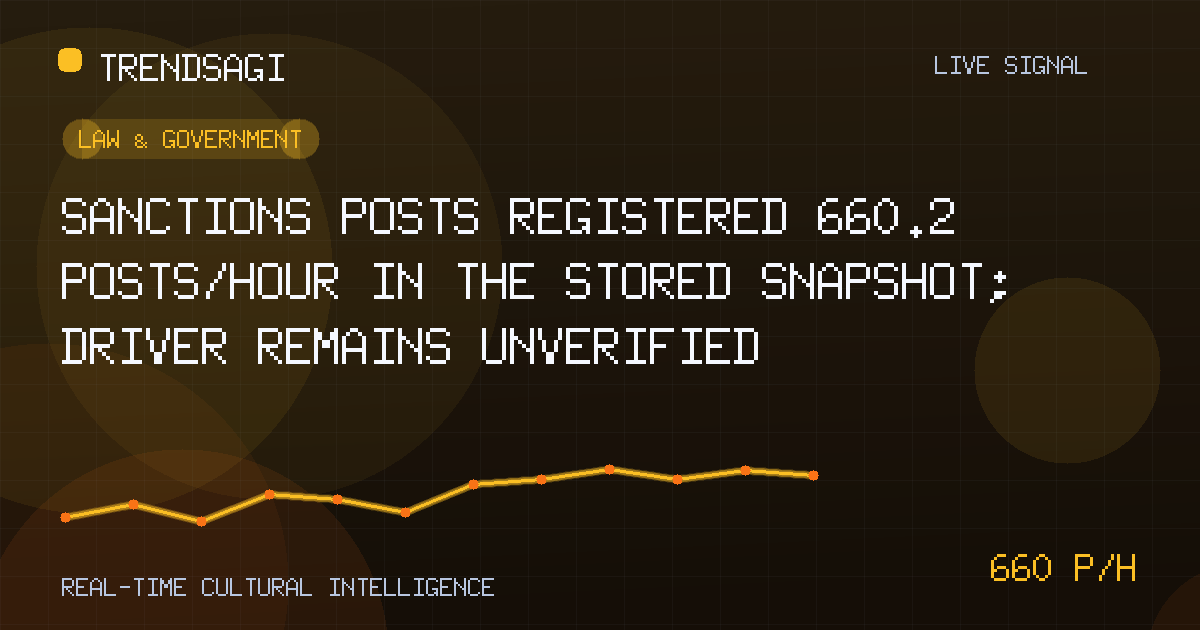
Sanctions posts registered 660.2 posts/hour in the stored snapshot; driver remains unverified
Sanctions posts registered 660.2 posts/hour in the stored window; here is what is known, unknown, and worth monitoring next.
Automated briefing. Generated from stored signal measurements and source-backed research; it is not manually reviewed. Read the methodology and limitations.
Metrics in this briefing are a snapshot associated with its publication date and may not reflect current conditions.
What changed
Posts associated with the stored “sanctions” label showed increased activity, reaching a measured snapshot rate of 660.2 posts/hour at the latest stored observation. No verified public context identifies the triggering event, so this should be treated as a burst of observed discussion—not proof of a new government action, enforcement step, or policy shift.
| Observation time | Measured posts/hour | Snapshot volume |
|---|---|---|
| 2026-10-09T21:10:38Z | 660.2 posts/hour | 2250 posts |
The 660.2 posts/hour figure was measured over an exact 2694-second window using 2 stored observations. The latest snapshot contained 2250 posts. Snapshot volume is not a rate. Posts/hour in this briefing means a measured snapshot rate, not a live or current rate, forecast, reach, engagement count, or total of unique people.
Why this topic may be moving
The cause remains unclear because the record does not name a jurisdiction, government, sanctioned party, measure, court, company, or dated event. A broad topic label can rise because of an official development, reaction to one, scheduled news, renewed earlier coverage, or a change in the monitored collection itself.
- Official action: A new designation, restriction, authorization, enforcement action, court development, or policy statement may drive attention.
- Reaction and amplification: Existing stories may resurface as news organizations, commentators, and users respond or republish.
- Event coincidence: A hearing, deadline, diplomatic meeting, or scheduled statement may create attention without changing policy.
- Broader discussion: The label may capture debate about sanctions policy, compliance, economic effects, or geopolitical consequences.
- Collection effects: Changes in sampling, keyword matching, duplicates, or automated activity may affect the observed count.
These are hypotheses to test, not findings about this signal. The material available for this briefing contains no confidently matched, publisher-backed event that explains the movement. Any stronger causal claim would therefore be speculation.
The key editorial distinction is between “more posts were observed under this label” and “a verified event caused the increase.” Only the first statement is supported here.
Why it matters
The practical issue is not whether sanctions discussion is “hot” in this snapshot, but whether a specific action has enough authoritative support to change decisions. A high posting rate can prioritize an investigation; it cannot substitute for checking the relevant legal authority, affected parties, scope, and effective date.
- Compliance and legal teams should determine whether an official measure actually changed and then review applicable obligations. They should not infer a duty from social volume alone.
- Sanctions analysts need the country or authority, program, entity names, action type, and implementation date before classifying the development.
- Journalists and policy teams should use the spike to seek primary documents and distinguish new facts from commentary or recycled coverage.
- Organizations with exposure can use the lead to check counterparties and internal records, but only after validating the underlying action.
That distinction matters because the word “sanctions” can cover materially different things. Discussion of a proposal is not an enacted rule; criticism of a policy is not evidence that it changed; and mention of a person or company is not necessarily a formal designation. The signal alone resolves none of those questions.
What the signal can and cannot establish
The signal is useful as a monitoring lead. It establishes when activity was observed, how many posts appeared in the latest snapshot, and the measured rate across the supplied interval.
It does not establish:
- Whether discussion favored or opposed a policy.
- Which countries, languages, institutions, or communities generated the posts.
- Whether participants were unique people or automated accounts.
- How representative the collection is of the wider public.
- Whether the rate persisted, accelerated, or reversed afterward.
- Whether any observed action had legal or economic consequences.
Nor can the 2250-post snapshot establish importance. Two observations provide a narrow view of direction, not a full trend curve. Without the prior count or a longer series, the data cannot show whether this was exceptional relative to the topic’s usual baseline.
What to watch next
A useful next round should turn the broad spike into a verifiable event trail and then test whether attention persists.
- Find a timestamp-matched primary record. Check official government, regulator, court, or legislative publications near 2026-10-09T21:10:38Z. Confirm the publisher, publication time, jurisdiction, authority, and exact action.
- Identify the program and parties. Record the country or authority involved, any entity named, the action taken, and whether it is a proposal, designation, restriction, enforcement step, ruling, or repeal.
- Verify implementation details. Establish scope, effective date, exemptions, and stated purpose from the primary text. Avoid treating a headline summary as sufficient if the operative document says something narrower.
- Corroborate the reaction. Look for reputable reporting that cites the same primary record, then compare timestamps to determine whether official news plausibly preceded the measured rise.
- Check subsequent stored observations. Use the same source and measurement method to see whether the 660.2 posts/hour snapshot rate is followed by sustained activity, a decline, or a new burst around a separate event.
- Audit the label and sample. Examine dominant terms, geography, language, reposts, duplicate text, likely automation, and possible keyword spillover. This helps separate a genuine event cluster from collection noise.
Concrete warning signs include repeated claims without a named authority, posts that pair an old action with new language, confusion among separate sanctions programs, or a sharp count increase with no matching official record. Those patterns call for caution rather than a causal conclusion.
Methodology and limitations
The rate of 660.2 posts/hour is a measured snapshot rate derived from 2 stored observations over an exact 2694-second window ending at 2026-10-09T21:10:38Z. The latest snapshot volume is 2250 posts. These values describe the monitored collection, not the whole internet.
The record does not provide the earlier observation’s value, platform mix, collection rules, deduplication method, geographic distribution, sentiment, or baseline. That prevents assessment of representativeness and causal direction. No external event is verified in the material available to explain the movement. The responsible takeaway is therefore narrow: sanctions-related posting activity increased in the measured snapshot, while its cause remains unconfirmed.
Track This Topic for New Signals
Set alerts for future velocity or sentiment changes around this topic.
Explore Tracking PlansAbout TrendsAGI research
TrendsAGI's automated research pipeline publishes dated signal snapshots, methodology notes, and practical workflows for teams evaluating cultural momentum. Read how signals are scoped, scored, and limited in our research methodology.