1352-second window · 3 observations · Measured Aug 26, 2026, 7:32 PM UTC · Provider: go_recent_snapshot_v2
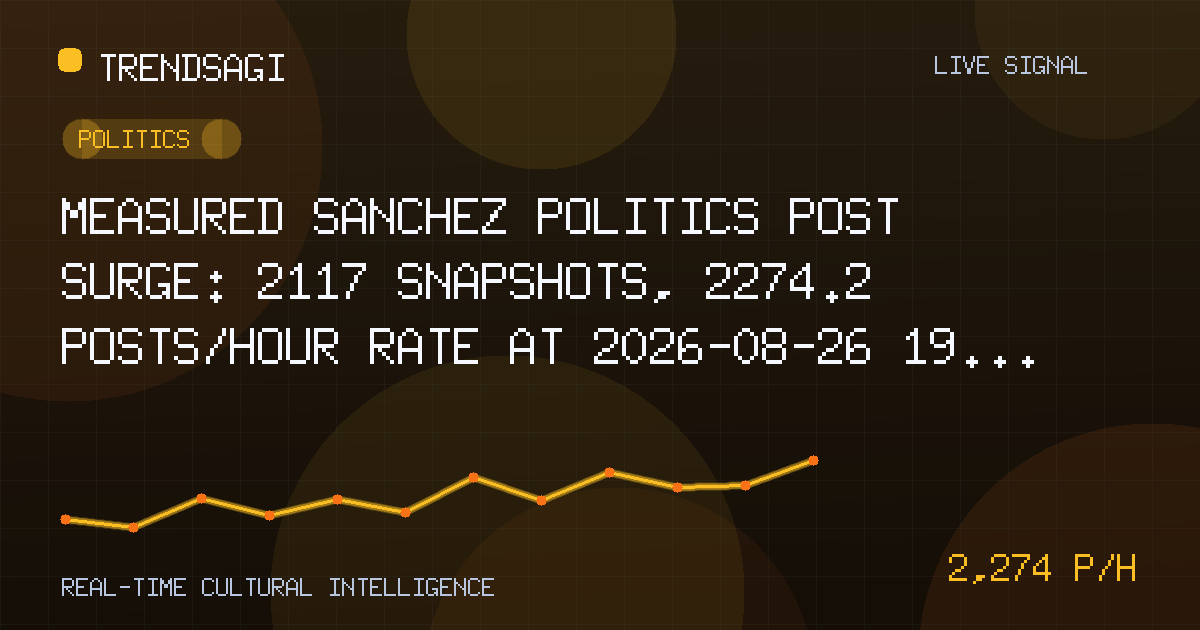
Measured Sanchez politics post surge: 2117 snapshots, 2274.2 posts/hour rate at 2026-08-26 19:32 UTC
At 2026-08-26 19:32 UTC, Sanchez politics posts reached 2117 volume with a measured 2274.2 posts/hour surge; briefing explains limits and watch signals.
Automated briefing. Generated from stored signal measurements and source-backed research; it is not manually reviewed. Read the methodology and limitations.
Metrics in this briefing are a snapshot associated with its publication date and may not reflect current conditions.
What changed
At 19:32 UTC on 26 August 2026, the Politics-labeled topic Sanchez showed a snapshot volume of 2117 posts, indicating a concentrated burst of discussion around that term in our stored observations. The direct answer for editors is that a notable cluster of Sanchez-related political posts was recorded, but the precise event driving it is not confirmed by verified public reporting available to this briefing.
Over an exact 1352-second window ending at the 2026-08-26T19:32:42Z observation, three stored observations produced a measured snapshot rate of 2274.2 posts/hour. This figure is a measured snapshot rate from stored data, not a live or current rate, not a forecast, and not a count of unique people or engagement. The latest snapshot volume at that timestamp was 2117 posts.
| Observation time (UTC) | Measured posts/hour | Snapshot volume (posts) |
|---|---|---|
| 2026-08-26T19:32:42Z | 2274.2 | 2117 |
Reading the table: the observation time is the timestamp of the latest stored snapshot. The measured posts/hour column reflects the derived rate from the window; the snapshot volume column is a separate count. They answer different questions—one about speed, one about size. The stored category for this signal is Politics, which tells us the clustering algorithm placed the posts in a political bucket, but it does not tell us the subtype of politics—electoral, legislative, diplomatic, or otherwise. The empty stored signal description provides no additional curator note.
Why this topic may be moving
We attempted to verify with public search why Sanchez in the Politics category was moving at that time. No attributed publisher fact could be confirmed within the constraints of this briefing. Therefore, the cause remains unclear. The label alone does not distinguish between multiple political figures, places, or policy debates that use the name.
Surname-based topics in politics often move because of a single high-profile action by a person with that name, a legislative vote, a court ruling, or an international summit. However, without attributed publisher confirmation, we cannot assign any of these as the cause for this specific surge. This briefing omits any unverified speculation. Another possibility is that the term Sanchez was used as a hashtag or shorthand in a broader political thread, which would inflate counts without a single named event. This is a known pattern in social data, but again we do not assert it occurred.
If a verified outlet later publishes a report about a Sanchez political event timed to that afternoon, the stored rate would be consistent with heightened attention, but the snapshot alone cannot confirm the link. Analysts should avoid closing the loop prematurely.
The 2274.2 posts/hour figure is a measured snapshot rate from three observations over 1352 seconds; it establishes intensity of stored posts, not the reason they were published.
Why it matters
Political topic surges can precede policy shifts, electoral moves, or reputation events. A measured rate above 2000 posts/hour with a snapshot volume over 2000 is uncommon in narrow topic buckets and warrants attention from monitoring desks. In practice, a high rate with moderate volume suggests a fast-developing but contained conversation, whereas a high volume with lower rate suggests a slow accumulation. Here both are elevated, which is a combination that merits a same-day look.
Who should care:
- Newsroom trend editors needing early clusters for assignment.
- Political risk analysts tracking name-driven volatility.
- Campaign monitors observing opponent or ally mentions.
- Platform integrity teams checking coordinated activity.
- Researchers studying surname ambiguity in political corpora.
What the signal can establish: that a burst of posts containing the term Sanchez under Politics was stored at the measured time, with a quantified rate. What it cannot establish: authorship, sentiment, geographic origin, whether posts are organic, or the exact referent of the name. Treating the volume as a rate or as unique users would be a measurement error.
The operational value is triage. A measured snapshot rate of 2274.2 posts/hour is a flag to allocate verification resources, not a finished story. Desks that ignore such flags may miss early movement; desks that over-react without external confirmation may publish unverified claims.
What to watch next
Practical next checks for a verified understanding:
- Cross-reference the 2026-08-26 19:32 UTC window with indexed news from established publishers.
- Segment the stored posts by account type and language to see if a specific Sanchez is identifiable.
- Monitor whether the measured rate sustains or decays in subsequent snapshots.
- Check official records or statements from political offices with the surname Sanchez around that date.
- Review adjacent topic labels (e.g., specific legislation or region) that co-occurred in the same posts.
Concrete watch signals that would raise confidence in a real-world driver:
- A named publisher reports a Sanchez political event within ±2 hours of the snapshot.
- Snapshot volume persists above 1500 posts in the next three observations.
- Measured rate climbs above 3000 posts/hour with verified external correlation.
- Sentiment tags shift from neutral to clearly event-driven in stored metadata.
- Multiple independent language editions show the same surge, suggesting global pickup.
Time zones matter: 19:32 UTC corresponds to afternoon in the Americas and evening in Europe and Africa. A political actor in one of those regions could generate simultaneous chatter. Mapping the snapshot’s language distribution would narrow the search. If none of these appear within 24 hours, the surge may reflect internal platform dynamics, a localized conversation, or a false positive in topic labeling. That outcome is also useful to record.
Methodology and limitations
The measured snapshot rate of 2274.2 posts/hour was computed from three stored observations across an exact 1352-second window, measured at 2026-08-26T19:32:42Z. Snapshot volume of 2117 posts is the count at the latest observation only. Neither number is transformed or extrapolated. Three stored observations means the rate is not a single-interval estimate but a multi-point measurement; however, with only three points, variance cannot be characterized. The 1352-second window is exact as stored; we do not round it.
Limitations:
- No live search was available to confirm cause; external facts are omitted if unverified.
- Snapshot volume is not a rate and not a unique-person count.
- The topic label Sanchez is supplied as-is and may be ambiguous.
- Stored signal description was empty, reducing contextual confidence.
- Rate is a measured snapshot rate, not a live, current, or forecast metric.
- Because the signal description was empty, we have no curator-added hint such as Spanish PM or local council. This absence is itself a limitation: human-in-the-loop notes often resolve ambiguity that algorithms leave open.
Editors should treat this briefing as an alert to a measured intensity, not as a concluded news event. Further verification is required before publishing attributable claims. The line between signal and story is precisely the verification step this document cannot complete alone.
Track This Topic for New Signals
Set alerts for future velocity or sentiment changes around this topic.
Explore Tracking PlansAbout TrendsAGI research
TrendsAGI's automated research pipeline publishes dated signal snapshots, methodology notes, and practical workflows for teams evaluating cultural momentum. Read how signals are scoped, scored, and limited in our research methodology.