1804-second window · 3 observations · Measured Oct 6, 2026, 10:55 PM UTC · Provider: go_recent_snapshot_v2
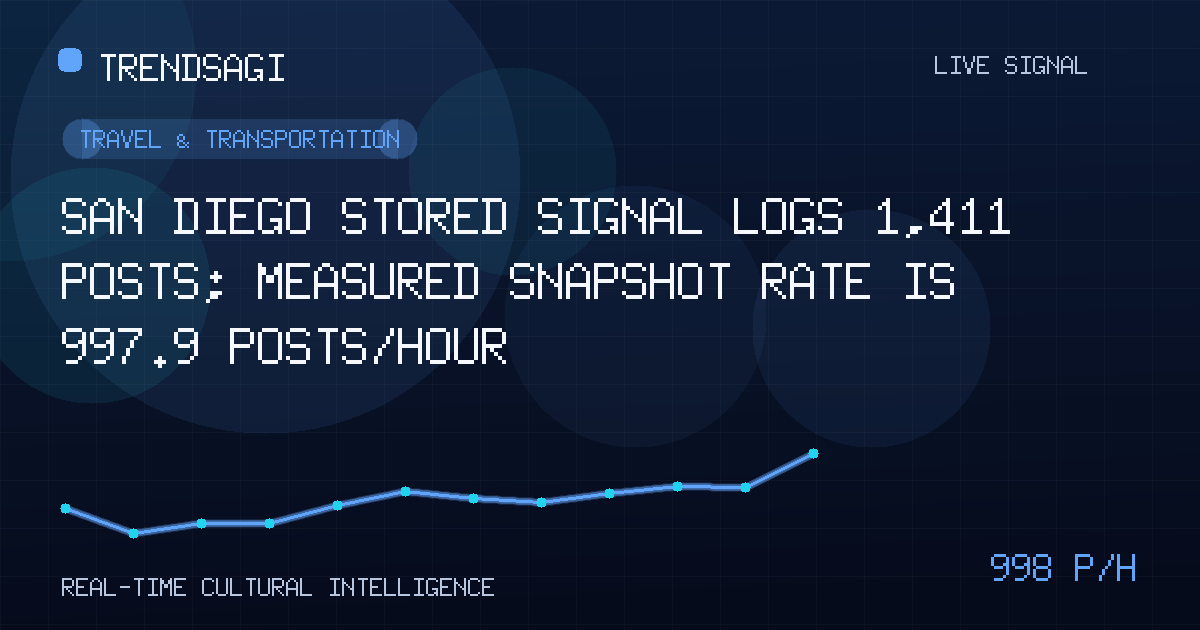
San Diego stored signal logs 1,411 posts; measured snapshot rate is 997.9 posts/hour
San Diego's stored signal shows 1,411 posts and a measured 997.9 posts/hour snapshot rate; the cause is unconfirmed, with practical checks for travel readers.
Automated briefing. Generated from stored signal measurements and source-backed research; it is not manually reviewed. Read the methodology and limitations.
Metrics in this briefing are a snapshot associated with its publication date and may not reflect current conditions.
What changed
The stored San Diego signal logged 1,411 posts in the latest snapshot, while its measured snapshot rate was 997.9 posts/hour over an exact 1,804-second window using 3 stored observations. The direct answer is limited: the stored sample merits closer monitoring, but no verified cause is established, and the activity cannot be treated as a confirmed citywide event.
| Metric | Stored observation |
|---|---|
| Observation time | 2026-10-06T22:55:43Z |
| Measured snapshot rate | 997.9 posts/hour |
| Latest snapshot volume | 1,411 posts |
What the figures do not mean: The 997.9 posts/hour figure is a measured snapshot rate, not a live or current rate. It is not a forecast, reach estimate, engagement measure, or count of unique people. With only 3 stored observations and no comparison baseline in the supplied record, it cannot establish whether activity is accelerating, cooling, or unusual against normal San Diego discussion. The 1,411 figure is the latest snapshot volume; it must not be substituted for the hourly rate.
Why this topic may be moving
No verified public explanation accompanies the stored signal, so the cause remains unclear. It would be premature to connect the movement to a named event, policy, disruption, or destination update. Travel & Transportation is the stored category, but that label describes the monitoring bucket, not what authors were actually discussing.
- Event attention: A scheduled gathering or announcement could produce a time-bound burst, but no specific event is verified here.
- Transport operations: Conversation could concern road, rail, airline, or transit conditions. The signal does not show which mode—or whether any operational issue exists.
- Travel conditions: Changes in fares, capacity, access, or destination appeal could prompt reactions, but none can be assigned as the driver from this record.
- Place-label spillover: A broader story may be tagged San Diego even when local impact is weak. Sampling post text is necessary before treating the label as geographic evidence.
The signal establishes observed discussion volume in a defined stored sample. It does not establish why people posted, how many distinct people were involved, whether the posts were influential, or what conditions existed on the ground.
Why it matters
For a destination market, this is a monitoring lead, not an operational alert. It tells researchers where to look next; it does not tell travelers what to do.
- Travel and hospitality teams should determine whether posts concern bookings, access, itineraries, or destination conditions, then compare those themes with operational data before changing forecasts or guest messaging.
- Transportation and city-service teams should check whether repeated references map to a published service notice; social volume alone is not enough to justify operational changes.
- Local publishers should inspect original text and source diversity before assigning a cause or using an event-driven headline.
- Residents and visitors should use confirmed operator, transit, or destination information for decisions, while treating the social signal as a prompt to verify.
What to watch next
Next checks should confirm or reject the signal’s relevance rather than simply generate more narrative around it.
- Persistence: Compare later stored snapshots with this window. A comparable or increasing measured snapshot rate would strengthen the case for continuing attention; a lower rate would suggest the reading may be temporary.
- Vocabulary: Sample posts and group concrete references. If the same disruption, service, event, or policy dominates the language, a specific explanation becomes more plausible; unrelated themes suggest aggregation.
- Geographic precision: Check whether San Diego is the actual subject, merely a location tag, or part of a wider regional conversation. Citywide relevance cannot be assumed from the label.
- Source mix: Separate original posts from reposts, reactions, promotional material, and automated-looking duplication. This helps distinguish spontaneous attention from repetition without treating volume as unique reach.
- External corroboration: Seek a verified statement from a relevant publisher, operator, transit agency, or event organizer whose timing and subject match the sampled posts. Agreement would support a real-world explanation.
- Operational cross-check: Compare claims with current official service notices, road information, or event communications. If conversation and verified conditions diverge, preserve that discrepancy rather than forcing a causal narrative.
Methodology and limitations
The measured snapshot rate covers an exact 1,804-second window using 3 stored observations and was measured at 2026-10-06T22:55:43Z. It is a property of that stored observation window. The latest snapshot volume of 1,411 is a separate count. Because the record does not state that snapshot’s duration or collection method, the figures should not be combined, annualized, or treated as covering identical periods.
The signal also lacks a historical baseline, source-level breakdown, geographic precision, author deduplication, engagement distribution, and verified cause. The topic classification may include loosely related or location-tagged posts. The data therefore supports a rapid verification workflow: inspect fresh samples, check source diversity, seek public corroboration, and then decide whether the activity reflects a durable travel or transportation issue, a short-lived information spike, or broad place-name chatter. Until that work is done, the cause remains unclear.
Track This Topic for New Signals
Set alerts for future velocity or sentiment changes around this topic.
Explore Tracking PlansAbout TrendsAGI research
TrendsAGI's automated research pipeline publishes dated signal snapshots, methodology notes, and practical workflows for teams evaluating cultural momentum. Read how signals are scoped, scored, and limited in our research methodology.