899-second window · 3 observations · Measured Oct 8, 2026, 1:56 PM UTC · Provider: go_recent_snapshot_v2
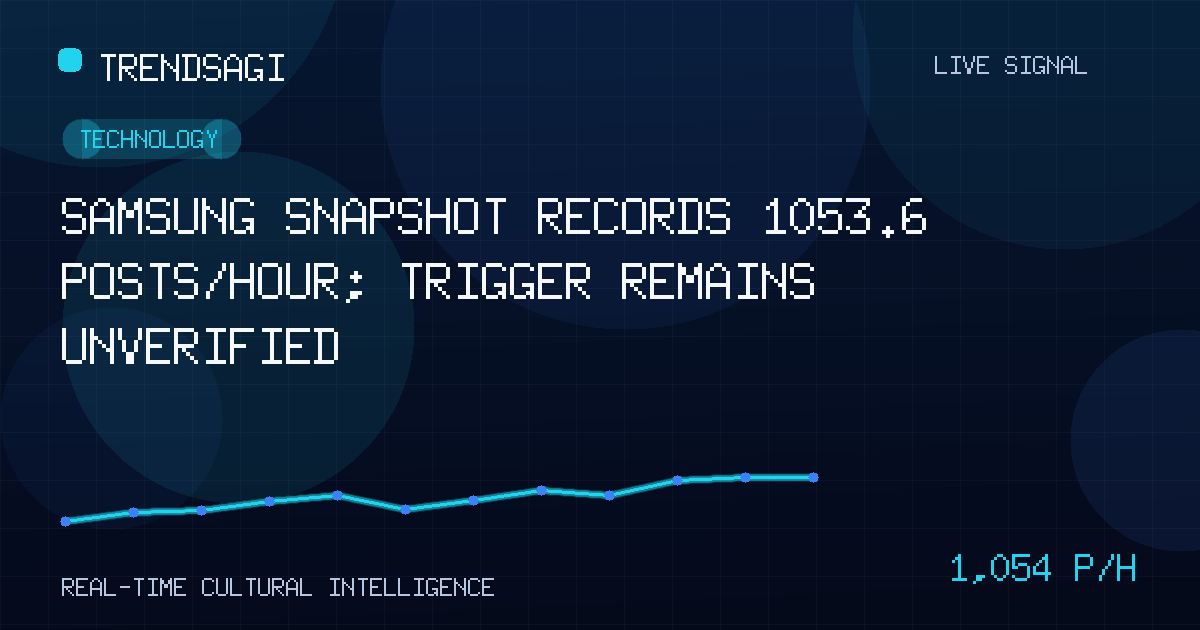
Samsung snapshot records 1053.6 posts/hour; trigger remains unverified
Samsung's stored snapshot contains 1028 posts and a measured 1053.6 posts/hour rate; this briefing explains what it establishes and how to verify the cause.
Automated briefing. Generated from stored signal measurements and source-backed research; it is not manually reviewed. Read the methodology and limitations.
Metrics in this briefing are a snapshot associated with its publication date and may not reflect current conditions.
What changed
The direct conclusion is limited: at the sampled moment, the Samsung topic registered 1028 posts and a measured snapshot rate of 1053.6 posts/hour at 2026-10-08T13:56:24Z. The cause cannot be verified from the available record, so no triggering announcement or public development can be responsibly named.
The 1053.6 posts/hour figure was measured over an exact 899-second window using 3 stored observations. It is a measured snapshot rate, not a live or current rate, forecast, reach, engagement, or unique-person count. The 1028 figure is separate snapshot volume, not a rate.
| Observation time | 2026-10-08T13:56:24Z |
|---|---|
| Measured posts/hour | 1053.6 posts/hour |
| Snapshot volume | 1028 posts |
Why this topic may be moving
The signal establishes pace within a sampled window, not a cause. It shows a short-window rate of 1053.6 posts/hour, but it does not show whether one announcement, several unrelated stories, a repeated post, or automated amplification drove the result. Those are hypotheses to test, not findings.
No verified public context accompanies the signal, so it would be unsafe to attribute the activity to a product release, corporate announcement, incident, or broader news event. The stored Technology category is useful for routing the topic, but it does not prove that a technology-specific event occurred. Likewise, the Samsung label may collect several kinds of posts rather than one coherent conversation.
A measured posting rate can identify where to look next; only post-level evidence and independently verified context can explain why it happened.
That distinction is especially important because speed can reward premature explanations. A high posting rate can reflect genuine attention, a concentrated reaction, repost behavior, or a monitoring artifact. The available figures do not separate those possibilities.
Why it matters
The immediate value is triage: the signal says Samsung merits closer inspection, not that any particular Samsung story has been proven important. The practical question is whether the activity reflects a new, time-sensitive fact that readers need now.
- Editors and newsrooms should verify the catalyst before treating the topic as breaking news. A fast rate raises the cost of waiting for confirmation, but it does not remove the need to check timestamps and sources.
- Brand, corporate communications, and customer-support teams can use the signal to locate recurring questions or unexpected themes. They should inspect the underlying posts before inferring sentiment, customer intent, or reputation impact.
- Product and market-intelligence teams can treat the snapshot as a prompt for deeper analysis. It is not evidence of demand, sales, preference, or financial impact, and it should not be used as a substitute for those measures.
- Trust and safety researchers may need to check whether repeated or coordinated accounts contributed. Coordination cannot be established from volume alone.
What to watch next
The next step is to move from the topic label to the posts themselves. Retrieve the full sample for the measured window, plus adjacent complete windows, and retain each post's timestamp, source, language, author identifier, and text. That will show whether the short-window rate persisted or was a brief cluster.
- Cluster the content. Group posts by specific subtopic and compare their timestamps. A single dominant thread would support a narrower explanation; several unrelated threads would point to a broader mix. Neither outcome should be assumed in advance.
- Check term relevance. Review whether every item truly concerns the intended Samsung subject. Remove obvious duplicates, quoted reposts, and unrelated matches before interpreting the sample.
- Test the timeline against verified context. A credible catalyst should have a publication or announcement time that aligns with the burst. The event must be verified independently before it is named as the cause.
- Separate volume from authorship. Count original posts and distinct authors where the data allows. If many items trace to the same source, the apparent conversation may be much narrower than 1028 posts suggests.
- Compare complete windows. Check whether subsequent measured rates remain near, above, or below 1053.6 posts/hour, and whether snapshot volume changes at the same time. Rate and volume answer different questions and should not be merged.
Concrete watch signals would include a verified event timestamp immediately before or within the measurement window; a dominant subtopic across multiple sources; growth in both original posts and distinct authors; persistence across several complete windows; an official response; or independent confirmation from credible reporting. A one-window cluster without those supports should remain classified as unexplained attention rather than a verified trend cause.
Methodology and limitations
This briefing uses the stored observation at 2026-10-08T13:56:24Z. The latest snapshot volume is 1028 posts. The measured snapshot rate is 1053.6 posts/hour, based on an exact 899-second window and 3 stored observations. Because the underlying observation values and post-level sample are not provided here, the calculation cannot be independently reproduced from this briefing.
The short window offers timeliness but weak context. The record contains no earlier rate, historical baseline, sentiment distribution, geography, language split, source list, or account-level duplication analysis. It therefore cannot show how unusual the rate is, how long the activity lasts, who participated, whether people agreed, or whether the activity was organic. Nor can it establish reach or influence.
No external causal claim is made because no verified public context is available to match the signal to a specific event. The appropriate next decision is not to announce a cause, but to inspect the sample and verify the timeline. Until that work is done, Samsung is a fast-moving monitored topic with an unverified trigger.
Track This Topic for New Signals
Set alerts for future velocity or sentiment changes around this topic.
Explore Tracking PlansAbout TrendsAGI research
TrendsAGI's automated research pipeline publishes dated signal snapshots, methodology notes, and practical workflows for teams evaluating cultural momentum. Read how signals are scoped, scored, and limited in our research methodology.