1791-second window · 2 observations · Measured Sep 27, 2026, 11:10 PM UTC · Provider: go_recent_snapshot_v2
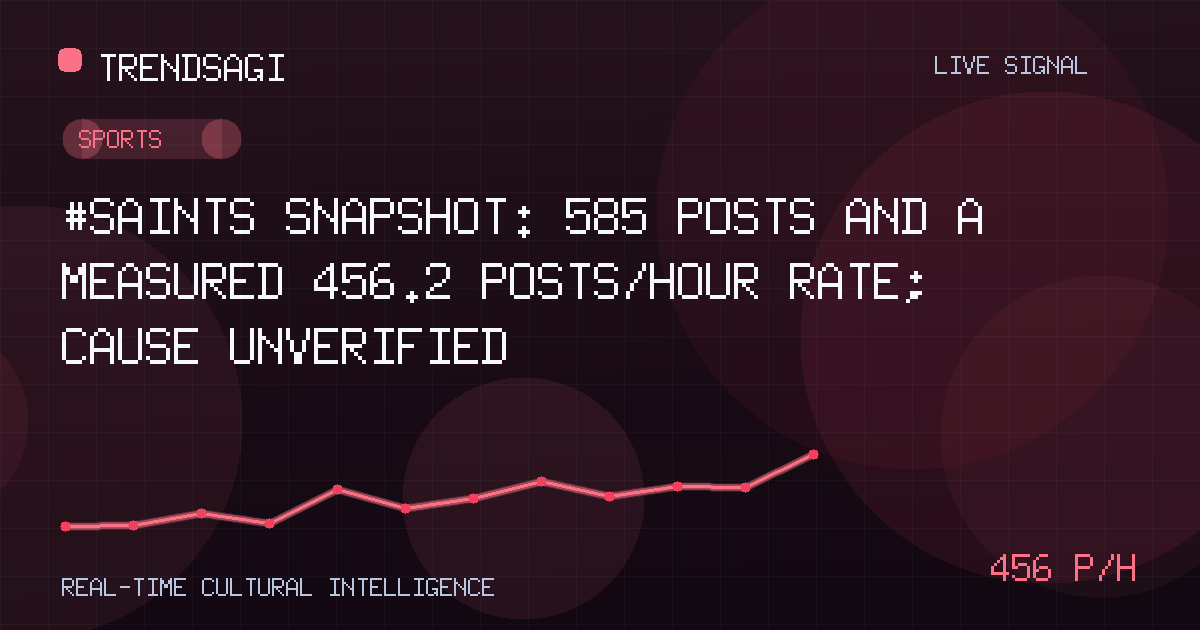
#Saints snapshot: 585 posts and a measured 456.2 posts/hour rate; cause unverified
#Saints recorded 585 posts and a 456.2 posts/hour measured snapshot rate; cause remains unclear, with checks for editors and analysts.
Automated briefing. Generated from stored signal measurements and source-backed research; it is not manually reviewed. Read the methodology and limitations.
Metrics in this briefing are a snapshot associated with its publication date and may not reflect current conditions.
What changed
The #Saints topic recorded 585 posts in its latest snapshot at 2026-09-27T23:10:31Z. The direct answer is that posting activity moved in the observed interval, but why it moved is not verified: no public catalyst has been established for this briefing.
The measured change rate was 456.2 posts/hour over an exact 1791-second window using 2 stored observations. This is a measured snapshot rate, not a live or current rate, forecast, reach figure, engagement count, or unique-person count. The 585 posts are a separate snapshot volume, not a rate, and should not be substituted for one.
| Observation time | 2026-09-27T23:10:31Z |
|---|---|
| Measured posts/hour | 456.2 posts/hour |
| Snapshot volume | 585 posts |
Why this topic may be moving
A sports interpretation is plausible because the topic is classified as Sports. Even so, #Saints alone does not establish which team, person, event, or wider conversation is producing the posts. The same label can mix fandom, criticism, general discussion, and unrelated uses. A team-related explanation is therefore plausible, but not proven.
The current record supplies no event description, and no verified public context links the movement to a game, roster move, injury, controversy, or announcement. Those are examples of possible catalysts, not explanations supported by the signal. The absence of a verified catalyst does not prove that no event happened; it means the observed activity should not be assigned to one yet.
The defensible conclusion is narrower: #Saints drew 585 posts in the observed snapshot, while the reason for the measured change remains unverified.
Volume also cannot reveal whether posts express support, criticism, confusion, or coordinated repetition. A single hashtag can combine several conversations, so apparent momentum may reflect multiple narratives rather than one shared story.
Why it matters
This signal is most useful as a verification trigger for people working under time pressure.
- Sports editors and reporters: The rate can prompt a fast check, but it cannot establish newsworthiness. A reporter should identify the subject and find a credible causal match before describing the activity as reaction to an event.
- Team, sponsor, and community teams: Responding to an ambiguous hashtag can misdirect a message or touch the wrong audience. Entity confirmation and sentiment checks should precede public outreach.
- Trend and audience analysts: The snapshot should rank monitoring priority, not audience size. It does not show how many people saw, authored, or engaged with the posts.
What the signal can—and cannot—establish
- Can establish: The observation time, the 585-post snapshot volume, and the 456.2 posts/hour measured rate over the stated window.
- Can support: Prioritizing a rapid identity and cause check rather than dismissing the topic as static.
- Cannot establish: Which entity the hashtag concerns, what caused the movement, or whether the activity persists beyond the observed interval.
- Cannot measure from this record: Sentiment, geography, unique authors, reach, engagement, organic participation, or whether repeated posts are independent.
What to watch next
Useful next checks should separate identity, cause, and durability.
- Sample the posts. Inspect a cross-section of recent posts and account descriptions for explicit references to a team, person, event, or phrase. Record which interpretation dominates and whether unrelated meanings remain visible.
- Verify a catalyst on the public web. Use Google Search for #Saints with the observation date and candidate entity terms found in the sample. Treat an event as explanatory only when a credible publisher explicitly connects it to the hashtag and the timing; a search result or unlabeled social post alone is not enough.
- Build a comparable time series. Collect additional snapshots using consistent window lengths. Keep snapshot volume and measured posts/hour in separate fields, and record whether the rate remains elevated, recedes, or changes direction.
- Check concentration and independence. Look for repeated wording, common source links, or many posts that appear to copy one another. This does not prove automation, but it can show whether volume represents broad discussion or repetition around a single item.
- Watch for corroboration. Stronger evidence would be several credible outlets naming the same catalyst, participants clearly referring to the same entity, and additional observation windows showing continued activity.
- Define the next reporting decision. If the subject remains mixed, report only the observed hashtag volume and rate. If a catalyst is verified, add it with attribution. If activity decays, treat the movement as a short-lived burst rather than an established trend.
Methodology and limitations
The figures are reported as recorded: observation time 2026-09-27T23:10:31Z, latest snapshot volume 585 posts, and measured change rate 456.2 posts/hour across 1791 seconds using 2 observations. The rate is historical and measured, not live. It is not recalculated, annualized, or forecast.
With only 2 observations and no longer baseline, the signal cannot establish normal activity, statistical significance, duration, or a durable trend. Platform collection boundaries, repeated content, and mixed topic use may affect interpretation. No claim about a specific real-world catalyst is made because none is verified here.
Track This Topic for New Signals
Set alerts for future velocity or sentiment changes around this topic.
Explore Tracking PlansAbout TrendsAGI research
TrendsAGI's automated research pipeline publishes dated signal snapshots, methodology notes, and practical workflows for teams evaluating cultural momentum. Read how signals are scoped, scored, and limited in our research methodology.