2705-second window · 3 observations · Measured Sep 27, 2026, 5:55 PM UTC · Provider: go_recent_snapshot_v2
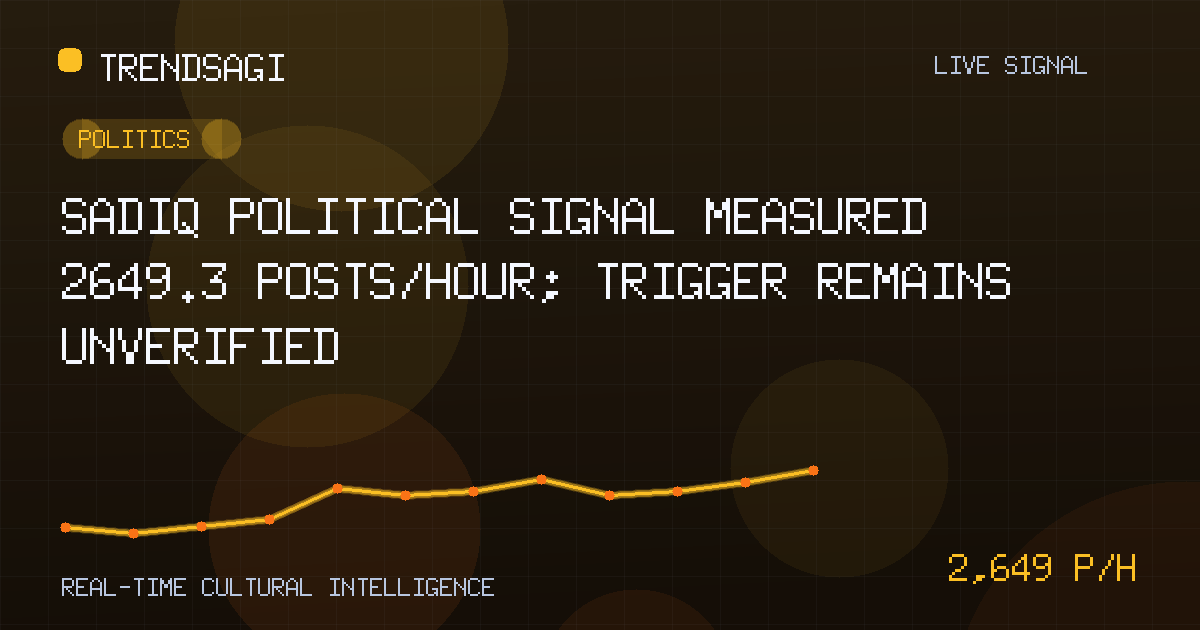
Sadiq political signal measured 2649.3 posts/hour; trigger remains unverified
Sadiq-tagged politics posts recorded 2649.3 posts/hour in a measured snapshot; the trigger is unclear, with practical verification steps.
Automated briefing. Generated from stored signal measurements and source-backed research; it is not manually reviewed. Read the methodology and limitations.
Metrics in this briefing are a snapshot associated with its publication date and may not reflect current conditions.
What changed
The “Sadiq” Politics signal records a positive measured change in tagged-post activity, but it does not support a specific causal headline. The supplied label does not establish whether the posts concern a single public figure, multiple identities, or incidental mentions, and no verified public event has been attached to the movement. The reliable finding is increased posting throughput; the reason remains unclear.
At the 2026-09-27T17:55:11Z observation, the measured snapshot rate was 2649.3 posts/hour across an exact 2705-second window using 3 stored observations. The latest snapshot volume was 2117 posts. The posts/hour figure is a measured snapshot rate, not a live or current rate, forecast, reach, engagement total, or count of unique people.
| Measure | Stored observation |
|---|---|
| Observation time | 2026-09-27T17:55:11Z |
| Measured snapshot rate | 2649.3 posts/hour |
| Latest snapshot volume | 2117 posts |
| Measurement basis | Exact 2705-second window using 3 stored observations |
Why this topic may be moving
No verified cause can be assigned from this observation alone. Because “Sadiq” does not identify a full person or event, the collection may combine different identities or incidental mentions. Entity ambiguity is therefore a serious alternative to treating every increase as response to one political development.
Several mechanisms could produce the observed change. They are hypotheses to test, not findings:
- Event response: A speech, announcement, interview, controversy, or campaign action involving someone named Sadiq could generate political discussion. A dated primary statement or report would be needed to support that explanation.
- Media or search amplification: An article, video, or quoted phrase could become a reference point and prompt broader posting without representing a new underlying event.
- Entity mixing: Posts about different people or topics may be pooled under the same first-name label, making unrelated conversations appear to be one trend.
- Repetition or coordination: Repeated wording, repost networks, or clustered publishing could increase post volume without an equivalent increase in independent discussion.
- Collection changes: A shift in sourcing, keyword matching, or topic classification could alter what enters the signal without a comparable change in actual conversation.
A Google Search verification should begin with exact phrases and fuller identity candidates found in a post sample. Any proposed trigger should be matched to a dated public report or primary statement and checked against the timing of the sampled posts. If the public record cannot be tied to the language and chronology of the activity, the cause should remain explicitly unverified.
An increase in posts carrying an ambiguous label establishes changed posting throughput, not a particular event, actor, audience, or political impact.
Why it matters
For editors and newsrooms, the immediate risk is misattribution. Publishing that “Sadiq is trending because” a specific event occurred would go beyond the evidence unless the identity, event, and chronology are independently established. The current signal supports coverage of an unresolved monitoring alert, not a causal news claim.
For researchers and analysts, the distinction between 2649.3 posts/hour and 2117 posts is essential. The former is the supplied measured rate over a defined window; the latter is the latest snapshot inventory. Neither establishes how many people participated, how widely the material traveled, or whether the same content was posted repeatedly.
For communications, public-affairs, and trust-and-safety teams, the next question is whether the signal represents broad public attention, a concentrated burst, or mixed entities. Those scenarios require different responses: reporting, identity correction, amplification analysis, or monitoring for coordinated inauthentic behavior.
What to watch next
The most useful follow-up work is verification that can change the interpretation, rather than another unqualified mention of the topic label.
- Resolve the identity: Review a time-ordered post sample and record full names, account handles, roles, locations, and co-occurring terms. Separate posts that clearly refer to different people or events.
- Establish chronology: Use the earliest sampled posts as the starting point, then search their exact wording and full-name variants on Google Search. Check whether a dated publisher report or primary statement actually precedes or aligns with the activity.
- Test concentration: Where the data permits, examine unique accounts, unique text, repost ratios, leading-account share, and tight timing clusters. These checks can show whether the volume reflects broad discussion or repeated distribution.
- Split the aggregate: Recalculate the activity by resolved identity, event, language, and geography when metadata supports it. If “Sadiq” covers distinct subjects, the combined headline may be misleading.
- Check persistence: Gather subsequent complete observation windows measured on the same basis. A reversal would support a short burst; continued elevation would indicate a more persistent pattern. Neither outcome should be assumed in advance.
- Require corroboration: A defensible causal explanation should connect an identifiable actor or artifact to a dated public record and, where available, independent reporting. Repetition around one account should not be treated as corroboration by itself.
Methodology and limitations
The reported 2649.3 posts/hour is a measured snapshot rate calculated from 3 stored observations across an exact 2705-second window associated with the stated observation time. The 2117-post figure is the latest snapshot volume, a separate measure that should not be converted into a rate. The underlying observation values are not provided here, so the calculation cannot be reconstructed or tested for sensitivity.
The signal does not supply a historical baseline, observation-level counts, geography, language, account uniqueness, engagement, sentiment, source mix, or a verified triggering event. It therefore cannot establish statistical significance, organic participation, national reach, or causation. The Politics category is a stored classification; it does not independently prove that every counted post contains substantive political discussion. The alert should remain an investigation lead until identity, context, and chronology are resolved.
Track This Topic for New Signals
Set alerts for future velocity or sentiment changes around this topic.
Explore Tracking PlansAbout TrendsAGI research
TrendsAGI's automated research pipeline publishes dated signal snapshots, methodology notes, and practical workflows for teams evaluating cultural momentum. Read how signals are scoped, scored, and limited in our research methodology.