902-second window · 3 observations · Measured Oct 8, 2026, 1:56 AM UTC · Provider: go_recent_snapshot_v2
Sabrina Ionescu posts surge to a measured 17,518.7 per hour; trigger unverified
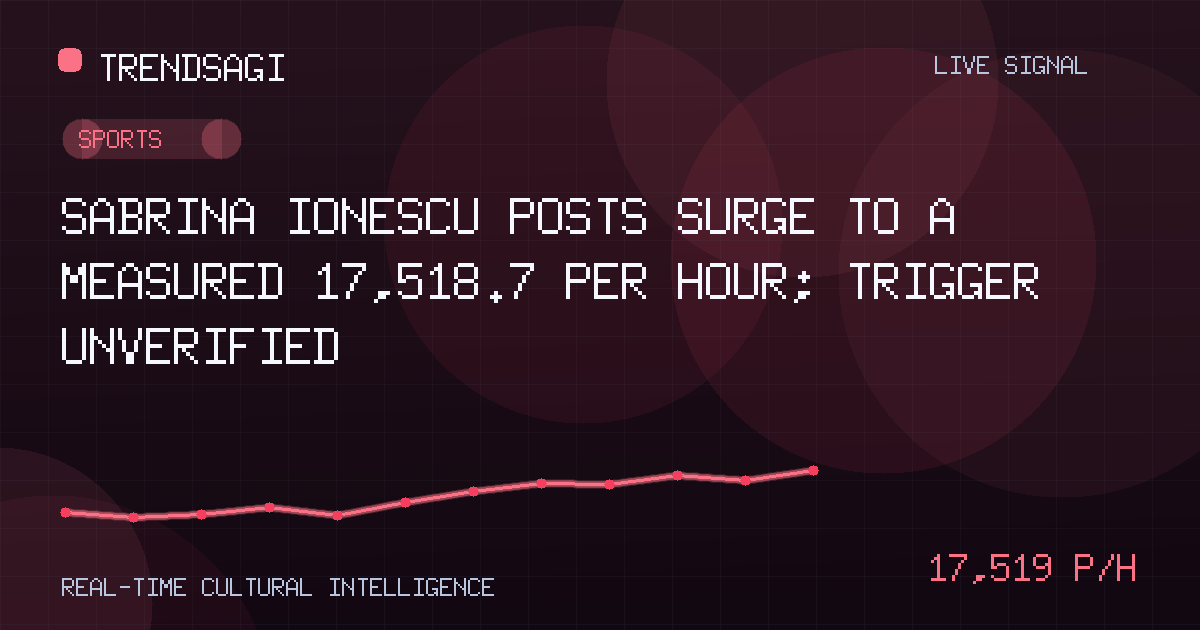
Stored Sabrina Ionescu posts surged to a measured 17,518.7 posts/hour; the 4,500-post snapshot shows scale, not cause.
Automated briefing. Generated from stored signal measurements and source-backed research; it is not manually reviewed. Read the methodology and limitations.
Metrics in this briefing are a snapshot associated with its publication date and may not reflect current conditions.
What changed
The stored series shows a sharp, short-window surge in posts about Sabrina Ionescu, but there is not enough verified public context to explain why. For editors, this is a verification alert: a large change has been measured, while any connection to a game, injury, controversy, award, or viral post remains a hypothesis.
The canonical series records a measured snapshot rate of 17,518.7 posts/hour over an exact 902-second window using 3 stored observations, with the latest observation at 2026-10-08T01:56:26Z. This is not a live or current rate, forecast, reach, engagement figure, or count of unique people. The latest snapshot volume was 4,500 posts.
| Metric | Stored value |
|---|---|
| Observation time | 2026-10-08T01:56:26Z |
| Measured snapshot rate | 17,518.7 posts/hour |
| Latest snapshot volume | 4,500 posts |
Why this topic may be moving
No verified public trigger is identified in the available record. The stored category is Sports, but that classification does not prove which event, if any, generated the posts. Without an attributable report or official announcement tied to the observation, the cause remains unverified.
Several non-equivalent mechanisms could produce this pattern:
- Event reaction: A game result, lineup or injury update, award discussion, or record milestone could cause a rapid response. These are checks to investigate, not findings about Ionescu.
- Viral recirculation: A clip, quotation, screenshot, or already-published story may have been redistributed rapidly without a newly announced event.
- Repetition or coordination: A volume burst can be amplified by a small group, automated accounts, repeated wording, or organized reposting. Volume alone does not reveal organic participation.
- Measurement effects: Changes in collection, topic matching, duplicate handling, or the number of stored observations could also affect the calculated movement.
The signal establishes a burst in recorded post activity, not the event behind it, who participated, or how many distinct people were involved.
Why it matters
For sports editors and newsrooms, the surge raises verification priority but does not increase confidence in any particular explanation. A fast-moving topic can reflect genuine audience demand, but it can also reflect repetition, speculation, or a misleading match between the topic label and the underlying posts. The responsible next step is to establish a timestamped trigger before using language such as “reaction to” or “spurred by.”
For trend and audience analysts, the important question is persistence rather than magnitude alone. The measured rate covers one exact window, while the 4,500-post figure is the stored level at the latest observation. Neither figure establishes how long the activity will last, whether the topic is still accelerating, or whether new and original posts are replacing recycled material.
For readers and communities following the athlete, premature attribution creates a second risk: repetition can make an unverified explanation appear to be consensus. Clear labeling should distinguish the measured change from any proposed cause and avoid presenting hypothesis as established context.
What to watch next
A useful follow-up should turn the alert into evidence in a fixed order:
- Find the timestamped trigger. Use a Google Search verification pass for reports, official announcements, and relevant event pages around 2026-10-08T01:56:26Z. Record publication times and whether credible information preceded the measured change. If nothing aligns, retain “cause unverified.”
- Sample the post stream. Review representative items from the beginning, middle, and end of the 902-second window. Separate original reactions, quotations, media reproductions, and duplicate text rather than coding only the most visible posts.
- Measure concentration. Check whether activity is distributed across accounts or dominated by a small cluster. Account totals should not be treated as unique people because automated activity, reposting, and multiple accounts can distort that interpretation.
- Test persistence. Compare subsequent observations with neighboring windows of the same length. Continued elevation would support a sustained event cycle; a rapid decline would be more consistent with a temporary burst. Neither outcome would identify the cause by itself.
- Check source convergence. Look for independent credible outlets and an official source converging on the same factual development. Many posts copying one unsupported claim do not constitute independent confirmation.
- Audit topic matching. Confirm that the posts actually concern Ionescu rather than an unrelated namesake, an old quotation presented as new, or content captured through broad keyword matching.
Methodology and limitations
The measured snapshot rate is supplied by the canonical series and is based on 3 stored observations across the exact 902-second interval. It is a time-normalized measure of change expressed per hour. Snapshot volume is a stored count at the latest observation. The two values answer different questions and should not be added or substituted; the available record does not show that all 4,500 posts arrived during the measured window.
The material available for this briefing does not include raw post text, account identities, prior baseline values, geography, language, engagement, source provenance, or a verified event link. It therefore cannot establish who posted, whether the participants were unique, whether the content was organic, whether wording was duplicated, or why the movement began. It also cannot show whether activity continued after the observation timestamp.
The 3 observations support the supplied short-window rate but are insufficient to establish a durable trend. The appropriate editorial status is “high-volume, short-window movement; trigger unverified.” Revisit that conclusion when timestamped public evidence, representative post content, and subsequent observations align.
Bottom line: The spike is operationally significant because the measured snapshot rate is high and the latest snapshot contains 4,500 posts, but its meaning remains unresolved. Confirm the event, content pattern, account concentration, and persistence before publishing a causal explanation.
Track This Topic for New Signals
Set alerts for future velocity or sentiment changes around this topic.
Explore Tracking PlansAbout TrendsAGI research
TrendsAGI's automated research pipeline publishes dated signal snapshots, methodology notes, and practical workflows for teams evaluating cultural momentum. Read how signals are scoped, scored, and limited in our research methodology.


