1033-second window · 3 observations · Measured Sep 30, 2026, 6:11 PM UTC · Provider: go_recent_snapshot_v2
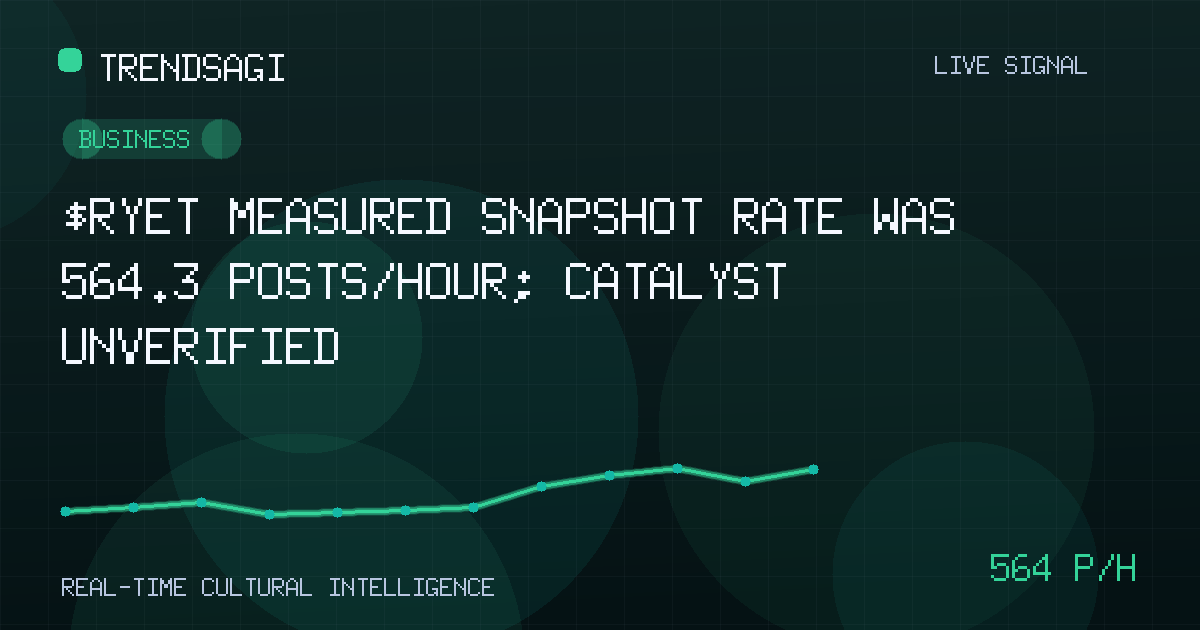
$RYET measured snapshot rate was 564.3 posts/hour; catalyst unverified
A stored $RYET snapshot shows 564.3 posts/hour and 291 posts, with interpretation, limitations, and checks for verifying the catalyst.
Automated briefing. Generated from stored signal measurements and source-backed research; it is not manually reviewed. Read the methodology and limitations.
Metrics in this briefing are a snapshot associated with its publication date and may not reflect current conditions.
What changed
The stored signal shows concentrated posting activity around $RYET at the observed snapshot, but it does not identify a verified public catalyst. The defensible answer is limited to the pace and volume captured; the company, asset, announcement, or event behind the label remains unresolved.
The measured change rate was 564.3 posts/hour across an exact 1033-second window using 3 stored observations, with the snapshot measured at 2026-09-30T18:11:25Z. The latest snapshot contained 291 posts. The rate is a measured snapshot rate, while 291 posts is snapshot volume; neither figure is a live rate, forecast, reach, engagement total, or unique-person count.
| Observation time | 2026-09-30T18:11:25Z |
|---|---|
| Measured snapshot rate | 564.3 posts/hour |
| Snapshot volume | 291 posts |
Why this topic may be moving
No verified public context in the available record explains why $RYET was moving. Nothing reviewed connects the label to a dated corporate announcement, official account post, regulatory filing, exchange notice, product release, or other originating event. The stored Business category is only a classification and does not establish that a business event occurred.
The dollar sign makes a market-style label plausible, but the record does not resolve what RYET denotes. It should not be treated as a confirmed equity ticker, cryptoasset, company name, product code, or campaign identifier. Until the exact entity is matched, entity-specific claims would exceed the evidence.
Possible mechanical explanations—such as repeated quoting, automated posting, coordinated amplification, or unrelated uses of the same label—remain hypotheses, not findings. Without a matched original source and post-level inspection, the signal cannot distinguish broad independent attention from a concentrated publishing burst.
What the signal can establish
The signal is useful as a detection and triage tool. It establishes the following:
- Observed activity: The collection associated 291 posts with $RYET at the stated observation time.
- Measured pace: The supplied rate was 564.3 posts/hour over the exact 1033-second window using 3 stored observations.
- Research priority: The label merits follow-up because short-window activity can make a fast-moving topic easy to miss.
It does not establish who posted, whether posts were original or duplicated, sentiment, credibility, commercial impact, or market impact. It also provides no prior baseline, so the rate alone cannot show whether attention was accelerating, peaking, or fading.
The strongest defensible conclusion is that $RYET produced measurable posting activity in this stored sample; its cause and real-world significance remain unverified.
Why it matters
Readers should care for different reasons depending on the label’s resolved identity:
- Investors and traders: If $RYET resolves to a security, they need a verified issuer, venue, and asset identity before treating the conversation as market-relevant.
- Journalists and researchers: They need an original source and confirmed timing before converting social activity into a news explanation.
- Project or company teams: They may need to monitor label ambiguity, mistaken attribution, or reputation risk even without a confirmed connection.
- Platform and trust teams: They need post-level evidence to assess duplication, automation, spam, or coordinated behavior.
What to watch next
A useful follow-up should seek evidence that can confirm or reject an external catalyst:
- Resolve the identity: Run exact-match searches for $RYET and test whether results consistently refer to one entity. Confirm the spelling and match any official domain, named issuer or project, and relevant registry or venue record before using entity-specific context.
- Find an originating source: Look for the first dated publication or official statement that predates the post cluster. Attribute any confirmed explanation to its publisher and compare its timing with the observation; a later article describing the trend is not necessarily its cause.
- Inspect post diversity: Compare wording, cited sources, account overlap, and posting cadence. Independent discussion supports broader attention, while repeated text may reflect syndication or amplification, although duplication alone does not prove automation.
- Check authenticity: Review account history and source provenance. Do not treat the dollar sign, posting rate, or Business label as proof of official status.
- Track persistence: Add later observations and compare new measured rates with an explicit baseline. Do not describe $RYET as ongoing, growing, or cooling unless subsequent stored evidence supports that wording.
- Watch for resolution: A credible correction, official clarification, or verified entity match would materially improve interpretation. Until then, conclusions should remain descriptive.
Methodology and limitations
The observation time is 2026-09-30T18:11:25Z. The supplied rate covers the exact 1033-second window and uses 3 stored observations. Snapshot volume is reported separately. The available record does not specify collection coverage, deduplication, account uniqueness, geography, language, sentiment, or whether posts were organic, automated, or coordinated. Those omissions prevent estimates of audience, influence, and market significance.
No external cause is asserted because no public fact could be matched and verified against both the label and the timing. The central question—what produced the measured posting activity—therefore remains open. The evidence supports monitoring $RYET and verifying its identity and source trail, not presenting a business or trading narrative as fact.
Track This Topic for New Signals
Set alerts for future velocity or sentiment changes around this topic.
Explore Tracking PlansAbout TrendsAGI research
TrendsAGI's automated research pipeline publishes dated signal snapshots, methodology notes, and practical workflows for teams evaluating cultural momentum. Read how signals are scoped, scored, and limited in our research methodology.


