903-second window · 3 observations · Measured Oct 10, 2026, 5:41 AM UTC · Provider: go_recent_snapshot_v2
Russian snapshot measured 3827.2 posts/hour; catalyst remains unverified
A Russian-topic snapshot measured 3827.2 posts/hour, but the catalyst is unverified; here is how to validate and interpret it.
Automated briefing. Generated from stored signal measurements and source-backed research; it is not manually reviewed. Read the methodology and limitations.
Metrics in this briefing are a snapshot associated with its publication date and may not reflect current conditions.
What changed
The “Russian” topic label recorded a rise in posting activity, but the available evidence does not identify the news event, cultural moment, or other catalyst behind it. The direct answer is therefore narrow: the labeled posting signal registered a positive rate of change, while its cause remains unverified. The broad label is not enough to call this a Russia-related breaking story.
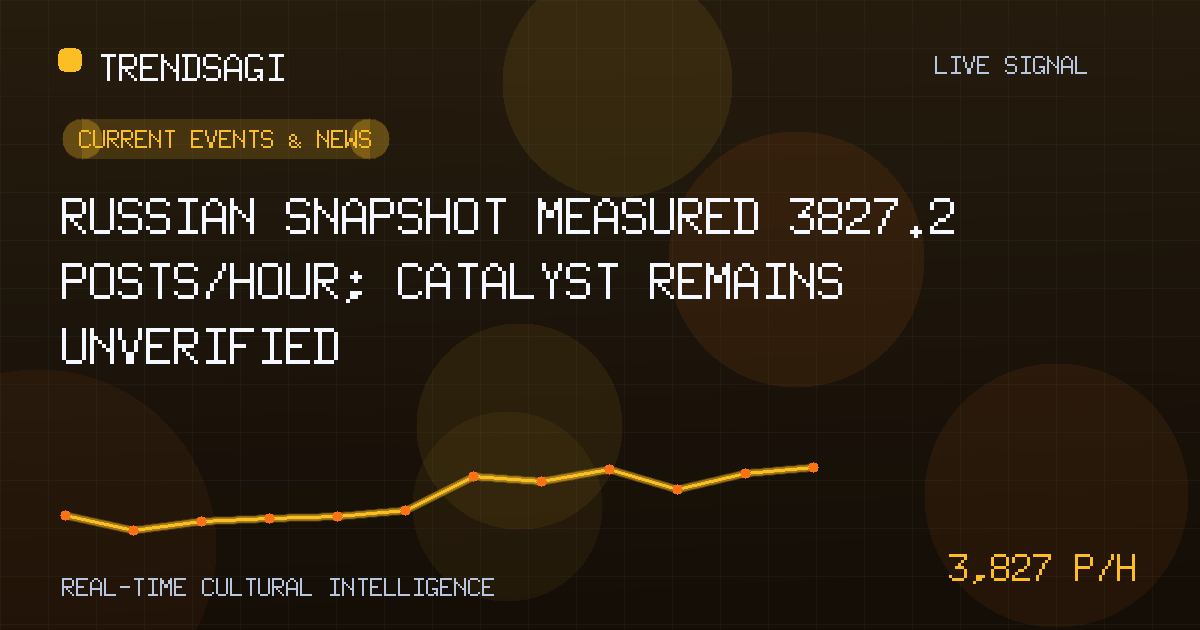
The snapshot was observed at 2026-10-10T05:41:33Z and contained 2400 posts. Across an exact 903-second window using 3 stored observations, the measured change rate was 3827.2 posts/hour. This is a measured snapshot rate—not a live or current rate, forecast, reach, engagement count, or unique-person count.
| Observation time | 2026-10-10T05:41:33Z |
|---|---|
| Measured snapshot rate | 3827.2 posts/hour over an exact 903-second window using 3 stored observations |
| Snapshot volume | 2400 posts |
What the signal can establish
The supported conclusion is temporal: the monitored corpus registered a positive measured rate of change during the defined window. The 2400-post snapshot shows the amount captured at that observation. It should not be treated as the numerator of the rate, substituted for the rate, or combined with it as though both represented the same measure.
- Volume and timing: The record shows where activity was observed and how quickly the sampled count changed.
- Not significance: A large post count does not show that an issue is important, accurate, popular with a particular demographic, or endorsed.
- Not independence: Repeated posts, copied claims, coordinated activity, and one story shared by many accounts can all lift volume.
The signal supports “the conversation became more active in this sample,” not the stronger claim “a specific event caused the conversation.”
Why this topic may be moving
No verified public context accompanies the observation, so attributing the increase to a statement, conflict, election, release, incident, controversy, or platform decision would exceed the evidence. A breaking-news burst, scheduled event, recommendation change, repetitive posting, or classifier shift could produce a similar pattern. These are testable possibilities, not established causes.
“Russian” adds a second layer of ambiguity. It can describe a language, people, institutions, a country and its government, culture, sport, or the use of an adjective in an unrelated context. A broad monitoring label can merge these meanings unless the underlying posts are separated. Without representative text, source links, language fields, and topic clusters, no one interpretation can be said to dominate.
Volume also cannot establish causation. Many posts repeating one claim are not many independent confirmations, and a smaller conversation may have greater consequence. The signal tells editors where to investigate, not what happened or whom to believe.
Why it matters
Newsrooms and media-monitoring teams should care because the burst may indicate an emerging story, a change in platform circulation, or noise that could distort coverage. Before assigning a headline or narrative, they need to identify what the posts actually reference and whether reputable reporting confirms it.
Researchers and analysts should care because an ambiguous label can contaminate comparisons. If the same bucket mixes Russian-language posts with references to Russia, or combines several unrelated events, an apparent spike may reflect classification or sampling effects rather than a coherent trend.
Organizations monitoring Russian-speaking communities should treat the count as a prompt for review, not a description of the community. It does not reveal audience size, sentiment, geography, credibility, or viewpoint diversity. General readers should likewise avoid converting post volume into votes, facts, or urgency.
What to watch next
The next useful step is not a broader guess but a rapid audit of the material behind the label.
- Inspect representative posts: Read enough original items to identify recurring entities, claims, links, quoted text, and timestamps. Separate original reporting from reactions and duplicates.
- Disambiguate the label: Classify whether “Russian” refers primarily to language, nationality, location, institutions, or something else. Look for mixed meanings and classifier errors.
- Check clustering: Determine whether activity centers on one event or several unrelated ones. A single dominant cluster is more actionable than a raw aggregate.
- Measure persistence: Compare the next available snapshots with the same collection and labeling method. A short burst and a sustained shift have different editorial implications.
- Verify externally: Once a concrete claim emerges, look for timely reporting and primary statements from attributable publishers. Do not treat repetition on the monitored platform as verification.
- Audit quality and diversity: Examine source mix, repost patterns, account behavior, and whether independent outlets are adding reporting. This helps distinguish broad attention from amplification.
Concrete warning signs would be a sudden concentration of identical text, one source dominating without corroboration, the label changing meaning, or the rate failing to persist in the next snapshot. Conversely, diverse original posts tied to independently verified developments would make a real event-driven explanation more plausible.
Methodology and limitations
The rate is a measured snapshot rate based on 3 stored observations across an exact 903-second window, ending at the stated observation time. It describes change in captured posts during that interval. It is not a forecast and should not be described as current activity outside the sample.
The latest snapshot volume is 2400 posts. Volume and rate answer different questions: the former is the captured count at an observation; the latter summarizes change across the defined window. The record does not provide post text, baseline history, collection coverage, deduplication status, account counts, or verified public context.
Consequently, this briefing can establish that the labeled signal moved and identify the evidence needed for a causal interpretation. It cannot establish what triggered the movement, who participated, what they believed, or whether the activity was organic.
Track This Topic for New Signals
Set alerts for future velocity or sentiment changes around this topic.
Explore Tracking PlansAbout TrendsAGI research
TrendsAGI's automated research pipeline publishes dated signal snapshots, methodology notes, and practical workflows for teams evaluating cultural momentum. Read how signals are scoped, scored, and limited in our research methodology.