914-second window · 3 observations · Measured Oct 7, 2026, 5:12 PM UTC · Provider: go_recent_snapshot_v2
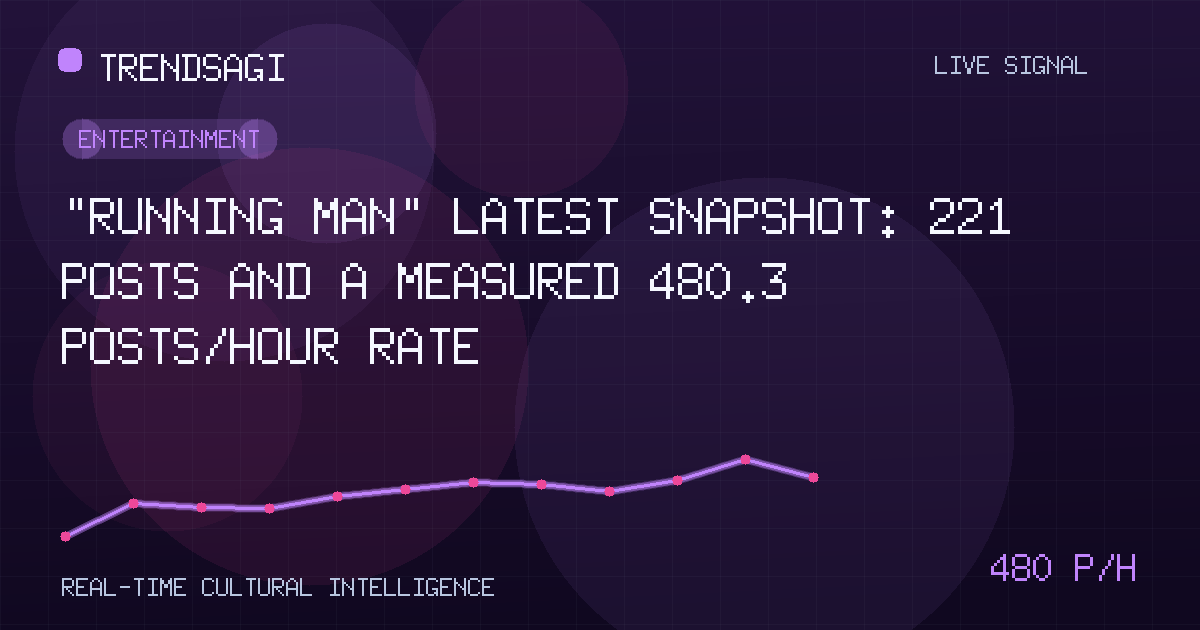
“Running Man” latest snapshot: 221 posts and a measured 480.3 posts/hour rate
The latest “Running Man” snapshot logged 221 posts and a measured 480.3 posts/hour rate; the cause remains unverified, with practical checks for editors.
Automated briefing. Generated from stored signal measurements and source-backed research; it is not manually reviewed. Read the methodology and limitations.
Metrics in this briefing are a snapshot associated with its publication date and may not reflect current conditions.
What changed
“Running Man” registered a short-window acceleration in the stored signal: the latest snapshot contained 221 posts, and the series records a measured snapshot rate of 480.3 posts/hour. That figure comes from 3 stored observations across an exact 914-second window ending at 2026-10-07T17:12:02Z; it describes the sampled feed, not live activity, reach, engagement, or a forecast.
The reason for the movement is not verified. The label is assigned to Entertainment, but neither that category nor the label identifies a specific work, release, performer, controversy, or event. The defensible answer is that post volume accelerated within the stored measurement window while its cause remains unclear.
| Observation time | 2026-10-07T17:12:02Z |
|---|---|
| Measured snapshot rate | 480.3 posts/hour |
| Latest snapshot volume | 221 posts |
Why this topic may be moving
Only the change in activity is established, not the motivation behind it. Several explanations remain hypotheses that need evidence: a timed promotion or entertainment release, a recirculating item gaining reactions, or several unrelated subjects being grouped under the same phrase. None should be promoted to a causal explanation without dated public reporting and a visible connection to the posts.
- Timed-event check: Look for a publisher's dated report on an announcement, release, episode, performance, or controversy. These are candidate event types, not claims that any one occurred.
- Recirculation check: Review the earliest substantive posts and what they cite. A repeated clip, meme, reaction, or repost would point toward amplification rather than a newly confirmed news event.
- Name-collision check: Read enough posts to determine whether “Running Man” refers to one title or several subjects. Without that check, an aggregate label can combine separate conversations and make one story look stronger than it is.
The acceleration is verified within the stored sample; the explanation is not. A confident causal headline would outrun the evidence.
Why it matters
A rapid change can signal a story worth checking, but only if editors separate observation from interpretation. The immediate value is triage: decide whether the topic deserves reporting, what entity it actually concerns, and whether the burst persists beyond the measurement window.
- Entertainment editors can use the signal to prioritize review while avoiding unsupported language such as “breakout” or “viral.”
- Teams connected to a specific “Running Man” property should confirm that the posts refer to their project before responding or drawing conclusions.
- Trend and audience analysts need the next comparable snapshots, source mix, and author counts to judge whether this is broad attention or a concentrated spike.
For readers, the practical benefit is an explicit confidence boundary: there is a measured rise in posts, but no verified story behind it yet.
What to watch next
The next useful evidence is not another summary of the same label. It is evidence that resolves identity, timing, concentration, and persistence.
- Does the acceleration persist? Compare later snapshots using the same measurement method. A return to the prior pattern would suggest a brief burst; sustained elevation across comparable windows would support a more durable change.
- Do the posts converge on one referent? Capture representative text and profile context. If the conversation consistently points to one work or event, the topic can be described specifically. If it splits, the combined count should not be attributed to any one segment.
- Is the burst concentrated? Check the number of distinct authors, repeated source material, leading accounts, and platform mix. A small set of posts copied or reposted many times can look busy without representing broad participation.
- What does Google Search verify? Use the exact phrase with 2026-10-07, then narrow results by candidate terms such as trailer, episode, game, performance, or official announcement. A useful result should come from an identifiable publisher, carry a publication time, and describe a specific event that can be matched to the post timeline.
- What came first? Establish whether a public item or the earliest posts appeared before the measured increase. The sequence supports context, but a close match in time still does not by itself prove causation.
- Is the conversation substantive? Separate original reactions from duplicates, automated-looking repetition, and generic phrase matches. Also distinguish discussion from reactions to the discussion, which can create a second wave.
Conditional outcomes should be handled differently. A brief, concentrated spike around one verified item would support an event-driven interpretation. Sustained activity across later windows would provide stronger evidence of continuing attention. Divergent referents would instead make topic aggregation the central concern. None of those outcomes is established yet.
Methodology and limitations
The reported rate is a measured snapshot rate based on 3 stored observations over the exact 914-second window and is timestamped 2026-10-07T17:12:02Z. The latest snapshot volume is 221 posts. These are separate measures: 221 is the count in that snapshot, while 480.3 posts/hour describes change only within the stored window.
The signal can show that the sampled series registered positive short-window change and can justify closer inspection. It cannot establish unique participants, reach, engagement, sentiment, geography, platform distribution, organic versus automated activity, market share, or the reason people posted. The topic label also lacks a stored description, so the subject matter cannot be resolved from the signal alone.
No verified public item was available to tie the movement to a specific trigger. Any later causal account should name the publisher of the relevant public information, state what it reported, and connect that event to the observed timing without overstating what the post count proves.
Track This Topic for New Signals
Set alerts for future velocity or sentiment changes around this topic.
Explore Tracking PlansAbout TrendsAGI research
TrendsAGI's automated research pipeline publishes dated signal snapshots, methodology notes, and practical workflows for teams evaluating cultural momentum. Read how signals are scoped, scored, and limited in our research methodology.