2687-second window · 3 observations · Measured Oct 8, 2026, 4:56 PM UTC · Provider: go_recent_snapshot_v2
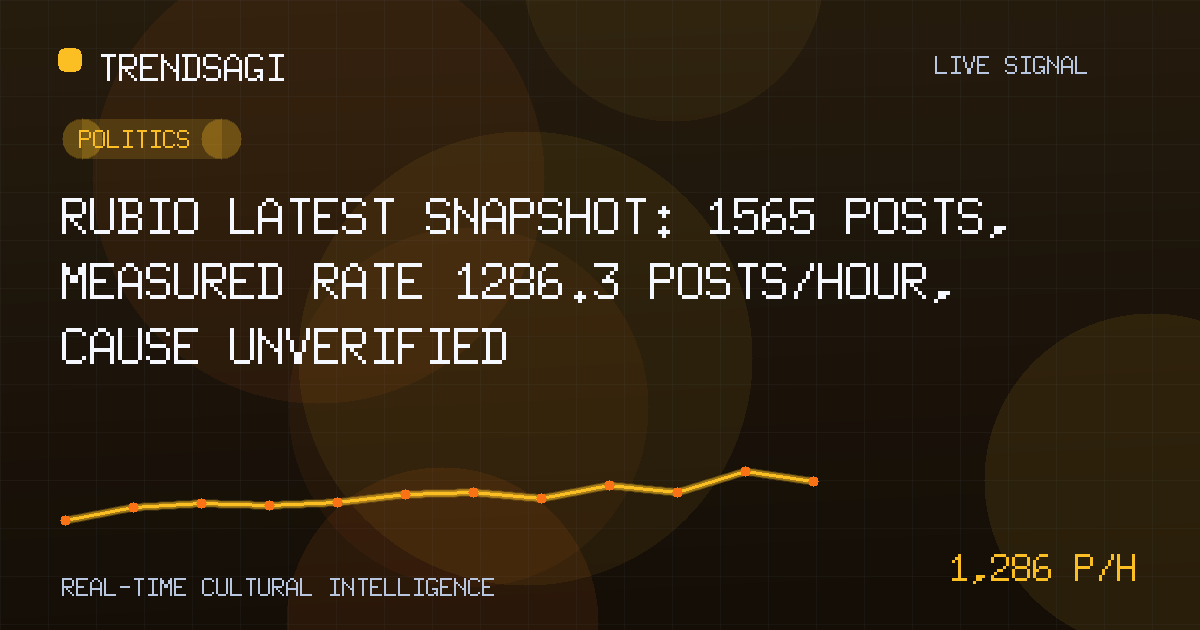
Rubio latest snapshot: 1565 posts, measured rate 1286.3 posts/hour, cause unverified
The latest Rubio snapshot contains 1565 posts and a measured 1286.3 posts/hour, while the identity and event behind the activity remain unverified.
Automated briefing. Generated from stored signal measurements and source-backed research; it is not manually reviewed. Read the methodology and limitations.
Metrics in this briefing are a snapshot associated with its publication date and may not reflect current conditions.
What changed
The monitored topic labeled “Rubio” was active at the latest observation, but the monitoring record does not establish why it was moving. The latest snapshot volume was 1565 posts. Because the label supplies no full identity, office, location, policy issue, or event—and because no verified public context is attached—the activity should not be attributed to a particular person or development.
The measured snapshot rate—the available change metric—was 1286.3 posts/hour over an exact 2687-second window using 3 stored observations, ending at 2026-10-08T16:56:25Z. It is not a live rate, forecast, reach figure, engagement measure, or count of unique people. No earlier comparison rate is supplied, so the record supports intensity within the measured window, not a claim that activity rose relative to an earlier baseline.
| Observation time | Measured snapshot rate | Latest snapshot volume |
|---|---|---|
| 2026-10-08T16:56:25Z | 1286.3 posts/hour | 1565 posts |
Why this topic may be moving
No verified public context has been established for this snapshot, so the cause remains unclear. The stored Politics category tells us how the signal was classified; it does not identify the underlying event. A posting burst can be associated with breaking news, a scheduled appearance, a political confrontation, a social-media controversy, coordinated amplification, or collisions among people sharing the same surname. Those are possible mechanisms, not verified explanations for this signal.
The most useful attribution test is temporal and semantic: establish a credible public event, confirm that it preceded the measured activity, and inspect a representative sample to determine whether those posts actually refer to it. A publisher report or official statement can verify the event itself. It cannot, without conversation-level evidence, prove that the event caused this particular burst.
A posting spike identifies where attention accumulated; it does not, by itself, identify the event, actor, sentiment, or truth of the claims driving that attention.
That distinction matters because monitoring can detect concentration before it understands meaning. The immediate editorial questions are which Rubio is being discussed, what event if any is referenced, and whether the activity persists beyond the current observation. Until those questions are answered, the label is a verification lead rather than a complete story.
Why it matters
The signal can do useful triage: it says that 1565 posts sat in the latest snapshot and that the stored observations yielded a measured snapshot rate of 1286.3 posts/hour. That is enough to prioritize review. It is not enough to infer what people believe, whether the activity is organic, or whether politics, foreign policy, elections, or another subject is driving it.
- News editors and reporters: Use the signal to decide what deserves immediate entity and source checking, not as evidence that a particular story is developing.
- Public-policy, campaign, and communications teams: Determine whether the label concerns an organization or person they track before responding, briefing, or escalating.
- Researchers: Treat the observations as leads for sampling and longitudinal analysis, not as a representative sample of public opinion.
- Readers and decision-makers: Distinguish conversation volume from consensus. Many posts can amplify a claim without making it accurate or broadly supported.
The signal cannot establish sentiment, geography, language, account uniqueness, organic versus automated participation, repost duplication, engagement, source reliability, or policy consequences. It also cannot show that one event caused the posts. Those questions require the underlying sample and comparison data.
What to watch next
- Resolve the entity. Check whether sampled posts repeatedly use a full name, title, office, location, handle, or other distinctive identifier. A bare surname is weak evidence for attribution.
- Establish sequence. Find a credible, timestamped public development that occurred before the measured window. A report published after the observation cannot explain the earlier burst.
- Inspect content. Code a representative sample by subject, claim, and source type, noting whether authors are discussing news, reposting, reacting, or using the name incidentally.
- Build a baseline. Compare equivalent windows before and after this snapshot. The present rate is measurable, but without an earlier rate it cannot establish acceleration, novelty, or abnormal elevation.
- Test duplication and authenticity. Look for repeated wording, synchronized posting, account reuse, or reliance on a common originating post. Raw volume can overstate independent attention.
- Check persistence. Review later snapshots to see whether activity remains concentrated around the same identity and event or quickly disperses into unrelated uses of the name.
Stronger confirmation would be convergence: a verified event, pre-existing timing, stable identity references, multiple independent posts, and continuity in later snapshots. Weaker confirmation would be a viral but unattributed post, heavy duplication, inconsistent identities, or a burst with no durable follow-through. These are watch signals, not thresholds or forecasts.
Methodology and limitations
The observation time is 2026-10-08T16:56:25Z. The rate of 1286.3 posts/hour is the supplied measured snapshot rate for an exact 2687-second window based on 3 stored observations. The figure of 1565 is a separate snapshot-volume measure. It describes the amount captured at the observation, while the rate describes posting pace across the measured window; neither figure establishes audience size or causation.
No baseline, raw observation counts, query definition, collection coverage, post sample, sentiment, engagement distribution, or account-level authenticity data are provided. The Politics label is a category assignment, not proof of the subject discussed. No external event is presented as the explanation because no attributable public development has been verified for this observation. The defensible conclusion is therefore narrow: “Rubio” generated substantial recorded activity, but its identity, cause, direction relative to history, and real-world significance remain unresolved.
Track This Topic for New Signals
Set alerts for future velocity or sentiment changes around this topic.
Explore Tracking PlansAbout TrendsAGI research
TrendsAGI's automated research pipeline publishes dated signal snapshots, methodology notes, and practical workflows for teams evaluating cultural momentum. Read how signals are scoped, scored, and limited in our research methodology.


