901-second window · 3 observations · Measured Oct 1, 2026, 7:21 PM UTC · Provider: go_recent_snapshot_v2
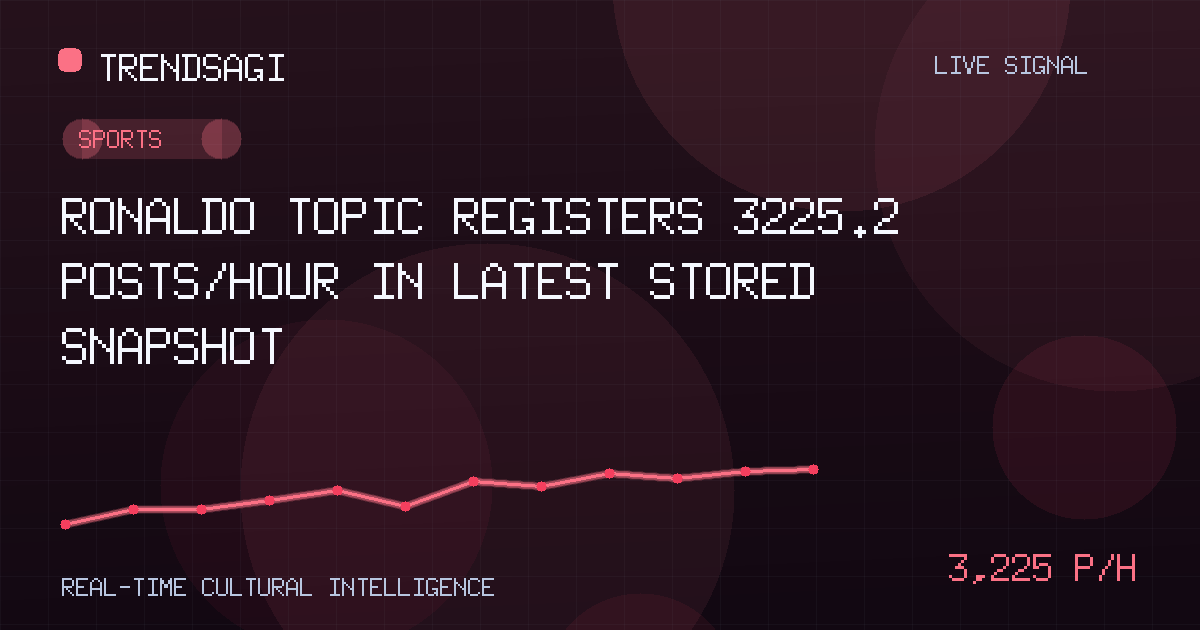
Ronaldo topic registers 3225.2 posts/hour in latest stored snapshot
The Ronaldo signal recorded 4235 posts and a measured 3225.2 posts/hour rate; the figures show intensity, but not the unverified cause.
Automated briefing. Generated from stored signal measurements and source-backed research; it is not manually reviewed. Read the methodology and limitations.
Metrics in this briefing are a snapshot associated with its publication date and may not reflect current conditions.
What changed
The monitored Ronaldo topic shows a concentrated burst of posting activity in the stored trend data, but no verified public trigger explains it. The latest snapshot records a volume of 4235 posts at 2026-10-01T19:21:31Z; this establishes observed activity, not a particular event, audience size, or cause.
| Observation time | Measured snapshot rate | Snapshot volume |
|---|---|---|
| 2026-10-01T19:21:31Z | 3225.2 posts/hour | 4235 posts |
The measured change rate was 3225.2 posts/hour over an exact 901-second window using 3 stored observations. This is a measured snapshot rate, not a live or current rate, forecast, reach figure, engagement total, or count of unique people. In practical terms, Ronaldo posts appeared at a high pace during the observed window, while the supplied evidence does not identify what concentrated that activity.
Why this topic may be moving
The cause remains unclear. No verified public context was available to connect the burst to a specific match, performance, transfer, award, controversy, announcement, or milestone, so none should be presented as the trigger. The Ronaldo label and Sports category establish the broad subject area, but not the story behind the volume.
Several mechanisms could produce the pattern: a genuine breaking event, a scheduled sports conversation, retrospective discussion, reactions to a public statement, repetition of one source, or aggregation of different people or stories sharing the Ronaldo label. These are hypotheses for checking, not findings. A rise in posts alone cannot distinguish among them.
An editor should also resolve entity ambiguity before interpreting the signal. The label does not establish that every item concerns the same person, competition, club, or national context. Until source-level review confirms those links, even a verified item about one Ronaldo-related event may not explain the full count.
The strongest conclusion is that the monitored dataset saw a high posting rate under Ronaldo at the stated time. Naming a match, club, award, transfer, or controversy as the cause without verified context would exceed the evidence.
What the signal can and cannot establish
The signal is useful as an alert because it provides three things: a timestamp, a latest snapshot volume of 4235 posts, and a measured rate of 3225.2 posts/hour across the stated window. Those values show how much activity the monitor captured around the observation. They support further verification and resource triage.
It does not show how many people participated, whether accounts were unique, or whether original posts were mixed with quotes, reposts, duplicates, automated activity, or coordinated amplification. It also does not provide sentiment, factual accuracy, geography, platform coverage, or the share of posts tied to a single source.
The 3 observations give the calculation a defined window, but they do not provide a detailed intra-window sequence. No earlier normal range is supplied, so the data cannot establish whether 3225.2 posts/hour is exceptional for this topic, compare Ronaldo with other sports topics, or support an all-time-high claim. The 4235-post volume is a snapshot count and must remain distinct from the posts/hour measure.
Why it matters
For sports desks, the signal says verify now, not publish a guessed explanation. A newsroom should search the observed timestamp for a contemporaneous public item, confirm the relevant Ronaldo identity, and test whether prominent posts point to the same development. Only after that chain is established should an event be named in a headline or alert.
For audience and brand teams, the number indicates monitoring priority, not market impact. A campaign, sponsor, club, or fan community could use the alert to inspect whether the conversation is relevant, but should not treat 4235 posts as 4235 impressions or 3225.2 posts/hour as unique-person volume.
For researchers and platform analysts, the case shows why rate and snapshot volume should be stored and explained separately. The event may be news-driven, repetitive amplification, entity conflation, or a short-lived platform phenomenon. Keeping those possibilities open prevents a strong rate from being turned into an unsupported causal story.
What to watch next
- Trigger check: Use Google Search around 2026-10-01T19:21:31Z to identify time-stamped public results and any primary item that could explain the onset. Compare publication time with the observation window, and distinguish a new event from older material recirculating. A result is useful only if its relevance to the intended Ronaldo is explicit.
- Entity check: Review the accounts and wording behind the largest clusters. Confirm which Ronaldo is meant, whether match or club references align, and whether unrelated same-name conversations were merged. This is especially important because the label alone supplies no entity identifier.
- Persistence check: Examine the next stored observations. A similar rate would strengthen the case for a sustained conversation, a quick decline would indicate a short burst, and a higher rate would show acceleration. None of those outcomes should be assumed before the observations exist.
- Composition check: Count distinct authors, original posts, quote posts, reposts, duplicate wording, and links to common sources. If many items repeat one post, the signal is amplification of a source, not evidence of equally broad participation.
- Context check: Once identity is confirmed, compare the timeline with the relevant event schedule or official announcements through Google Search. The aim is not to find any plausible story, but to find evidence that appeared at the right time and was actually referenced by the monitored posts.
- Decision signal: Treat the trend as event-driven only when a verified trigger, relevant post cluster, and continued activity align. Treat it as possibly mechanical or coordinated if volume is concentrated in repeated content or a narrow account set. Flag entity conflation when posts refer to different people or contexts. These are analytic tests, not labels to apply automatically.
Methodology and limitations
This briefing uses the canonical stored observation timestamped 2026-10-01T19:21:31Z, the supplied snapshot volume of 4235 posts, and the supplied measured rate of 3225.2 posts/hour calculated over an exact 901-second window from 3 observations. The rate characterizes that measured window only. It is not projected forward and does not describe activity after the snapshot. Because no public cause was verified, the briefing makes no event attribution. Any later update should preserve the original figures, add the verified publisher and event context, and distinguish new evidence from inference.
Track This Topic for New Signals
Set alerts for future velocity or sentiment changes around this topic.
Explore Tracking PlansAbout TrendsAGI research
TrendsAGI's automated research pipeline publishes dated signal snapshots, methodology notes, and practical workflows for teams evaluating cultural momentum. Read how signals are scoped, scored, and limited in our research methodology.