876-second window · 3 observations · Measured Oct 7, 2026, 2:56 AM UTC · Provider: go_recent_snapshot_v2
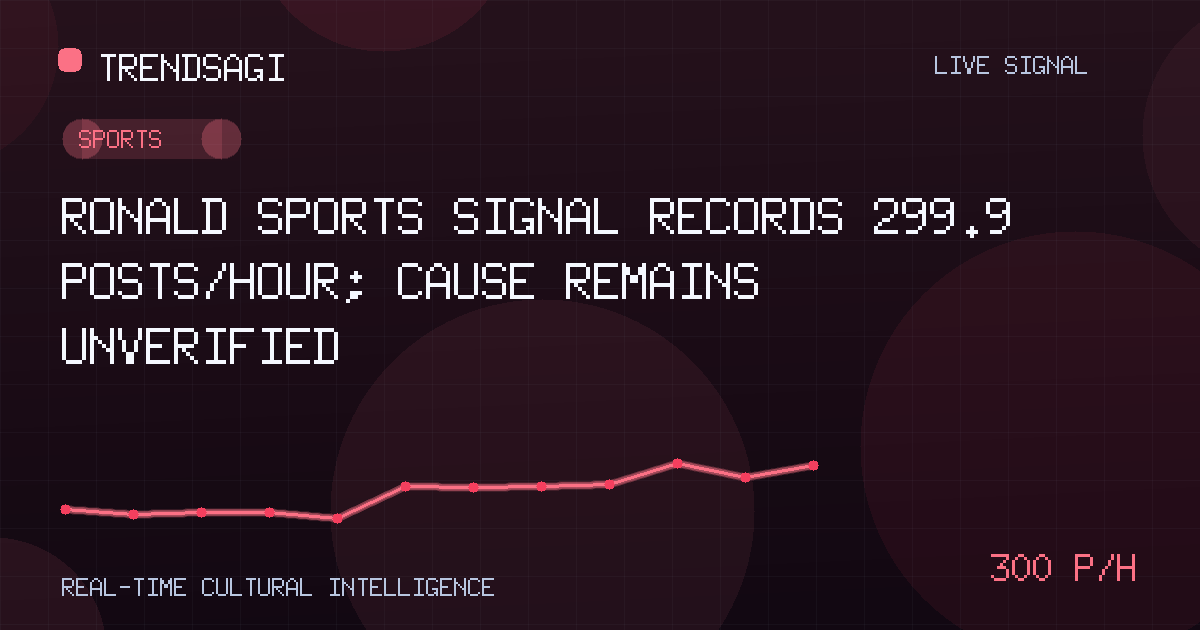
Ronald sports signal records 299.9 posts/hour; cause remains unverified
The stored Ronald Sports signal recorded 299.9 posts/hour and 216 posts; verify its identity, cause, and persistence before acting.
Automated briefing. Generated from stored signal measurements and source-backed research; it is not manually reviewed. Read the methodology and limitations.
Metrics in this briefing are a snapshot associated with its publication date and may not reflect current conditions.
What changed
The direct answer is that the stored Sports signal labeled “Ronald” shows a measured snapshot rate of 299.9 posts/hour, while the reason for the change remains unverified. The reading confirms posting activity around an ambiguous label at the observation time; it does not establish a particular person, team, event, or broader public trend.
That rate was measured at 2026-10-07T02:56:50Z over an exact 876-second window using 3 stored observations. The latest snapshot volume is 216 posts. These are distinct measures: 216 is the captured post count, while 299.9 posts/hour is the measured snapshot rate for the specified window. No comparison rate or normal baseline is included, so the record cannot show how unusual the activity is relative to earlier periods or whether it persisted after the snapshot.
| Measure | Value |
|---|---|
| Observation time | 2026-10-07T02:56:50Z |
| Measured snapshot rate | 299.9 posts/hour |
| Exact observation window | 876 seconds |
| Stored observations | 3 |
| Snapshot volume | 216 posts |
Why this topic may be moving
No verified public explanation accompanies the stored signal, so the cause is unclear. Several explanations remain possible, but none should be treated as fact without context that directly connects the posts to the same subject.
- Identity ambiguity: “Ronald” could refer to a person, act as shorthand, or arise from matching within longer text. The name alone does not establish which entity is intended.
- Reaction to an event: A match result, announcement, personnel matter, or controversy could generate discussion, but the available record does not tie the movement to any specific sports event.
- Repeated distribution: A wave of copied or syndicated material could increase the post count without representing an equivalent amount of independent conversation.
- Broad or noisy classification: The stored Sports category narrows the context but does not verify that the label accurately describes every matching post.
These are monitoring hypotheses, not verified explanations. Assigning the movement to a named individual or incident would go beyond what the stored evidence supports.
Why it matters
For sports editors, the immediate issue is whether this is a reportable development or a naming collision. A fast-moving label can justify a verification pass, but it is not enough to support a headline. The 216-post snapshot provides a defined volume marker for the review, not a measure of audience size.
Researchers, platform teams, event organizers, and fan communities also have different reasons to investigate. Editors need an identified subject and event; trust teams need to know whether repetition reflects ordinary sharing or coordinated behavior; organizers need to distinguish genuine conversation from an unrelated use of the same name. Treating all 216 posts as one phenomenon would obscure those differences.
A fast label is a monitoring trigger, not an explanation. Before calling “Ronald” a sports trend, an editor should establish what the name denotes, find a time-matched authoritative event, and check whether the activity persists.
What to watch next
- Resolve the identity. Review a representative sample of the captured posts and record what “Ronald” denotes in each context. Separate direct references, quotations, reposts, unrelated people, and possible keyword matches before aggregating them under one story.
- Verify a time-matched event. Use public search results to check established publishers and official sports accounts for an event involving the same person or term near the observation time. A topical resemblance alone is not enough; the source must support the connection.
- Construct a valid baseline. Compare adjacent observation windows collected with the same category, matching method, and deduplication rules. Keep snapshot volume separate from posts/hour, preserve the original window length, and avoid mixing incompatible measurements.
- Measure source concentration and duplication. Check whether posts come from many independent accounts or a narrow set of publishers, and whether wording is repeated or timing is synchronized. Different distributions can produce similar totals while representing very different behavior.
- Watch for context drift. If sampled posts refer to different people or non-sport subjects, the label is too ambiguous for an event-level conclusion. If the references converge on one verified sports development, confidence in that interpretation increases.
A second observation at a similar measured rate would provide evidence of persistence. Continued coverage by authoritative sports sources would strengthen an event explanation. Without either check, the present signal should remain a short-window activity alert rather than a confirmed trend.
Methodology and limitations
This briefing uses the stored observation timestamp, category, topic label, window, rate, observation count, and snapshot volume. The topic has no accompanying descriptive explanation, and no verified public context establishes a cause. Accordingly, no external event is credited with the movement.
The 299.9 posts/hour figure is a measured snapshot rate based on 3 stored observations across the exact 876-second window. It is not a live or current rate, forecast, reach, engagement level, sentiment measure, or count of unique people. Likewise, the 216-post snapshot may contain repeated or related material and does not establish how many people actually participated.
Important details are unavailable, including collection coverage, matching rules, deduplication, platform and geographic distribution, account authenticity, and historical baselines. The signal can therefore direct attention and define what should be checked next, but it cannot by itself establish causation, organic interest, authenticity, or comparative importance. The defensible conclusion is elevated short-window activity around an unidentified “Ronald” label—not a verified explanation of why it moved.
Track This Topic for New Signals
Set alerts for future velocity or sentiment changes around this topic.
Explore Tracking PlansAbout TrendsAGI research
TrendsAGI's automated research pipeline publishes dated signal snapshots, methodology notes, and practical workflows for teams evaluating cultural momentum. Read how signals are scoped, scored, and limited in our research methodology.


