903-second window · 3 observations · Measured Oct 7, 2026, 1:06 AM UTC · Provider: go_recent_snapshot_v2
Rogers topic records 542.1 measured posts/hour; reason remains unverified
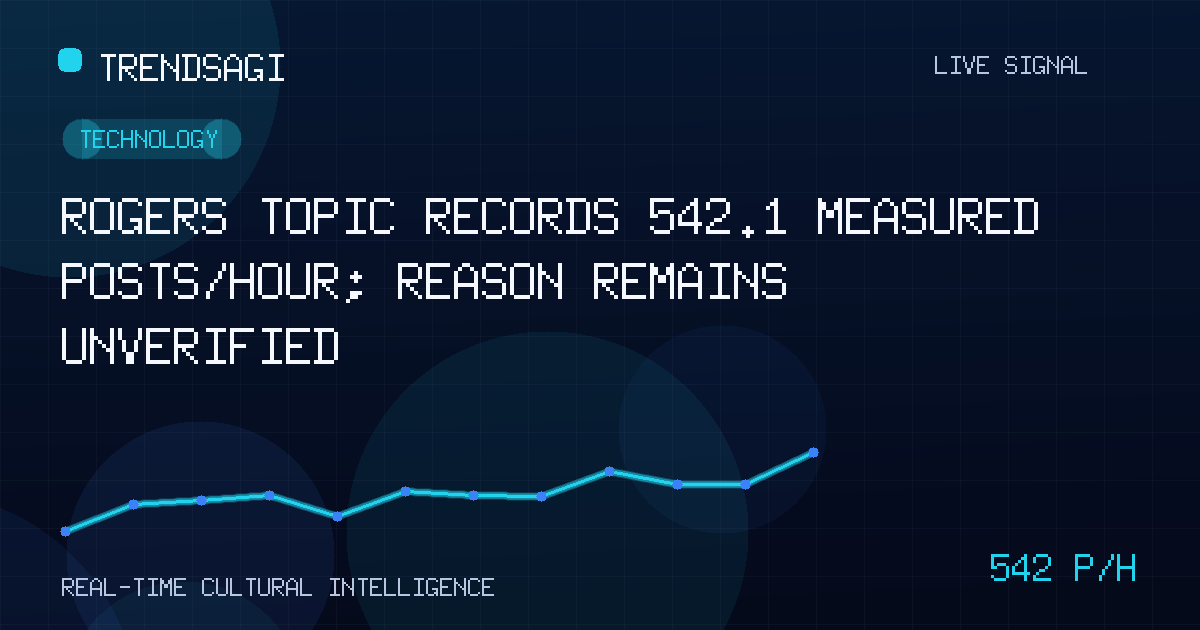
The Rogers topic logged 321 posts and a 542.1 posts/hour measured snapshot rate; it documents activity, not a verified cause.
Automated briefing. Generated from stored signal measurements and source-backed research; it is not manually reviewed. Read the methodology and limitations.
Metrics in this briefing are a snapshot associated with its publication date and may not reflect current conditions.
What changed
The Rogers topic is showing rapid posting activity, but the evidence does not yet resolve which entity is being discussed or why. The latest snapshot contains 321 posts, observed at 2026-10-07T01:06:53Z.
The associated measured change is 542.1 posts/hour, measured over an exact 903-second window using 3 stored observations at the same observation time. This is a measured snapshot rate, not a live rate, forecast, reach estimate, engagement measure, or count of unique people. It shows the speed of observed posting under the label, but not the cause of that activity.
| Observation time | Measured snapshot rate | Snapshot volume |
|---|---|---|
| 2026-10-07T01:06:53Z | 542.1 posts/hour | 321 posts |
Why this topic may be moving
The available evidence does not establish a verified public catalyst. “Technology” is a category assignment, not proof of a product announcement, service disruption, corporate event, or another specific development. Unrelated events could produce a burst under the same broad label, so assigning one without source and timing confirmation would risk a false explanation.
The label itself creates an additional constraint. A broad name can be used for different entities or ambiguous references. Until the posts consistently point to the same person, organization, product, place, or event, the defensible conclusion is posting activity around an unresolved label—not a confirmed technology story.
A rapid rise in labeled posts is an alert for investigation, not proof of a breaking event. Entity identity, source timing, and post composition must be confirmed before the movement is given a storyline.
Why it matters
Fast posting activity is useful for triage even when the catalyst is unknown. It tells monitoring teams where to look first and gives editors, analysts, and communications professionals a reason to check whether the signal represents a meaningful development, an entity collision, or a transient reaction. The practical risk is misinterpretation: an ambiguous label can generate confident but incorrect narratives.
- Communications and monitoring teams should verify the organization or person intended by “Rogers” before issuing an alert or response.
- Technology and product teams should check for a relevant announcement, operational event, or stakeholder statement only after the underlying entity is resolved.
- Newsrooms and analysts should distinguish observed posting velocity from evidence of broad public importance or a confirmed news event.
- Decision-makers should treat the signal as a prompt for verification rather than as evidence of impact, sentiment, or market relevance.
What the signal can establish
The stored observation supports several narrow conclusions:
- At the stated observation time, the Rogers label had a snapshot volume of 321 posts.
- The measured change rate for the label was 542.1 posts/hour over the stated window.
- The rate was derived from three stored observations within that exact measurement period.
- The topic was categorized as Technology, although that classification does not establish the subject of the posts.
- Further investigation is warranted because the observed posting rate is substantial, even though no comparative baseline is supplied.
It does not establish who posted, whether the same people posted repeatedly, where they were located, what they believed, or whether the activity was organic, coordinated, or automated. It also cannot establish platform-wide prevalence because collection coverage is unspecified.
What to watch next
The next checks should move from quantity to identity, timing, and composition:
- Resolve the entity. Inspect representative post text, account profiles, cited organizations, and linked source names. Determine whether “Rogers” consistently refers to one subject or combines several unrelated meanings.
- Find the onset. Compare the earliest posts in the window with later ones. A concentrated start around a public statement, operational event, announcement, or scheduled occurrence would provide a more plausible explanation than volume alone.
- Verify catalyst timing. Look for a public source published before or during the rise that directly discusses the same Rogers entity. The wording and event should match; topical association alone is insufficient.
- Examine composition. Assess whether posts are original reactions, copied wording, repetitive account activity, automated publication, or links converging on a common source. These observations would help distinguish diverse discussion from a mechanical burst.
- Track comparable windows. Compare subsequent snapshot volumes and measured rates using the same collection method and window length. Persistence would strengthen the signal, while a quick fade would suggest a short-lived event.
- Watch for entity separation. If results split across different meanings, label each cluster separately. Combining them would inflate the apparent scale and could produce an inaccurate trend narrative.
Methodology and limitations
The reported rate covers an exact 903-second window and uses three stored observations measured at 2026-10-07T01:06:53Z. The 321-post figure is the latest snapshot volume, not another rate. No baseline or earlier comparable rate is supplied, so the signal cannot establish that activity is unusually high, accelerating, or approaching a record.
The available summary also does not expose the observation timestamps, post-level content, account distribution, geographic coverage, sentiment, or engagement. The rate should therefore not be extrapolated into a live trend or forecast. No verified public catalyst has been established in the available evidence, so this briefing attributes the movement to unresolved posting activity rather than inventing a cause.
Track This Topic for New Signals
Set alerts for future velocity or sentiment changes around this topic.
Explore Tracking PlansAbout TrendsAGI research
TrendsAGI's automated research pipeline publishes dated signal snapshots, methodology notes, and practical workflows for teams evaluating cultural momentum. Read how signals are scoped, scored, and limited in our research methodology.


