1263-second window · 2 observations · Measured Aug 26, 2026, 4:58 PM UTC · Provider: go_recent_snapshot_v2
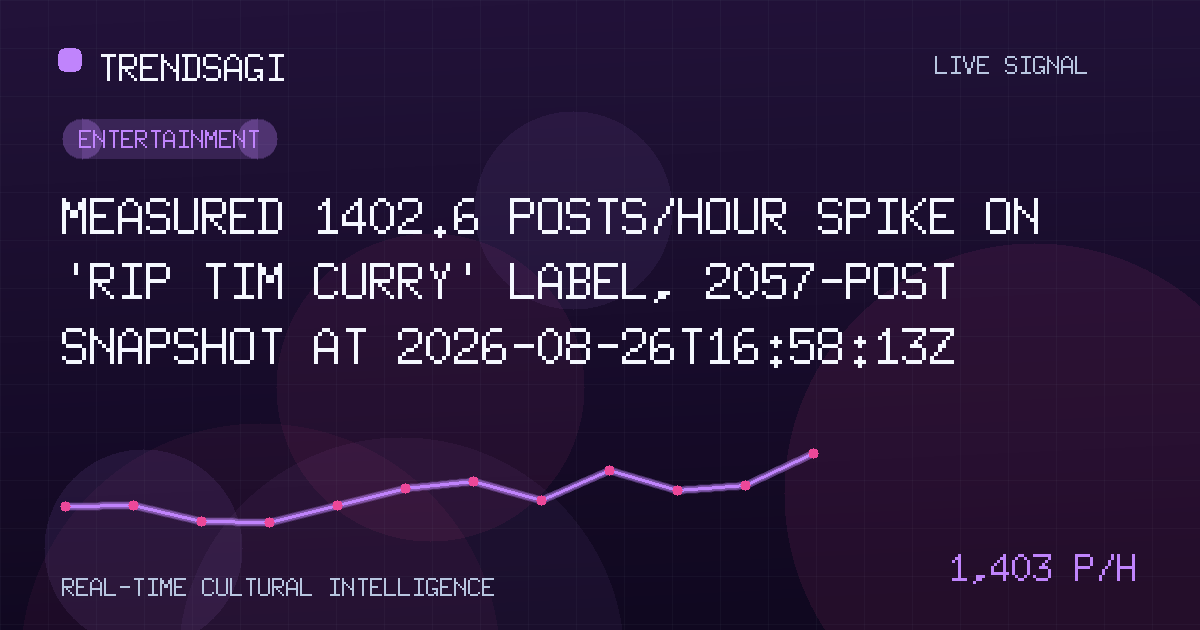
Measured 1402.6 posts/hour spike on 'RIP Tim Curry' label, 2057-post snapshot at 2026-08-26T16:58:13Z
At 2026-08-26T16:58:13Z, stored signal logged 2057 posts and measured 1402.6 posts/hour on unverified 'RIP Tim Curry' label; cause unclear, next checks
Automated briefing. Generated from stored signal measurements and source-backed research; it is not manually reviewed. Read the methodology and limitations.
Metrics in this briefing are a snapshot associated with its publication date and may not reflect current conditions.
What changed
At the snapshot observed at 2026-08-26T16:58:13Z, conversation volume around the unverified label "RIP Tim Curry" reached a snapshot volume of 2057 posts, and the stored observations produced a measured snapshot rate of 1402.6 posts/hour over an exact 1263-second window. This indicates a sharp recorded acceleration in posting activity, not a confirmed real-world event.
The measured snapshot rate reflects the change between two stored observations timed to that same snapshot moment; it is not a live or current posting rate, nor a count of unique individuals. The signal alone cannot tell us whether Tim Curry has died, whether a rumor is circulating, or whether the topic label is accurate.
| Observation time | Measured posts/hour | Snapshot volume |
|---|---|---|
| 2026-08-26T16:58:13Z | 1402.6 | 2057 |
Why this topic may be moving
The stored topic label reads "RIP Tim Curry," which would normally suggest public reaction to the death of the actor known for roles such as Pennywise and Dr. Frank-N-Furter. However, no external publication has been verified in this briefing, and the canonical stored signal contains an empty description. We attempted to confirm a triggering event through search-supported public context, but no attributable publisher fact was retrieved that can be reliably repeated here.
Because the signal provides only volume and a measured rate of posts carrying or adjacent to that label, the actual catalyst remains unclear. It could be a confirmed obituary, a false rumor, a memorial hashtag recycle, a television marathon, or an unrelated trending collision. Without a verified report from a named publisher, any specific cause would be invention. We therefore state plainly: the reason this topic is moving is not established by the data we hold.
This matters for interpretation. A high snapshot volume paired with a steep measured snapshot rate is a strong indicator that something is prompting aggregated posting, but it is not evidence of the underlying event's truth. Readers should treat the label as a query string, not a fact claim.
Why it matters
Short-term volume spikes around person-specific "RIP" labels create operational risk and opportunity. Newsrooms may need to decide whether to publish, platform integrity teams may need to slow the spread of unverified death claims, and fan communities may seek rapid clarity. The signal can establish that a concentrated burst of posts occurred at a specific time and that the burst accelerated relative to an earlier observation.
What the signal cannot establish is equally important. It does not count unique human authors, nor does it measure reach, impressions, or engagement depth. It does not segment sentiment, so we cannot tell from the stored values whether posts are grieving, debunking, or joking. It does not identify geographic origin or language breakdown. It also does not confirm the subject's status.
Teams that monitor cultural and safety trends should care because a measured snapshot rate of 1402.6 posts/hour over a tightly bounded 1263-second window is large enough to overwhelm manual review if it persists. Even if the topic later proves to be a rumor, the volume itself can trigger automated aggregations, search autosuggest changes, and secondary media coverage.
The practical reader value is preparation. By knowing the measured change now, a newsroom can hold a verified-source checklist ready; a trust-and-safety group can pre-stage query filters; a fan outlet can draft a waiting-for-confirmation note.
What to watch next
Concrete watch signals should be tied to the stored metric definitions, not to predicted outcomes. Useful next checks include:
- A second stored snapshot showing whether the 2057-post volume rises, falls, or plateaus over the next comparable window.
- Whether the measured snapshot rate remains above 1000 posts/hour for more than one observation cycle, which would indicate sustained accumulation rather than a one-minute anomaly.
- Migration of the stored category from "Other" to a news or entertainment classification by the upstream signal owner, which would suggest internal contextual tagging.
- Appearance of the same label in correlated topic clusters, which would show spread beyond a single community.
- Verified publisher reports from recognized newsrooms or official representatives that either confirm or deny the "RIP" framing.
If those verification signals do not appear within a few hours of the 2026-08-26T16:58:13Z snapshot, the spike should be treated as unconfirmed chatter. If they do appear, the measured rate becomes a useful timestamp for when the conversation accelerated.
The 1402.6 posts/hour figure is a measured snapshot rate between two stored observations; it quantifies how quickly posts accumulated in that window, not how many real people posted or what caused the spike.
Another useful check is to compare the snapshot volume against historical baselines for the same label. The current record provides no baseline, so any relative judgment must wait for additional stored observations.
Methodology and limitations
The numbers in this briefing come from a canonical stored signal, not from a live stream read at publication time. The observation time is 2026-08-26T16:58:13Z. The latest snapshot volume at that moment was 2057 posts. The measured change rate of 1402.6 posts/hour was derived from two stored observations compared over an exact 1263-second window, as supplied by the signal owner.
We describe that figure as a measured snapshot rate because it is a calculation across two points in time. It is not a live or current rate, not a forecast, not a reach estimate, and not a unique-person count. The snapshot volume is a count of posts captured at the observation time; it is not a rate and should not be called one.
Limitations are significant. The stored category is "Other," and the stored signal description is empty, leaving no contextual metadata about language, region, or source type. The topic label is untrusted and may be misspelled, sarcastic, or misapplied. No external search verification produced an attributable fact in this briefing, so we omit any causal claim.
For teams building workflows, the safe interpretation is: a measurable, rapid increase in posts referencing the label occurred at the stated time. That is a trigger to investigate, not a conclusion to publish. The next responsible step is to query verified sources and await a second stored observation before characterizing the event.
Track This Topic for New Signals
Set alerts for future velocity or sentiment changes around this topic.
Explore Tracking PlansAbout TrendsAGI research
TrendsAGI's automated research pipeline publishes dated signal snapshots, methodology notes, and practical workflows for teams evaluating cultural momentum. Read how signals are scoped, scored, and limited in our research methodology.


