903-second window · 3 observations · Measured Oct 7, 2026, 6:52 AM UTC · Provider: go_recent_snapshot_v2
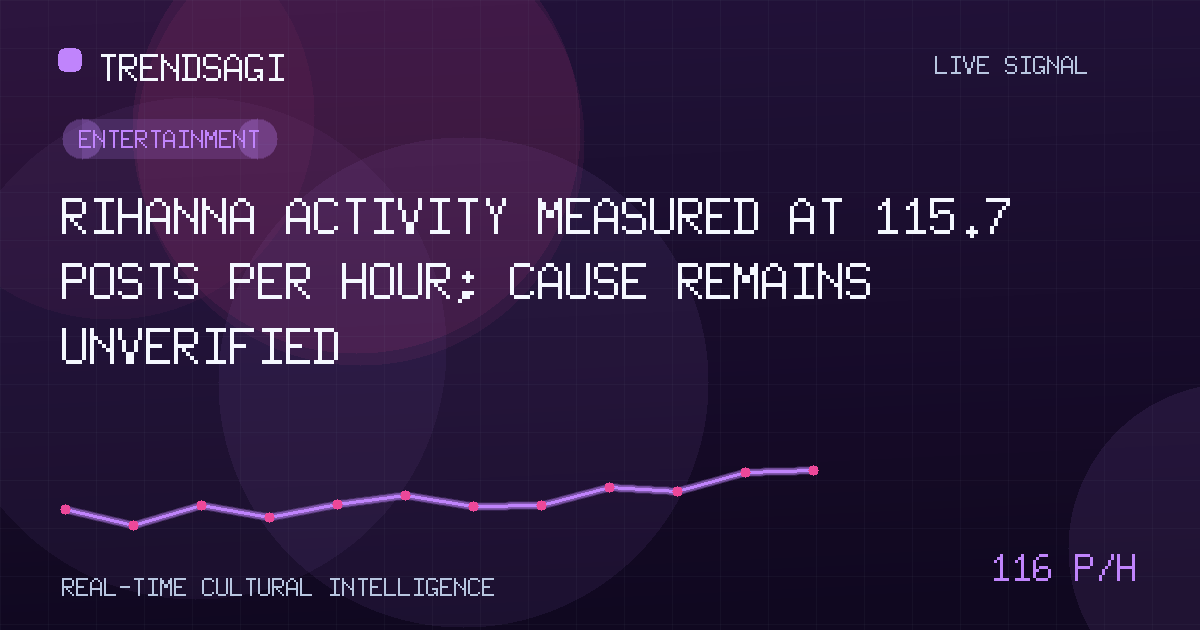
Rihanna activity measured at 115.7 posts per hour; cause remains unverified
Rihanna’s latest snapshot shows 115.7 posts per hour and 128 posts; the signal is measurable, but its cause and reach are unverified.
Automated briefing. Generated from stored signal measurements and source-backed research; it is not manually reviewed. Read the methodology and limitations.
Metrics in this briefing are a snapshot associated with its publication date and may not reflect current conditions.
What changed
The latest Rihanna signal shows a measured snapshot rate of 115.7 posts per hour, measured over an exact 903-second window from 3 stored observations and recorded at 2026-10-07T06:52:12Z. This establishes short-window activity in the monitored data, but it does not identify the event, audience, sentiment, or cause behind the activity.
The latest snapshot volume is 128 posts. Volume and rate answer different questions: 128 describes the size of the captured snapshot, while 115.7 posts per hour describes the measured pace across the stated window. The volume is not reach, engagement, or a unique-person count, and the rate is not a live reading, forecast, or estimate of future attention.
| Measure | Stored value |
|---|---|
| Observation time | 2026-10-07T06:52:12Z |
| Measured snapshot rate | 115.7 posts/hour |
| Exact measurement window | 903 seconds |
| Stored observations | 3 |
| Latest snapshot volume | 128 posts |
Why this topic may be moving
No verified trigger can be stated from the available evidence. The stored record contains no event description, and no external claim has been verified for this briefing. It would therefore be premature to attribute the activity to a release, performance, appearance, campaign, controversy, or other Rihanna-related news. Each is a research hypothesis, not an established explanation.
The defensible conclusion is that Rihanna was attached to a measured concentration of monitored posts; the data does not yet establish what happened or why people posted.
The measured rate could reflect several different mechanisms, and they require different evidence. A news event would normally require dated primary evidence and independent coverage. A fandom wave would require repeated references to a shared prompt. Media amplification could involve many accounts reproducing the same source, while duplication or collection effects could increase the count without an equivalent increase in distinct conversation.
- Event-driven discussion: A specific Rihanna announcement or public appearance could prompt immediate reactions, but no such trigger is identified in the stored signal.
- Fandom mobilization: Fan communities can organize around shared language, challenges, or reactions. Repetition of a prompt should not automatically be interpreted as broad public reach.
- Media amplification: Several publishers or accounts may repeat one underlying item. That can raise post volume while offering limited new information.
- Measurement effects: Query configuration, sampling, duplicate records, or changes in collection conditions could affect the observed rate. The supplied totals do not show whether those factors changed.
Why it matters
For editors and publishers, the immediate risk is attaching a causal headline to an aggregate activity alert. Writing that Rihanna is trending because of a particular event would go beyond the evidence unless a dated source and a connection to the observed conversation window are established.
- Newsrooms should wait for a verifiable trigger before presenting the signal as reaction to news.
- Brand and marketing teams should not treat 128 posts as audience size or use the measured rate as evidence of consumer sentiment.
- Trend analysts need post-level inspection and a consistent historical baseline before deciding whether this represents sustained momentum or a short concentration of activity.
The key editorial distinction is between measurement and explanation. The signal supports a precise statement about monitored activity at the recorded time. It does not yet support a statement about why attention formed, who generated it, whether it was organic, or how long it will last.
What to watch next
The next useful step is to test the missing causal link rather than generate another volume-based headline. Concrete checks should include:
- Inspect the underlying snapshot, if available: Review the 128 records for timestamps, repeated wording, reposts, account types, links, and the specific Rihanna references appearing in them.
- Identify a candidate trigger with Google Search: Search only for events that could explain the timing, then open results and verify the publication date, original claim, and explicit connection to Rihanna.
- Check primary evidence: Look for a dated statement or announcement from an official Rihanna channel or another directly responsible organization. A secondary article should not substitute for the source it reports.
- Require independent corroboration: Determine whether separate credible publishers identify the same event within the relevant period, rather than merely copying a shared headline or social post.
- Test breadth and persistence: Compare later snapshots collected under the same method, check whether activity continues, and assess whether it comes from distinct accounts and contexts after duplicates are removed. No persistence or breadth claim is supported yet.
Methodology and limitations
The figure of 115.7 posts per hour is a measured snapshot rate over the exact 903-second window using 3 stored observations. Snapshot volume is separately reported as 128 posts and is not a rate. Posts per hour must not be described as a live or current rate, forecast, reach, engagement, or unique-person count.
No underlying post texts, account identities, engagement data, sentiment, geography, language distribution, duplication controls, or historical baseline are supplied. The observation timestamp records the signal; it does not prove that the underlying event began then. With only the stated aggregate values, the activity cannot be assigned to a verified cause or compared with a prior rate. The resulting briefing therefore reports what changed numerically while leaving the explanation explicitly unresolved.
Track This Topic for New Signals
Set alerts for future velocity or sentiment changes around this topic.
Explore Tracking PlansAbout TrendsAGI research
TrendsAGI's automated research pipeline publishes dated signal snapshots, methodology notes, and practical workflows for teams evaluating cultural momentum. Read how signals are scoped, scored, and limited in our research methodology.