899-second window · 2 observations · Measured Oct 9, 2026, 7:22 AM UTC · Provider: go_recent_snapshot_v2
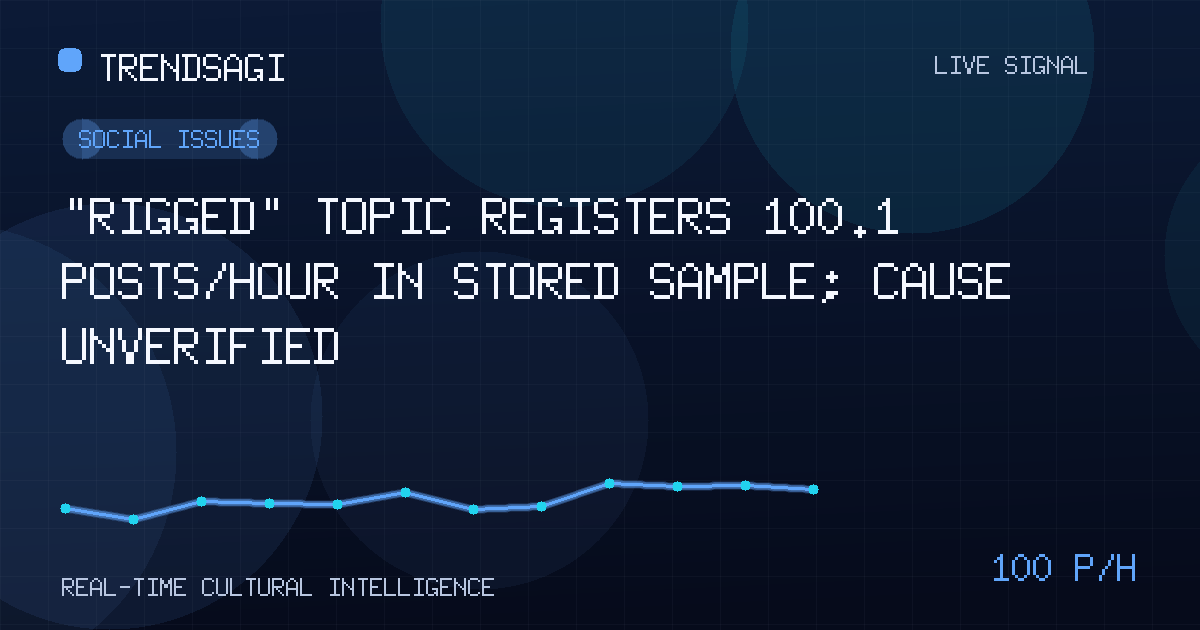
“Rigged” topic registers 100.1 posts/hour in stored sample; cause unverified
A stored “Rigged” topic sample measured 100.1 posts/hour over 899 seconds; the cause remains unverified, with practical checks for readers and editors.
Automated briefing. Generated from stored signal measurements and source-backed research; it is not manually reviewed. Read the methodology and limitations.
Metrics in this briefing are a snapshot associated with its publication date and may not reflect current conditions.
What changed
The stored signal’s measured change was 100.1 posts/hour around the label “Rigged” during an exact 899-second window. The direct conclusion is limited: posting activity registered in the monitored sample, but the record does not identify what was being described, show that any underlying claim was true, or verify a public event as the cause.
The rate was measured at 2026-10-09T07:22:10Z from 2 stored observations. The latest snapshot contained 220 posts. The 220-post figure is snapshot volume, not a rate; the 100.1 posts/hour figure is a measured snapshot rate, not a live or current rate, forecast, reach figure, engagement measure, or count of unique people.
| Observation time | 2026-10-09T07:22:10Z |
|---|---|
| Measured snapshot rate | 100.1 posts/hour |
| Exact comparison window | 899 seconds |
| Supporting observations | 2 stored observations |
| Latest snapshot volume | 220 posts |
Why this topic may be moving
The reason for the movement remains unclear because the record contains no verified public context and no post-level description. “Rigged” can describe several kinds of alleged unfairness or manipulation, so the label alone cannot connect the cluster to a particular institution, contest, industry, community, or geographic event. The stored “Social Issues” category supplies broad classification, not subject-level evidence.
A short concentration of posts could reflect reaction to news, reuse of an existing phrase, criticism of a decision process, recommendation by a platform, or repeated and potentially coordinated distribution. These are monitoring hypotheses, not findings. Without the posts, their timestamps, and their provenance, none can explain this signal responsibly. What is established is movement in post volume within the stored sample—not movement in belief, sentiment, or factual reality.
A measured posting rate can justify closer verification without validating the claim contained in a topic label.
Why it matters
The immediate risk is false attribution: readers may attach a loaded label to the nearest controversy even though the dataset does not show what the posts concerned. The signal is best treated as a verification queue, not a conclusion.
- General readers: Do not interpret the topic label as evidence that an election, game, market, organization, or other process was actually manipulated.
- Journalists and editors: Identify the named target, claim, and timing before describing the cluster as a reaction to an event.
- Platform trust and safety teams: Review provenance and coordination risk before inferring a coordinated campaign.
- Researchers and policymakers: Avoid using the sample as a public-opinion measure until its collection method, coverage, and representativeness are known.
What the signal can—and cannot—establish
It can establish that the stored topic sample registered 100.1 posts/hour over the stated window and therefore merits follow-up. It also fixes the observation time and volume, allowing later analysts to compare the record with new collection results.
It cannot establish:
- what “Rigged” meant in the posts or whether speakers endorsed, rejected, or merely repeated it;
- the cause of the activity or the truth of any allegation associated with the label;
- how many people were involved, whether accounts were unique, or whether posts were original, copied, automated, or coordinated;
- the cluster’s reach, engagement, sentiment, geographic spread, or persistence beyond the observation.
What to watch next
- Resolve the referent. Inspect the earliest, most repeated, and latest posts, including text, media, named entities, and contextual links. Determine whether “Rigged” points to one event or several unrelated uses.
- Build a verified timeline. Compare post timestamps with credible public reporting and official records. A report that predates the cluster would support, but not prove, a reaction explanation.
- Test persistence. Add collection on both sides of the observed window. A short spike that disappears should not be described as an ongoing trend.
- Audit post provenance. Distinguish original contributions from reposts and duplicates; examine account history, posting patterns, geography, and language.
- Check for label collision. Review relevant variants and related terms to see whether apparently separate clusters describe the same underlying conversation.
- Set attribution thresholds. Raise confidence only when one named referent, a coherent timeline, and multiple substantive posts align. Lower confidence if activity is duplicate-heavy or the label spans unrelated contexts.
Methodology and limitations
This briefing uses the supplied stored metrics: observation at 2026-10-09T07:22:10Z; latest snapshot volume of 220 posts; an exact 899-second window; 2 stored observations; and a measured change rate of 100.1 posts/hour. The rate describes that stored snapshot, not a live or current rate. Snapshot volume is not interchangeable with rate, reach, or participation.
No post text, account data, sampling frame, baseline, sentiment analysis, or verified external event was available. Those omissions prevent causal attribution and limit conclusions about representativeness or authenticity. The label and category should therefore be reported as monitoring metadata. If post-level evidence or verified public context becomes available, the explanation should be reassessed rather than inferred from the label alone.
Track This Topic for New Signals
Set alerts for future velocity or sentiment changes around this topic.
Explore Tracking PlansAbout TrendsAGI research
TrendsAGI's automated research pipeline publishes dated signal snapshots, methodology notes, and practical workflows for teams evaluating cultural momentum. Read how signals are scoped, scored, and limited in our research methodology.