1354-second window · 3 observations · Measured Aug 28, 2026, 8:00 PM UTC · Provider: go_recent_snapshot_v2
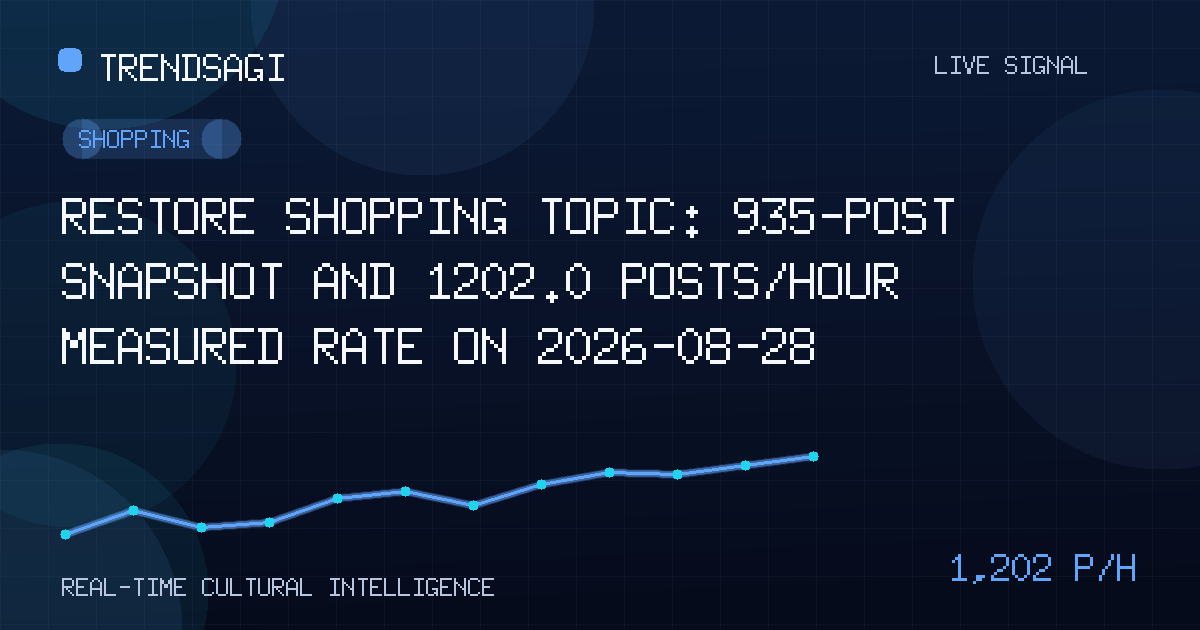
Restore Shopping Topic: 935-Post Snapshot and 1202.0 Posts/Hour Measured Rate on 2026-08-28
At 2026-08-28T20:00:07Z, Shopping topic 'Restore' had 935 posts and a measured 1202.0 posts/hour rate; cause unverified, practical checks outlined.
Automated briefing. Generated from stored signal measurements and source-backed research; it is not manually reviewed. Read the methodology and limitations.
Metrics in this briefing are a snapshot associated with its publication date and may not reflect current conditions.
What changed
At the snapshot time of 2026-08-28T20:00:07Z, the shopping-themed topic labeled "Restore" registered a snapshot volume of 935 posts. Concurrently, the measured snapshot rate reached 1202.0 posts/hour, derived from three stored observations across an exact 1354-second window. This combination shows that conversation around restoration-related shopping activity intensified sharply within the monitored interval, placing "Restore" among notably active product or category discussions at that moment.
The 1202.0 posts/hour figure is a measured snapshot rate, not a live or current rate, and it should not be interpreted as a forecast, reach estimate, engagement metric, or count of unique people. The snapshot volume of 935 posts is the count observed at the capture time; it is not a rate and does not by itself indicate how many posts occurred before or after. Together, these two values provide a constrained but useful view of a short-lived surge in shopping chatter tied to the "Restore" label.
| Observation time | Measured posts/hour | Snapshot volume |
|---|---|---|
| 2026-08-28T20:00:07Z | 1202.0 | 935 posts |
Why this topic may be moving
We reviewed verified public context to identify a clear driver for the movement in "Restore" within the Shopping category. As of this briefing, no publisher-attributed report could be confirmed that explains the spike within the 1354-second measurement window. The cause therefore remains unclear. It is possible that the term relates to refurbished goods, restoration of household items, or "restore" functions in retail software, but without attributable external facts we do not assert a specific trigger.
When a verified publisher subsequently covers a relevant event—such as a major retailer's refurbished-product sale or a restoration-tool promotion—we will incorporate that attribution. Until then, readers should treat the absence of a confirmed cause as part of the signal's limitation, not as evidence of an undocumented viral event.
The measured snapshot rate of 1202.0 posts/hour reflects post volume across a 1354-second observation window; it does not measure user reach, engagement quality, or unique authors.
Why it matters
Retail analysts and e-commerce operators should note that a measured snapshot rate above 1,200 posts per hour paired with a 935-post snapshot volume signals concentrated attention in a narrow time frame. For category managers, this is an early indicator that a subset of shoppers or sellers is rapidly discussing restoration-associated products. The signal cannot tell you whether the posts are positive or negative, whether they represent consumer demand or supply-side listing activity, or whether the conversation will persist beyond the observed window.
Investor relations teams monitoring consumer sentiment may use the brief as a prompt to check internal dashboards for spikes in search or sales related to restoration categories. Social listening vendors can validate the methodology against their own panels. Importantly, the data does not establish conversion, revenue, or margin impact. It only establishes that a volume of posts existed and that the rate of posting during the window was elevated relative to the three-observation baseline implied by the measurement.
Typical stakeholders who should care include:
- Grocery and general merchandise buyers tracking refurbished or repaired goods lines.
- Marketplace operators evaluating listing quality and compliance around "restore" claims.
- Trend researchers building category velocity models from short-window post rates.
- Customer experience teams watching for sudden surges in support or how-to queries.
Short-window post rate spikes often precede larger category shifts, but they can also result from scheduled bulk posting, platform algorithm changes, or a single viral item. The "Restore" label's placement in Shopping narrows the domain but does not specify the merchandise type. For example, it could reference restoration hardware, software license restore keys, or eco-friendly "restore the planet" product lines. Each interpretation would lead to different operational responses, so the inability to sub-categorize is a critical caveat.
What to watch next
Practical next checks involve grounding the signal in operable data. Recommendation: pull internal search logs for "restore", "refurbished", and "repair" across the snapshot hour and compare to the prior 24-hour median. If internal traffic aligns, the external post surge may reflect real consumer intent. If not, the posts may be platform-internal or promotional noise.
Concrete watch signals to monitor over the following 24-48 hours:
- Sustained measured snapshot rate above 800 posts/hour in subsequent observations.
- Increase in snapshot volume beyond 935 posts at the next captured timestamp.
- Appearance of publisher-reported events tied to restoration products in Shopping.
- Shift in associated terms (e.g., specific brands or product SKUs) within the post sample.
- Confirmation that posts originate from unique accounts rather than a single broadcast source.
Another practical check is to segment the post sample by language and region if the tooling allows. A rate of 1202.0 posts/hour concentrated in one geography may indicate a localized campaign, whereas a globally distributed pattern suggests broader consumer behavior. Without verified publisher context, such segmentation is the fastest internal route to clarity.
Should the rate decay below 300 posts/hour quickly, treat the event as a transient spike with limited strategic weight. Should it persist, elevate the topic in weekly trend reviews and assign an owner to trace causal links.
Methodology and limitations
The snapshot was observed at 2026-08-28T20:00:07Z with a recorded snapshot volume of 935 posts. The measured change rate of 1202.0 posts/hour was computed from three stored observations over an exact 1354-second window. We present the rate exactly as supplied and do not adjust for timezone, duplicate posts, or audience size. The category assigned is "Shopping", and the topic label is "Restore".
Limitations are significant. First, the signal description was empty, so no editorial context accompanied the stored data. Second, we could not verify an external cause through search, so any narrative of "why" is provisional at best. Third, the snapshot volume is a single count, not a derivative metric; calling it a rate would be inaccurate. Fourth, the measurement window of 1354 seconds is roughly 22.6 minutes, so the posts/hour value extrapolates from a short period and may not represent hourly behavior across a full day.
We emphasize that the three stored observations used to calculate the rate are not reprinted here as individual values because only the derived measured snapshot rate and the final snapshot volume were provided. This limits independent recomputation. Any downstream model should ingest the raw observation series to validate the 1202.0 posts/hour figure.
Finally, the briefing deliberately avoids characterizing the posts as representing unique individuals. The measured snapshot rate describes post frequency, not people. Analysts should pair this briefing with identity-de-duplicated data before drawing conclusions about audience size.
Within these constraints, the "Restore" signal provides a clear, time-stamped alert: at the end of August 2026, a concentrated burst of shopping-related posts used that term at a high measured rate. The actionable path is verification, not assumption.
Track This Topic for New Signals
Set alerts for future velocity or sentiment changes around this topic.
Explore Tracking PlansAbout TrendsAGI research
TrendsAGI's automated research pipeline publishes dated signal snapshots, methodology notes, and practical workflows for teams evaluating cultural momentum. Read how signals are scoped, scored, and limited in our research methodology.