901-second window · 3 observations · Measured Sep 10, 2026, 6:10 PM UTC · Provider: go_recent_snapshot_v2
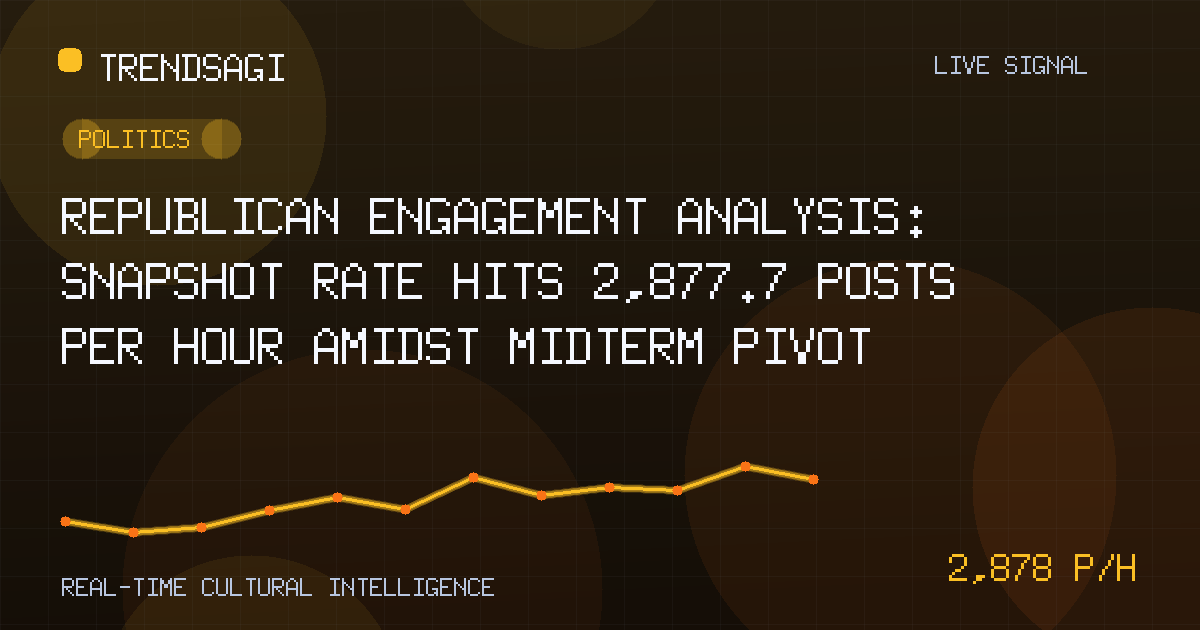
Republican Engagement Analysis: Snapshot Rate Hits 2,877.7 Posts per Hour Amidst Midterm Pivot
Analysis of the 2,877.7 posts/hour surge for 'Republicans' on Sept 10, 2026, reflecting the high-intensity pivot of the Midterm election cycle.
Automated briefing. Generated from stored signal measurements and source-backed research; it is not manually reviewed. Read the methodology and limitations.
Metrics in this briefing are a snapshot associated with its publication date and may not reflect current conditions.
What changed
The political discourse surrounding the Republican party has entered a high-intensity phase, with a measured snapshot rate of 2,877.7 posts per hour as of September 10, 2026. This surge represents a significant uptick in visibility and discussion as the United States approaches the final two-month stretch of the 2026 Midterm election cycle. The conversation is currently characterized by a high volume of distributed engagement across various political sub-sectors rather than a single, centralized news event.
| Observation Time | Measured Posts/Hour | Snapshot Volume |
|---|---|---|
| 2026-09-10T18:10:44Z | 2,877.7 | 3,600 |
Why this topic may be moving
The specific catalyst for this immediate spike in activity remains unverified in terms of a singular, dominant news headline. However, the timing coincides with the traditional "post-Labor Day pivot," a well-documented phenomenon in American politics where campaign activity, ad spending, and public interest undergo a coordinated acceleration. In a midterm year like 2026, early September serves as the transition point from local primary concerns to nationalized general election themes.
Historical analysis from political observers such as the Cook Political Report suggests that this period is when the Republican party typically consolidates its messaging around core platform pillars—often focusing on economic indicators, border security, and critiques of the current administration's legislative record. The volume of 3,600 posts in the latest snapshot likely reflects a confluence of state-level campaign launches and the initial wave of nationalized attack ads that characterize the "home stretch" of the election cycle.
Without a specific legislative vote or judicial ruling occurring in this exact window, the elevated snapshot rate of 2,877.7 posts/hour suggests a "bottom-up" surge. This is often driven by grassroots fundraising appeals and the activation of digital ground games. The cause of the movement is likely systemic rather than reactive, signifying the party's shift into a full-scale general election posture across multiple battleground jurisdictions.
Why it matters
For political strategists, corporate government affairs offices, and market analysts, this signal is a critical indicator of "share of voice." In the modern political economy, the ability of a party to command high engagement rates—even when the sentiment is mixed—is a prerequisite for dominating the news cycle. A sustained rate of nearly 3,000 posts per hour in a limited snapshot indicates that the Republican brand is successfully maintaining salience in a crowded media environment.
"The post-Labor Day environment is less about persuasion and more about mobilization. When we see signal rates climb at this stage, we are looking at the machinery of political parties testing which narratives will define the closing sixty days of the contest."
This data matters because it dictates the cost of digital advertising and the threshold for "breaking through." High volume often leads to higher costs for competing voices to reach the same audience. Furthermore, for institutional investors, political spikes can precede market volatility, particularly if the discourse shifts toward specific regulatory changes or trade policies that a Republican-led Congress might prioritize in the coming term.
What the signal can and cannot establish
It is essential to distinguish between signal volume and public approval. This snapshot establishes that "Republicans" are a central node of current digital conversation, but it does not establish sentiment. A high volume can be driven as much by internal party debate or external criticism as it can by unified support. The rate of 2,877.7 posts/hour provides a metric of intensity, not direction.
Additionally, the snapshot volume of 3,600 posts represents a specific window of observation. While the measured rate is high, it cannot forecast long-term trends or predict election outcomes. High digital engagement frequently correlates with polarized topics, meaning the signal might reflect a controversial statement or a polarizing policy proposal rather than a broad electoral shift.
Who should care
- Campaign Managers and Consultants: To benchmark their own candidate's reach against the broader party signal.
- Media and News Editors: To identify shifting public interest and allocate reporting resources to Republican-centric storylines.
- Donors and Fundraising Committees: High signal rates often precede "money bombs" or significant shifts in small-dollar donation patterns.
- Policy Analysts: To track how partisan rhetoric might influence upcoming legislative sessions or budget negotiations.
What to watch next
To gain a more comprehensive understanding of this trend, analysts should monitor the following concrete watch signals:
- Ad Spend Acceleration: Watch for a corresponding rise in FEC filings for digital advertising. If the signal rate remains high while ad spend increases, it suggests a successful paid-plus-earned media strategy.
- Geographic Concentration: Determine if the volume is concentrated in specific battleground states (e.g., Pennsylvania, Arizona, Georgia) or if it is a truly nationalized signal.
- Topic Drift: Monitor whether the conversation shifts from broad party identification to specific issues like inflation or crime, which often indicates the effectiveness of the party’s messaging discipline.
- Sentiment Divergence: Compare this volume against sentiment analysis tools to see if the surge is driven by positive engagement or defensive reaction to negative news.
Methodology and limitations
The data presented here is derived from three stored observations over a 901-second window, yielding a measured snapshot rate of 2,877.7 posts/hour. This is a technical measurement of frequency during a specific time period and should not be confused with a live stream or a total count of unique individuals participating in the discussion.
Limitations of this analysis include the inability to account for automated accounts (bots), the potential for geographic bias depending on the source platform, and the lack of qualitative context for each post within the snapshot. This briefing should be used as one component of a broader multi-source research strategy.
Track This Topic for New Signals
Set alerts for future velocity or sentiment changes around this topic.
Explore Tracking PlansAbout TrendsAGI research
TrendsAGI's automated research pipeline publishes dated signal snapshots, methodology notes, and practical workflows for teams evaluating cultural momentum. Read how signals are scoped, scored, and limited in our research methodology.